

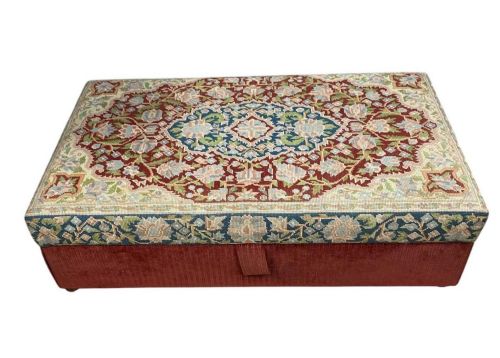
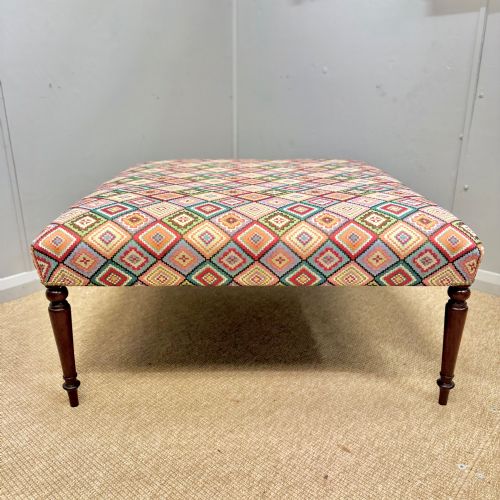


Traditional Rectangular Footstool
A traditional rectangular footstool anchors a room with quiet utility, offering solid timber frames and soft upholstery designed for daily use.
Traditional Rectangular Footstool
A traditional rectangular footstool is a low seating piece built to support the feet or serve as a flexible centre stool in a living space. When you search for this phrase, you encounter items designed primarily for comfort and stability, rooted in historical forms.
The versions most commonly met on this page date from the nineteenth century, reflecting periods from the eighteenth century up to the nineteen-thirties. They appear in forms such as large country house ottomans, oblong footstools, and low foot boards.
Makers constructed these sturdy items using timber frames paired with various textiles. Their shapes remain strictly rectangular, matching the functional requirements of traditional English interiors.
How they were made
Cabinet makers built the structural frames using dense hardwoods like mahogany, oak, teak, and walnut. These timbers provided the load-bearing strength needed for frequent use in domestic settings.
Upholstery techniques involved durable woven fabrics, velvet, and textile coverings secured over padding. Artisans frequently mounted larger examples on brass castors for ease of movement across heavy carpets.
Carved details appear on specific revival pieces, echoing earlier George II styles through shaped wooden rails and cabriole supports. Rattan also appears woven into specific frames, adding textural contrast to the timber.
Traditional Rectangular Footstool Retail Price Guide 2026
Typical asking prices for traditional rectangular footstool among the pieces listed under this phrase on Sellingantiques today, from the lower quarter to the upper quarter. They describe what is for sale here now, not the wider market.
Some nineteenth-century examples come fitted with brass castors so enthusiastic loungers could chase the retreating warmth of the fireplace without standing up.
What varies in quality
The distinction between standard utility items and finer pieces lies in the selection of timber and the precision of the frame construction. Heavier woods and sophisticated joinery elevate the standing of a stool.
Carved ornament depth and execution separate simple vernacular items from those built in historical revival styles. Skilled hand-carving on walnut or mahogany frames indicates a higher grade of workshop production.
The quality of the upholstery application and the inclusion of original brass castors or woven rattan elements further differentiate the examples found across this range.
Howard and Sons
The Traditional Rectangular Footstool Glossary
- Castor
- A small wheel mounted in a swivel frame at the base of a furniture leg to allow smooth rolling. These frequently incorporate brass fittings on nineteenth-century footstools.
- George II Style
- A design vocabulary recalling the mid-eighteenth century, characterised by robust proportions and carved mahogany or walnut woodwork. Makers often revived these classical lines in later periods.
- Ottoman
- A low, upholstered seat or footstool lacking arms or a backrest, often built on a large scale for country house interiors. They function as both foot supports and auxiliary seating.
- Upholstery
- The padded and fabric-covered components secured to a wooden frame. Traditional pieces utilise textile coverings ranging from simple woven cloth to heavy velvet.
- Centre Stool
- A substantial freestanding stool designed to sit in the middle of a room or beneath a table rather than tucked against a wall.
Traditional Rectangular Footstool: Frequently Asked Questions
What is a traditional rectangular footstool used for?
These pieces function primarily to support the feet when seated in an armchair or lounge chair. They also serve as low centre tables or extra seating in living rooms.
Their robust timber frames and upholstered surfaces were designed for practical, heavy domestic use in traditional settings.
How do I identify a nineteenth-century footstool?
Nineteenth-century examples often feature dense timbers such as mahogany, walnut, or oak combined with traditional textile upholstery. Look for structural clues like hand-cut joinery and heavy brass castors.
Many pieces also display revival design elements, particularly referencing the earlier George II style through carved wooden rails.
Are these footstools newly upholstered?
Some pieces retain historical coverings, while others arrive newly upholstered in contemporary or traditional woven fabrics and velvet. This depends entirely on the conservation history of the individual item.
Check the specific title and description to see whether the fabric is recent or period-correct.
What woods were used for these stools?
Cabinet makers relied on durable hardwoods including mahogany, oak, teak, and walnut. These materials offered the necessary strength to support daily weight and stress.
Finer decorative models typically utilised mahogany or walnut to allow for detailed carving along the frame.