
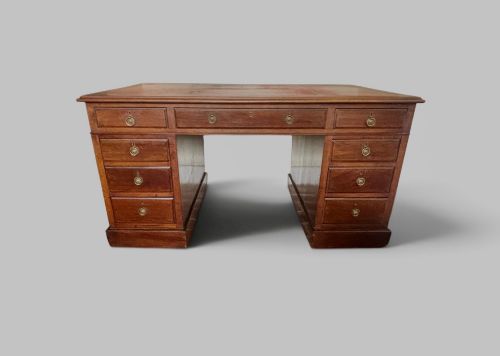


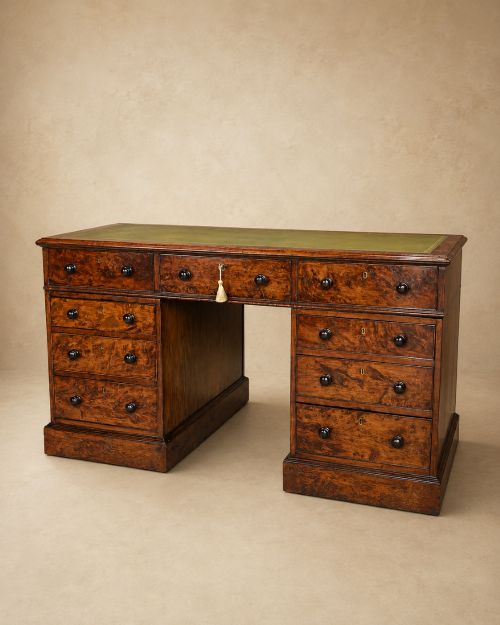
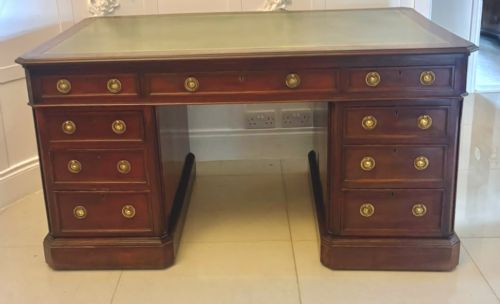
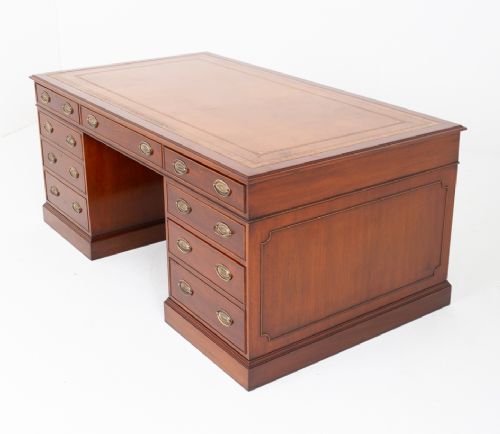
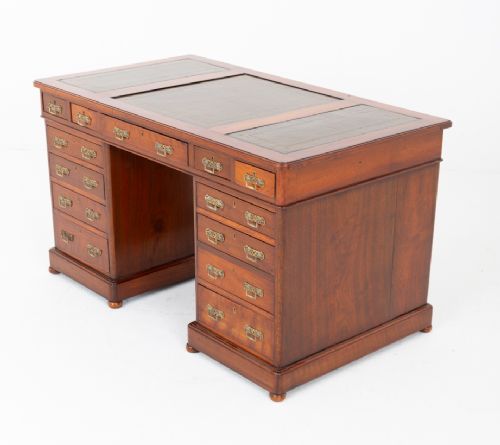
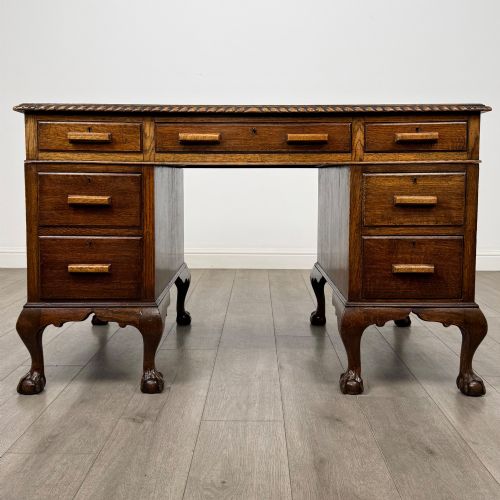
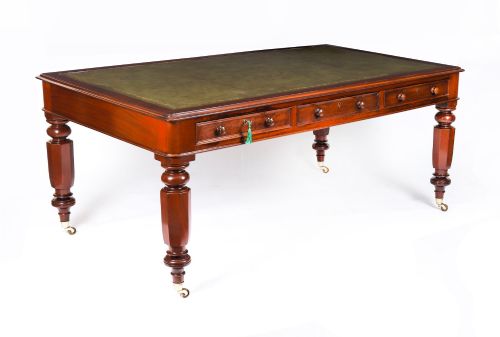
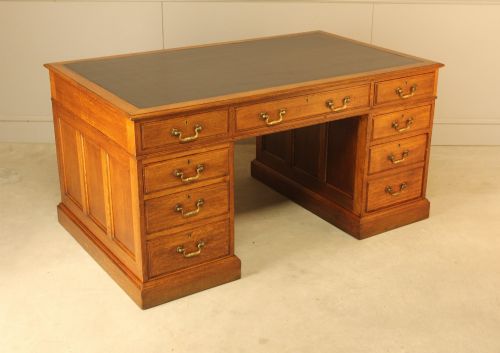
Traditional Partners Writing Desk
A traditional partners writing desk provides double-sided workspace and deep drawers, built for two people to sit opposite each other.
Traditional Partners Writing Desk
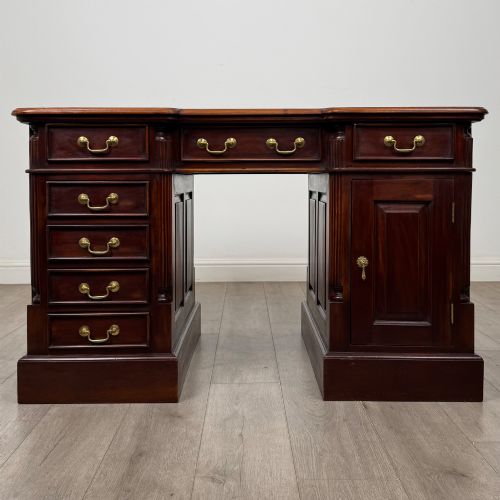
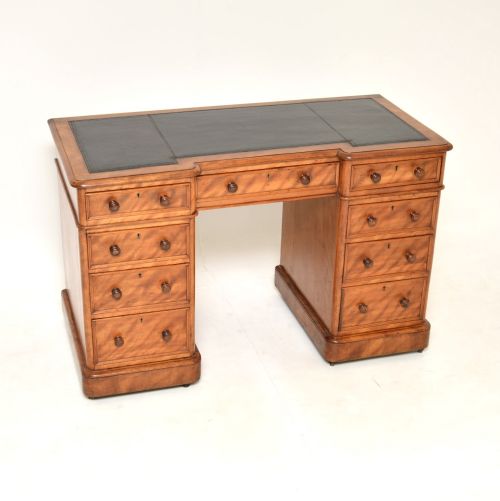
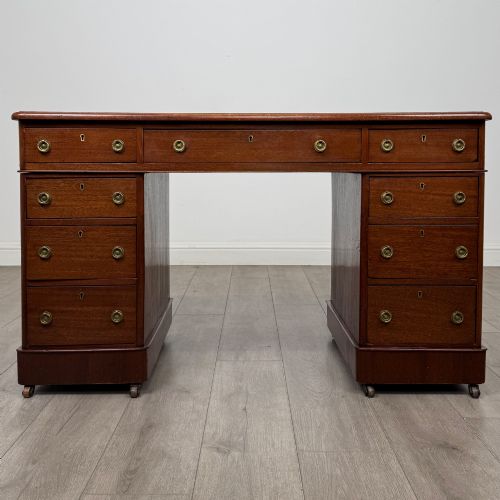
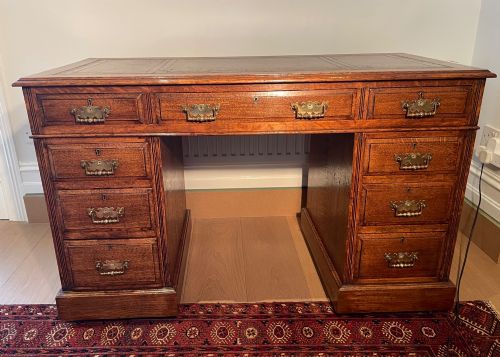
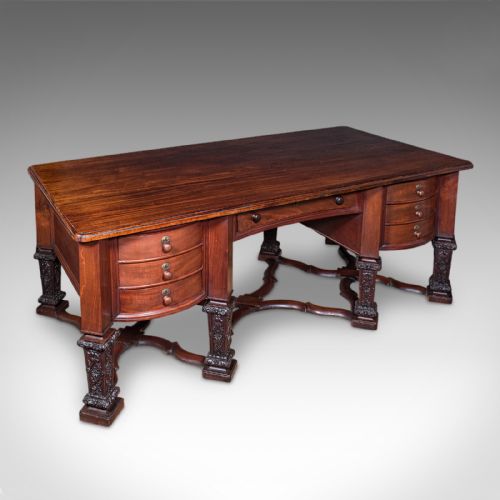
A traditional partners writing desk is a large pedestal form designed with opposing banks of drawers or cupboards so two people can work face to face. These substantial pieces emerge most frequently from the nineteenth century, spanning Victorian and Edwardian eras alongside earlier Georgian examples.
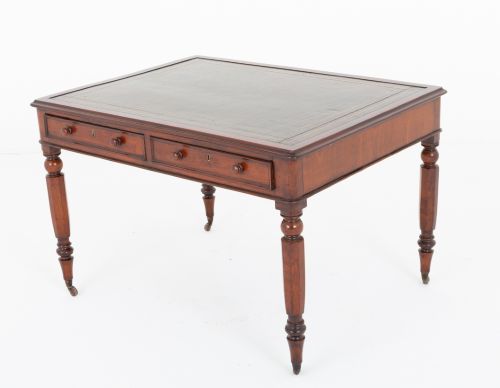
The layout typically incorporates freestanding pedestal bodies beneath a spacious top inset with leather. Variations include library tables with four drawers and kneehole desks equipped with fitted stationery slides.
Makers adapted classical proportions to suit large libraries and studies, producing pieces in mahogany, oak, and walnut that remain centrepieces of executive rooms.
Materials and Construction
Cabinet makers utilised dense timber stocks such as mahogany, oak, and walnut, often applying burr walnut veneers to larger surfaces to create striking grain patterns. Satinwood and maple appear in select decorative finishes.
Working surfaces incorporate inset leather writing pads, frequently tooled with gold leaf borders. Brass handles, escutcheons, and drawer pulls complete the heavy functional hardware necessary for large pedestal construction.
Listings span the eighteenth, nineteenth, and early twentieth centuries, incorporating Georgian, Victorian, and Edwardian periods in mahogany, oak, and walnut.
Craftsmanship and Proportion
Quality rests in the selection of timber figures, such as matching burr walnut veneers across opposing drawer fronts, and the depth of the cabinet work. Superior examples feature fully finished backs on pedestals designed for central room placement rather than being pushed against a wall.
The integrity of internal drawer construction, original brass hardware, and well-fitted leather writing surfaces distinguish finer workshop production from standard commercial output.
Trollope & Sons·Whytock & Reid of Edinburgh·Maple & Co
The Traditional Partners Writing Desk Glossary
- Partners desk
- A double-sided pedestal desk designed with drawers and cupboards on both the front and back to accommodate two users.
- Pedestal desk
- A freestanding desk comprising a top resting on two separate pedestals or stacks of drawers.
- Burr walnut
- A figured wood veneer taken from the gnurled growths of walnut trees, prized for its swirling patterns.
- Escutcheon
- A protective plate surrounding a keyhole, usually cast in brass.
- Kneehole desk
- A single-sided desk with a central recess for the legs, flanked by pedestals of drawers.
Traditional Partners Writing Desk: Frequently Asked Questions
How do I care for the leather top?
Clean the leather surface gently using a damp cloth and treat it periodically with leather balms to prevent cracking.
Avoid placing hot cups or direct moisture on the desktop to preserve the gilt tooling and hide finish.
Are these desks truly double-sided?
Traditional partners desks feature functional drawers or cupboards accessible from both sides so two people sit opposite each other.
Single-sided pedestal desks have a finished or panelled back and cannot accommodate seating on both sides.
What wood types are most common?
Mahogany forms the majority of nineteenth-century examples, followed closely by walnut, burr walnut, and oak.
Select pieces utilise satinwood or maple for lighter decorative contrast within drawer linings and crossbanding.