

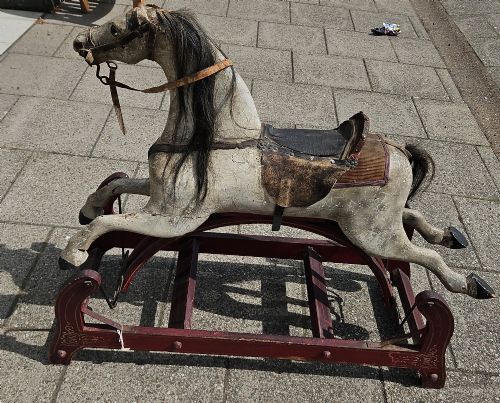


Traditional Nursery Rocking Horse
A traditional nursery rocking horse brings generations of movement and play into a room.
Traditional Nursery Rocking Horse
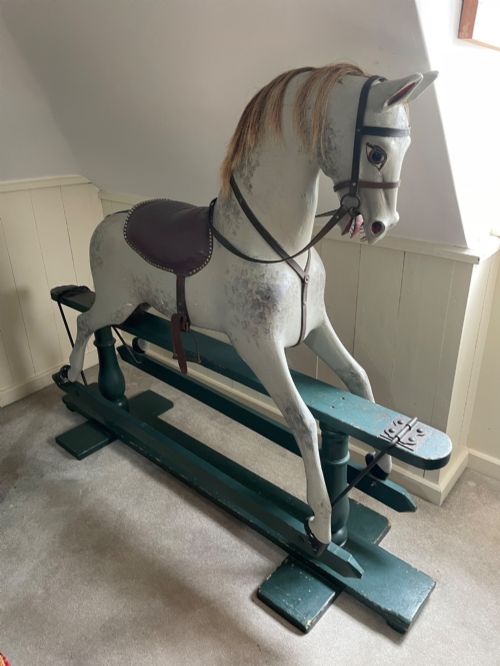
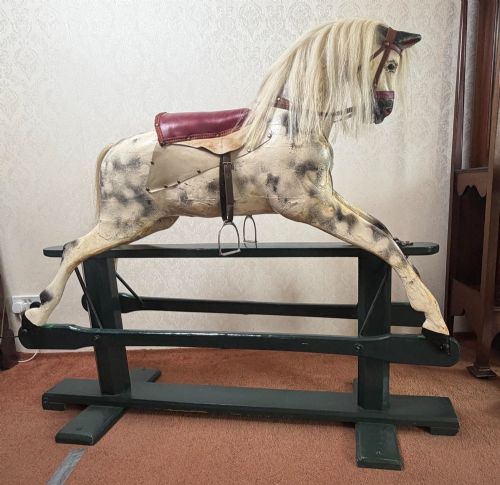
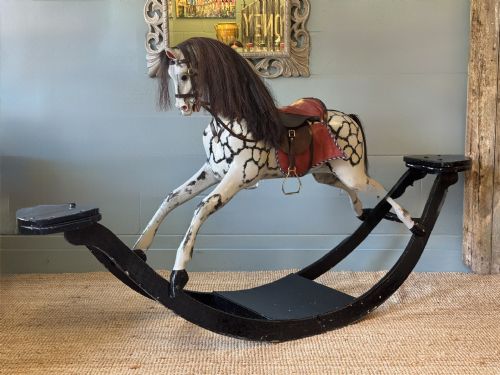
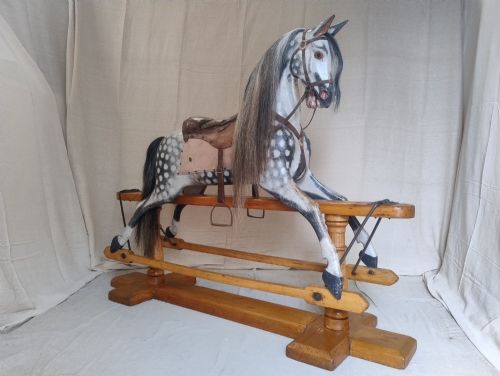
A traditional nursery rocking horse is a child's toy built from wood, shaped by hand and mounted on curved wooden rockers or safety stands. You will find examples here spanning from the nineteenth century through the interwar period and into the mid-twentieth century.
The selection on this page ranges from naive folk art pieces made in Spain and Britain to large commercial works by major London makers. Most pieces follow standard Victorian and Edwardian forms, designed for heavy play in nurseries.
Makers focused on sturdy construction, utilising pine and carved wood finished with paint, leather tack and real horsehair. These large toys survive in varying states, from original untouched paint to worn surfaces showing decades of use.
How they were made
Makers constructed the core bodies of these horses from carved pine and solid wood, shaping heads and legs before mounting them onto robust curved wooden rockers. Iron and steel brackets or fittings occasionally reinforced the joints to withstand vigorous motion.
Surface finish involved layers of paint, sometimes in dappled grey patterns, complemented by genuine horsehair manes and tails. Tack and saddles were fashioned from leather, adding tactile realism to the toy.
Traditional Nursery Rocking Horse Retail Price Guide 2026
Typical asking prices for traditional nursery rocking horse among the pieces listed under this phrase on Sellingantiques today, from the lower quarter to the upper quarter. They describe what is for sale here now, not the wider market.
Materials across these listings include leather, horsehair, wood, iron, metal, pine, paint and steel.
What varies in quality
The distinction between ordinary and exceptional examples lies in the depth of the carving and the fidelity of the animal's anatomy. Finer workshop pieces display expressive heads and well-proportioned bodies, whereas naive folk art versions offer rustic charm through simpler, bolder lines.
Survival of original surface decoration dictates the character of a piece. Retaining the early paint, leather tack and horsehair elevates a horse above examples that have undergone heavy later repainting or extensive structural restoration.
G & J Lines of London·F.H.Ayres·Collinson·Lines Bros Sportiboy
The Traditional Nursery Rocking Horse Glossary
- Dappled
- Painted with small spots or patches over a base colour to imitate a grey horse. This traditional finish required careful layering by workshop painters.
- Rockers
- The curved wooden shoes attached beneath the horse that allow it to swing back and forth. Original rockers are integral to the piece's historical integrity.
- Tack
- The harness, bridle and saddle fitted onto the horse. These elements are typically constructed from leather and metal hardware.
- Folk art
- Objects created by self-taught makers or outside mainstream academic traditions. These pieces often show simpler, more naive carving styles.
Traditional Nursery Rocking Horse: Frequently Asked Questions
How do I date a rocking horse?
Dating relies on examining construction methods, nail types and the style of the carving. Victorian examples often feature deeper, more anatomical carving.
Later twentieth-century versions shift towards simpler forms and different joint techniques. Comparing the paint layers also aids in establishing the era.
Are these horses safe for children?
These antique and vintage toys are primarily valued as decorative objects or collector pieces rather than modern playthings. Their historical construction may not meet current safety standards for active toddlers.
Supervision is essential if younger children interact with them, though many owners prefer to keep them as static display items.
What is original condition?
Original condition means the horse retains its initial paint layer, horsehair mane and tail, and leather tack without major replacement parts. Minor wear and surface marks are expected from historical nursery use.
Pieces described this way have avoided heavy modern restoration or total repainting.
How should I care for the wood?
Keep the rocking horse away from direct sunlight and damp environments to protect the wood and painted surfaces. Stable room temperatures prevent the pine from cracking or warping over time.
Dust gently with a dry cloth and avoid harsh chemical cleaners that might strip the historic finish.