



Traditional Marine Fine Art
Traditional marine fine art captures the raw power of the sea and coastal life through enduring oil paintings.
Traditional Marine Fine Art
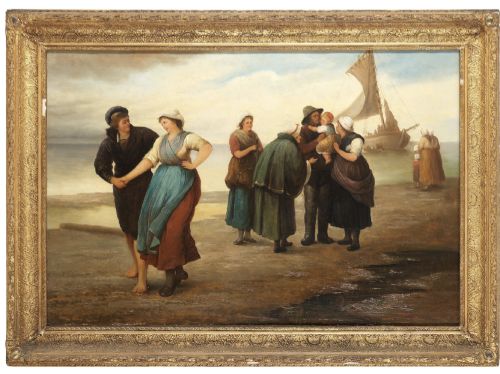
Traditional marine fine art encompasses oil paintings and watercolours depicting maritime scenes, coastal landscapes, and ships upon the water. These works record naval heritage and coastal life primarily across the nineteenth and twentieth centuries.
Buyers encountering this genre will most frequently find nineteenth-century and early twentieth-century oil paintings on canvas, often housed in period frames. Subjects range from busy harbours and Venetian lagoons to dramatic shipwrecks and quiet evening seascapes.
The category bridges maritime history and landscape painting, offering a window into historical coastal commerce and leisure. Regional British and French schools dominate the available selection, reflecting distinct European artistic traditions of the era.
How traditional marine fine art was made
Artists utilised oil paint applied to canvas, often building texture with thick brushwork to render the movement of water and the atmosphere of the coast. Canvas supports provided durability and a fine tooth for capturing shifting light on the sea.
Many works incorporate ornate wooden frames embellished with gesso and gold leaf to complement the finished painting. Giltwood surrounds added presence and protected the edges of the canvas from environmental wear over the decades.
Frames include ornate giltwood and gesso designs alongside simpler wooden mouldings that complement the maritime subjects.
What varies in quality
Quality rests upon the artist's ability to render atmospheric conditions, maritime architecture, and the fluid dynamics of the sea with conviction. Finer works demonstrate a confident handling of light and shade that creates genuine depth within the maritime scene.
The preservation of the original oil paint surface and the integrity of the canvas dictate the overall standard of a piece. Original giltwood frames matching the period of the painting further elevate the integrity of the work.
William Edward Webb·William Pitt·Antoine Bouvard Senior·Jane Vivian·Thomas Rose Miles·Owen Bowen·Walter Holmes·Samuel Bough
The Traditional Marine Fine Art Glossary
- Oil on Canvas
- Pigments bound in a drying oil applied to a stretched woven fabric support. This combination allows for rich colour blending and textured impasto suited to maritime scenes.
- Giltwood
- Wood carved and coated with a thin layer of gold leaf or metallic powder. It provides a decorative and protective border for traditional paintings.
- Gesso
- A paint mixture consisting of a binder mixed with chalk, gypsum, or pigment. It serves as a smooth preparation base for wooden picture frames before gilding.
- Impasto
- Paint applied thickly to a canvas so that the strokes stand out from the surface. This technique brings a tactile quality to crashing waves and billowing sails.
Traditional Marine Fine Art: Frequently Asked Questions
What subjects appear in marine fine art?
Paintings in this category feature clipper ships, harbour views, fishing vessels, and coastal landscapes. Scenes range from calm Venetian lagoons to stormy northern waters.
Artists often documented specific locations, such as the Isle of Man or Cornwall, grounding their seascapes in verifiable maritime topography.
How should I hang an oil painting?
Select a wall away from direct sunlight and sudden temperature changes to protect the canvas and the wooden frame. Secure fixings suited to the weight of the giltwood surround are essential.
Maintain stable indoor humidity levels to prevent the gesso on antique frames from cracking or flaking over time.
How do I identify the period?
Examine the style of the brushwork, the preparation of the canvas, and the construction of the wooden stretcher bars behind the painting. Nineteenth-century works often employ heavier impasto and darker maritime palettes.
Frame styles and signatures also offer clues, though framing can change across the lifespan of an antique painting.
Are these paintings signed by the artist?
Many works bear the signature or monogram of the painter, often placed discreetly in a lower corner of the canvas. Documentation and stylistic traits help attribute unsigned pieces to particular nineteenth or twentieth-century schools.
Researching recorded works by regional artists aids in confirming authorship and verifying the geographical setting of the scene.