


Traditional Framed Prints Set
These traditional framed prints set examples offer British sporting art and historic street scenes in matched groups, giving a room instant balance and period character.
Traditional Framed Prints Set
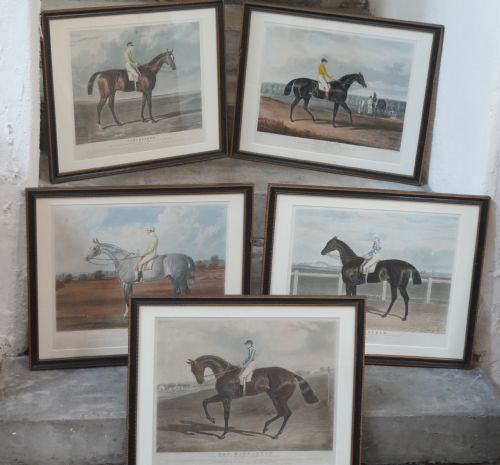
When you search for a traditional framed prints set, you find grouped wall art dominated by equestrian subjects, horse racing, hunting sequences, and cock fighting scenes. These groupings preserve historic sporting narratives and traditional British pastimes across multiple matching frames.
The most common versions on this page are sets of four or more nineteenth-century engravings and coloured prints. They bring together works after artists such as Henry Alken, Charles Hunt, and Francis Calcroft Turner, framed behind glass in wood or gilt wood.
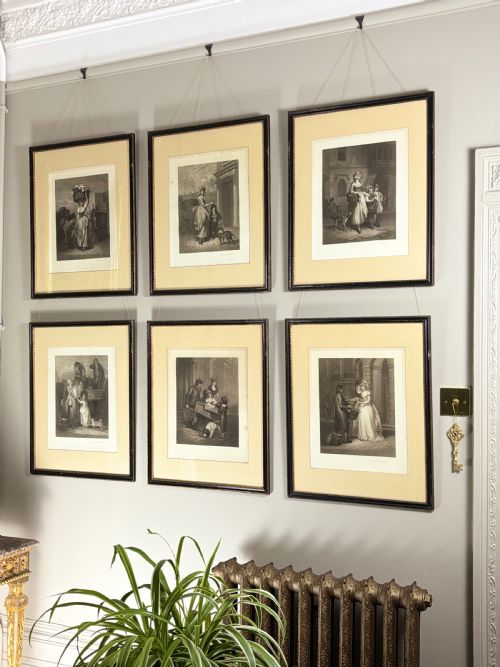
Other variations include sets of large mezzotints and coloured street scenes such as the Cries of London. Dating principally from the mid-nineteenth century and the Victorian period, these sets provide a complete visual sequence rather than a single isolated image.
How they were made
The images within a traditional framed prints set are typically produced as engravings or mezzotints on paper, occasionally hand-coloured with watercolour or gouache. Printmakers transferred detailed compositions onto metal plates before pulling impressions on paper stock.
Framing materials reflect nineteenth-century workshop practices, combining timber mouldings in oak or plain wood with gilt wood finishes. Prints are protected behind glass to shield the paper from environmental damage and handling.
Subject matter centres on British sporting art, including horse racing, hunting sequences, and shooting scenes.
What varies in quality
Quality in a traditional framed prints set rests upon the clarity of the printed line and the crispness of the plate impression. Finer sets maintain deep contrast in the darks and precise application of hand-colouring without bleeding into the paper fibres.
The integrity of the matching frames and the survival of the complete sequence dictate the standing of a set. Uniformity across the wooden or gilt frames ensures the group reads as a cohesive decorative unit.
Thomas G Appleton·Alken·Charles Johnson Payne Snaffles·Charles Hunt·Francis Calcroft Turner·J F Herring
The Traditional Framed Prints Set Glossary
- Engraving
- A printmaking technique where an artist cuts a design directly into a metal plate with a sharp tool. The resulting lines hold ink to create the final image on paper.
- Mezzotint
- A tonal printmaking method that allows for rich darks and subtle gradations of shade. It produces velvety surfaces well suited to reproducing paintings.
- Gilt wood
- Wood coated with a thin layer of gold leaf or gilt preparation. This finish adds a reflective border to the framed artwork.
- Gouache
- An opaque water-based paint used to add colour and highlights to works on paper. It differs from transparent watercolour through its heavier body.
- Victorian
- The period spanning the reign of Queen Victoria, associated here with mid-nineteenth-century print production and sporting subjects.
Traditional Framed Prints Set: Frequently Asked Questions
How do I hang a set?
Arrange the frames in a level horizontal line or a balanced grid to maintain the narrative sequence of the prints. Keep the spacing even between each frame so the group functions as a single visual piece.
Ensure the hanging fixings match the weight of the timber and glass frames securely. Position the centre of the arrangement at eye level for optimal viewing.
Where should I display them?
Traditional sporting prints suit studies, libraries, and hallways where historic art creates an established atmosphere. Hang them away from direct sunlight to protect the paper and watercolour pigments from fading.
Maintain stable indoor humidity to prevent the wood frames and paper from warping. Avoid damp walls that could compromise the backing boards.
Are matching frames original?
Many sets retain their original nineteenth-century wood or gilt wood frames, though some groups are assembled later to match the prints. Look for consistent wear and matching timber mouldings across all pieces in the set.
Original framing often shows age-appropriate patination on the gilt surfaces and traditional backing construction. Replacement frames are sometimes used to preserve fragile paper contents.
How do I date these prints?
Examine the paper stock, printing technique, and any inscribed publication lines or artist signatures at the base of the image. Nineteenth-century engravings often carry publisher details and dates that indicate when the plate was issued.
Compare the style of the dress, horses, and framing materials against known periods like the Regency or Victorian eras. The presence of period framing methods also helps narrow down the timeframe.