

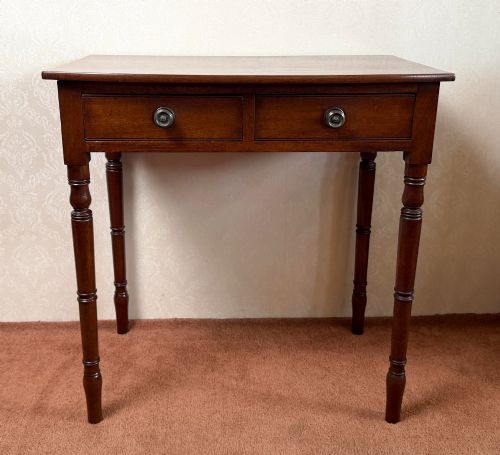
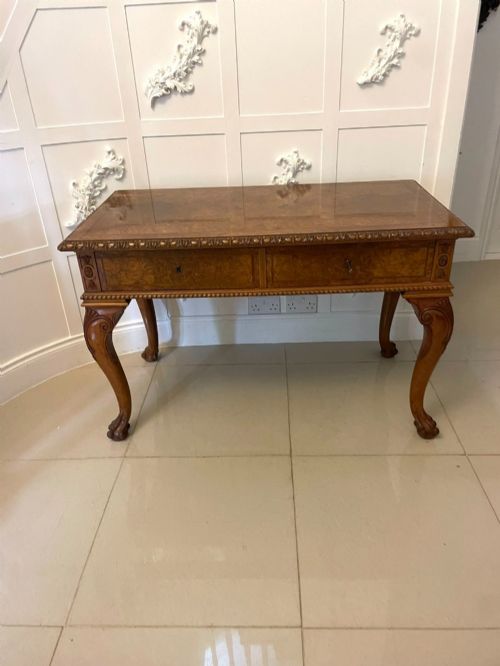
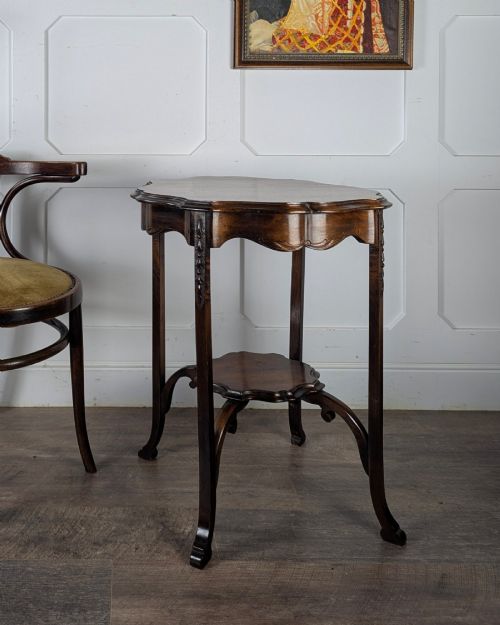


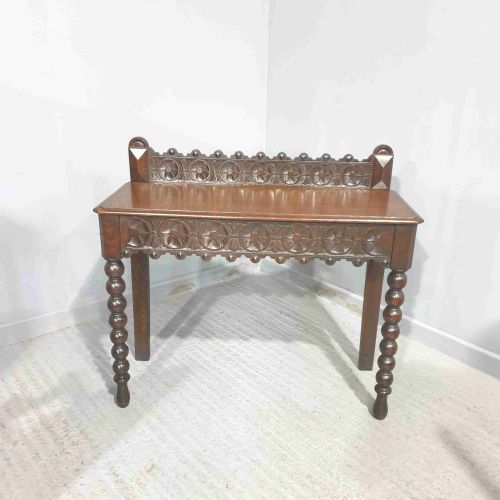


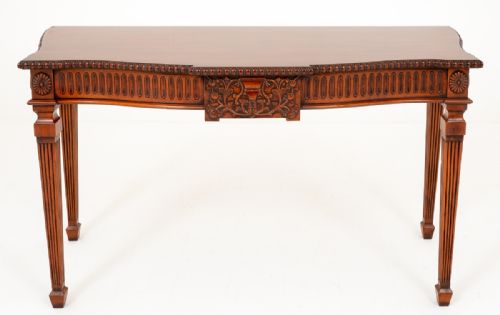
Traditional Foyer Side Table
These traditional foyer side table pieces offer practical surface space and period character for an entrance hall.
Traditional Foyer Side Table
A traditional foyer side table serves as a functional surface in an entrance hall or hallway, providing a place for decorative objects or everyday items. The selection includes console tables, side tables, and centre tables that fit narrow spaces against a wall or stand freely in a room.
Examples on this page span the nineteenth century up through the nineteen-thirties, showing revival aesthetics such as Georgian Revival, Jacobean Revival, Queen Anne Revival, and Edwardian Revival alongside Regency and Victorian pieces.
How they were made
Cabinet makers utilised solid timbers and selected veneers, shaping mahogany, walnut, burr walnut, and oak into durable frames and surfaces. Carved details and turned supports define the structural appearance across different revival styles.
Selected surfaces incorporate inset leather tops, while brass fittings appear on relevant forms. These traditional materials provide both stability and distinct surface textures.
The listings span from eighteen-eighty to nineteen-thirty, representing Victorian, Edwardian, and various revival periods.
What varies in quality
The choice of timber creates a clear distinction across the range, with burr walnut and figured mahogany showing more complex grain patterns than plain oak. Finer pieces display careful selection of veneer matching and detailed carving on the frames and legs.
Design execution separates standard revival pieces from those with stronger stylistic ambition, such as tables featuring Adam style influences or freestanding console formats designed to be viewed from all sides.
The Traditional Foyer Side Table Glossary
- Console table
- A table designed to be fixed against a wall or freestanding, often used in a hallway or foyer. These forms provide surface space without occupying excessive floor area.
- Centre table
- A freestanding table intended to stand in the middle of a room rather than against a wall. Such pieces are finished on all sides.
- Burr walnut
- A prized timber veneer taken from the wart or growth on a walnut tree, producing swirling and mottled patterns. This material appears on high quality revival furniture.
- Georgian Revival
- A design style from the late nineteenth and early twentieth centuries that reinterprets eighteenth-century furniture forms. It adopts classical proportions and mahogany construction.
Traditional Foyer Side Table: Frequently Asked Questions
Where should I place a traditional foyer side table?
These tables fit naturally in entrance halls, corridors, or landings where surface space is useful for keys, correspondence, or lamps. Wall-backed console formats suit narrow passageways.
Freestanding centre tables work better in wider hallways or reception spaces where people walk around all four sides of the furniture.
What is the difference between a console and a side table?
A console table traditionally stands against a wall and may rely on the wall or brackets for total stability, though freestanding versions also exist. Side tables are self-supporting and can move more easily to different positions in a room.
Both types serve similar functional roles in a traditional interior setting.
How do I identify revival styles in these tables?
Revival furniture borrows decorative vocabulary from earlier historical periods, such as Queen Anne pad feet or Jacobean turning. Makers in the nineteenth and early twentieth centuries reproduced these historical looks using contemporary workshop methods.
Examining the timber and construction details helps distinguish the true date of manufacture from the historical style it copies.
How do I care for mahogany and walnut surfaces?
Polished wood surfaces benefit from regular dusting with a soft, dry cloth to prevent grit accumulation. Avoiding direct sunlight and maintaining stable room humidity protects veneers from drying out.
Leather top inserts require gentle cleaning without harsh solvents to preserve the material over time.