

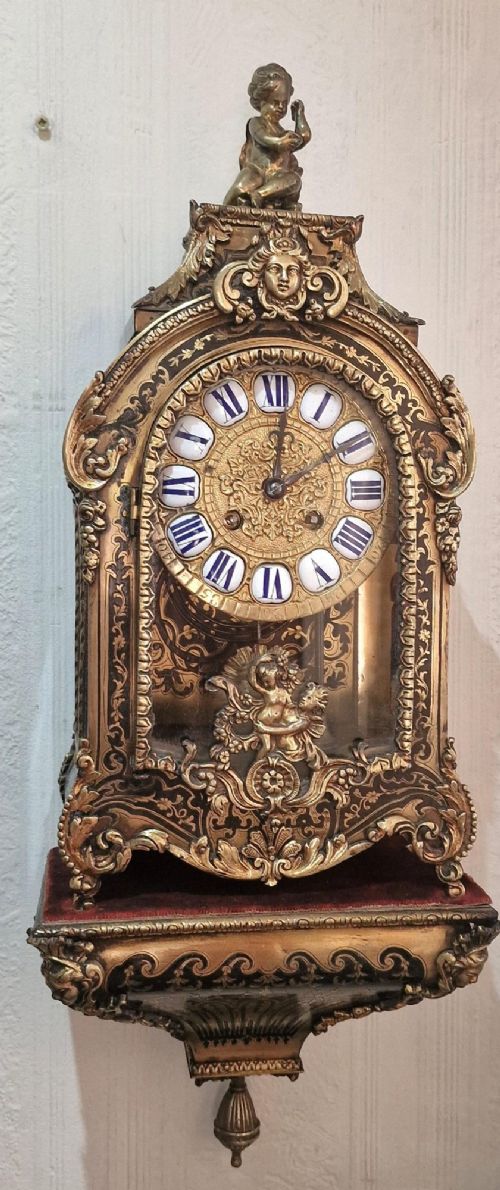
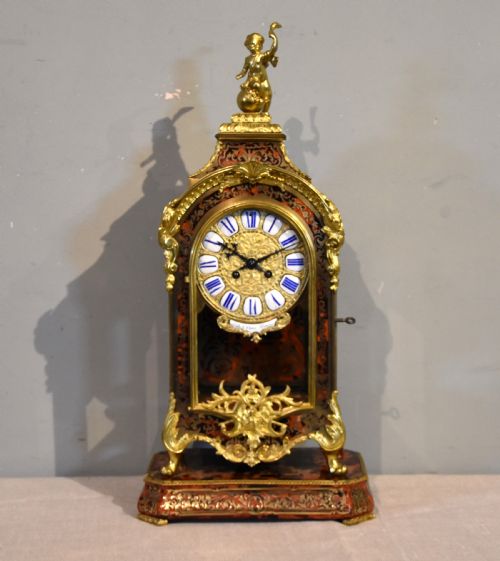


Tortoiseshell Marquetry Clock
A tortoiseshell marquetry clock brings domestic French grandeur into a room through intricate tortoiseshell and cut brass inlay.

Tortoiseshell Marquetry Clock
A tortoiseshell marquetry clock typically presents as a French mantel clock, wall clock, or longcase clock decorated in the Boulle manner. These pieces date across the nineteenth century, with Victorian examples frequently displaying French Rococo Revival or Louis XIV styles.
Most items encountered on this page are mantel clocks paired with matching brackets, housed in ebonised wood cases mounted with ormolu or gilt bronze. Green tortoiseshell variants also appear alongside traditional red-brown tortoiseshell grounds.
The aesthetic draws heavily on seventeenth-century Parisian court design, adapted by nineteenth-century makers to serve as grand domestic timepieces. Buyers seek these objects for their complex brass and shell surfaces that catch domestic light.
Assessing quality and execution
Quality in a tortoiseshell marquetry clock rests upon the precision of the brass cutting and the tightness of fit between the metal and the shell. Superior examples maintain crisp lines in the scrollwork without wide gaps filled with adhesive.
The refinement of the cast ormolu mounts and the presence of a matching original wall bracket elevate a piece above standard production. Movement makers of note, such as Samuel Marti or Henri Marc, also distinguish the finest horological examples.
Tortoiseshell Marquetry Clock Retail Price Guide 2026
Typical asking prices for tortoiseshell marquetry clock among the pieces listed under this phrase on Sellingantiques today, from the lower quarter to the upper quarter. They describe what is for sale here now, not the wider market.
Some tortoiseshell clocks utilise stained horn as a convincing alternative to genuine shell when intricate curves demand greater flexibility.
Henri Marc of Paris·Samuel Marti
The Tortoiseshell Marquetry Clock Glossary
- Boullework
- Marquetry of tortoiseshell and brass popularized by André-Charles Boulle during the reign of Louis XIV. The technique involves sawing fitted patterns from contrasting sheets of material.
- Ormolu
- Gilded bronze used for decorative mounts on furniture and clock cases. The process involves applying a mercury-gold amalgam to cast bronze and heating it.
- Premiere-partie
- The layout where brass forms the dominant pattern against a tortoiseshell background. It represents the primary positive cut from the dual-layer sheet.
- Contre-partie
- The reverse layout where tortoiseshell forms the dominant pattern against a brass background. This utilises the second layer cut simultaneously with the premiere-partie.
- Bracket clock
- A clock designed to sit upon a matching wall-mounted shelf or bracket rather than directly on a mantelpiece. Many nineteenth-century French examples retain their original matching supports.
Tortoiseshell Marquetry Clock: Frequently Asked Questions
What is Boulle work?
Boulle work is a form of marquetry developed in seventeenth-century France, combining tortoiseshell and cut brass in intricate floral or geometric patterns.
Craftsmen cut the materials simultaneously to create interlocking designs that were applied to wooden clock cases and furniture.
Are these clocks eight day movements?
Many nineteenth-century French examples are eight day clocks, requiring winding once a week.
They generally utilise mechanical movements that drive both the timekeeping and the hourly or half-hourly strike on a bell or gong.
Do mantel clocks come with brackets?
Certain wall and mantel clocks include matching wooden brackets designed to support the clock on the wall.
These brackets feature corresponding tortoiseshell marquetry and ormolu mounts to match the main clock case.
How do I identify a Louis XIV style clock?
Louis XIV style clocks display symmetrical architectural forms, rich ormolu mounts, and elaborate brass and tortoiseshell marquetry.
They often incorporate classical motifs and figures inspired by seventeenth-century French court design.