
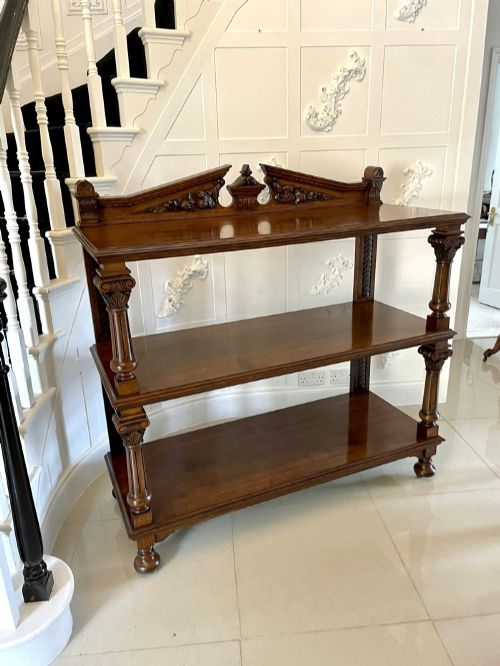
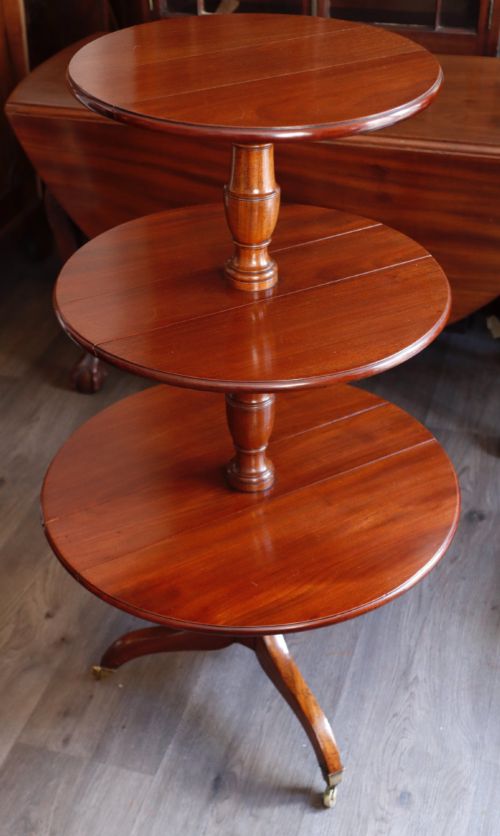
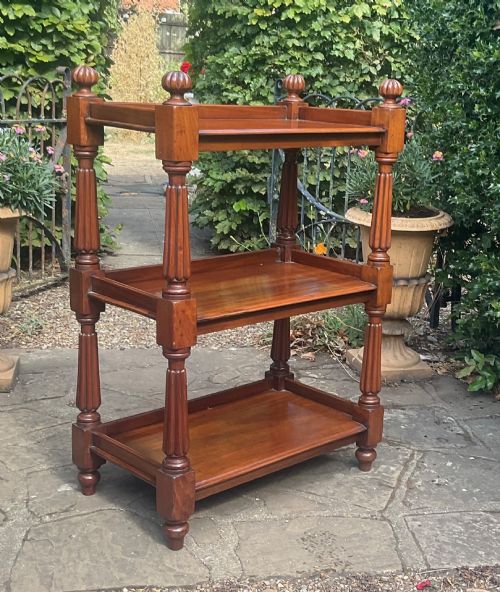
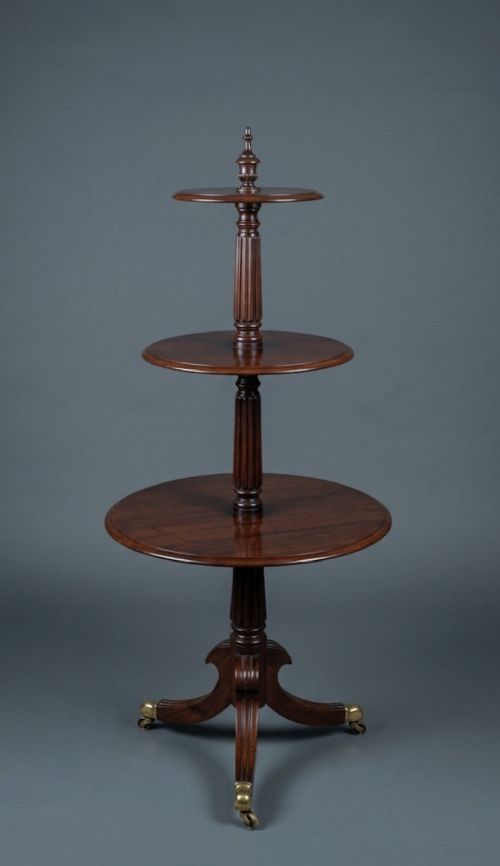


Tiered Server Stand
A tiered server stand offers multi-level surface space, combining practical service with period craftsmanship.
Tiered Server Stand
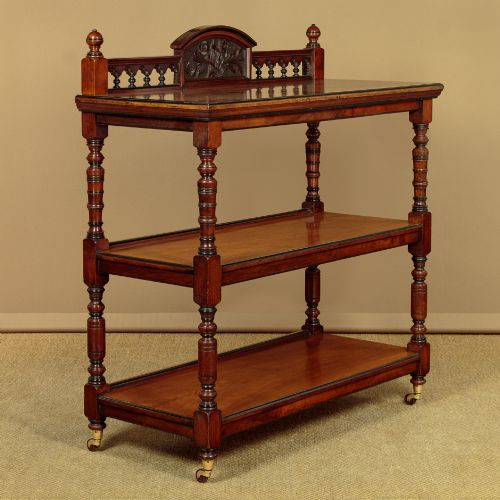
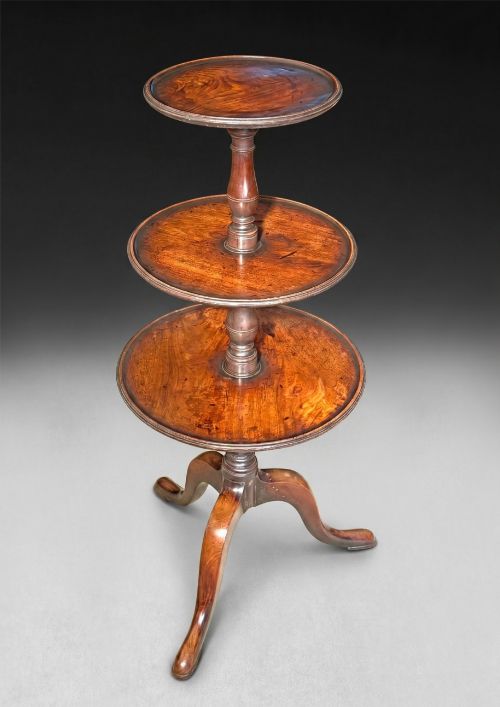
When searching for a tiered server stand, you encounter pieces historically known as dumb waiters, etageres, and buffets. These items provide ascending tiers supported by central columns or tripod bases, designed originally to hold dishes or serveware during meals without requiring servants in the room.
The versions most commonly met on this page span the Georgian, Regency, and Victorian periods. They appear predominantly in mahogany, with occasional examples in walnut, oak, burr walnut, and pollard oak, often featuring circular or drop-leaf graduating tiers.
Makers and designers of these multi-level pieces produced forms ranging from revolving circular trays to slim three-tier etageres and rectangular drop-leaf serving stands. Some pieces incorporate brass fittings, castors, or galleries along the edges of the wood to secure items placed upon each tier.
How they were made
Construction relies heavily on dense timbers such as mahogany and oak, selected for their stability and capacity to support stacked weight across multiple levels. Cabinet makers turned central pillars from single blocks of wood and joined them securely to tripod or pedestal bases.
Joinery methods involved precise turning, mortise and tenon joints, and sometimes hinged drop-leaf mechanisms operated by wooden rule joints and brass brackets. Tier edges frequently received turned mouldings, brass galleries, or carved detailing depending on the prevailing style.
Listings feature mahogany predominantly, alongside walnut, oak, sterling silver, and glass across Georgian, Victorian, and Regency periods.
What varies in quality
Quality in these stands rests upon the selection of timber figure, the crispness of any turned or carved elements, and the structural integrity of the tiered tiers. Superior examples maintain firm central columns without wobble across the joints, even when fully loaded.
The sophistication of the mechanism distinguishes finer pieces, particularly in revolving or folding variants where the movement remains smooth and precise. Original brass hardware, castors, and untouched timber patination further elevate the standing of a piece.
Maple & Co·Gillows
The Tiered Server Stand Glossary
- Dumb waiter
- A freestanding multi-tiered piece of dining room furniture used to hold food and tableware. They typically feature graduating circular shelves on a single central pillar.
- Etagere
- A piece of furniture consisting of a set of open shelves for displaying small objects or serving items. These often appear in slender proportions from the Victorian and Edwardian eras.
- Drop-leaf
- A table top or tier design featuring hinged flaps that fold down to save space or extend outwards when needed. This mechanism is frequently found on Georgian circular serving stands.
- Tripod base
- A support structure comprising three spreading legs radiating from a central column. This configuration provides stable balance for heavy stacked tiers.
- Gallery
- A raised wooden or brass rim fitted around the edge of a shelf or table tier. Its purpose is to prevent items from sliding off when the stand is moved.
Tiered Server Stand: Frequently Asked Questions
What is a tiered server stand used for?
Historically, these stands served dining rooms by holding extra dishes, wine bottles, and silverware close to the table. Today, they function well as display surfaces for plants, books, or decorative objects in living spaces.
The graduating shelves allow you to arrange items across multiple levels without occupying excessive floor space in a room.
Are the shelves on these stands fixed?
Many traditional dumb waiters feature fixed circular tiers secured tightly to a central turned column. However, some period variations include revolving shelves or folding drop-leaves.
Checking the underside of the tiers reveals how the maker attached each level to the central support pillar.
Where should I place a tiered server in my home?
These stands suit corners, hallways, or beside seating areas where vertical display space is useful. Their compact footprints make them adaptable alternatives to standard side tables.
Ensure the floor is reasonably level if the piece relies on a tripod base for stability.