
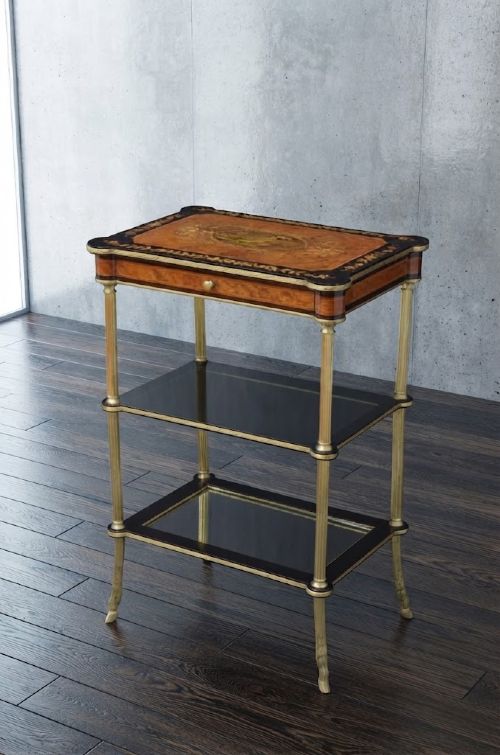
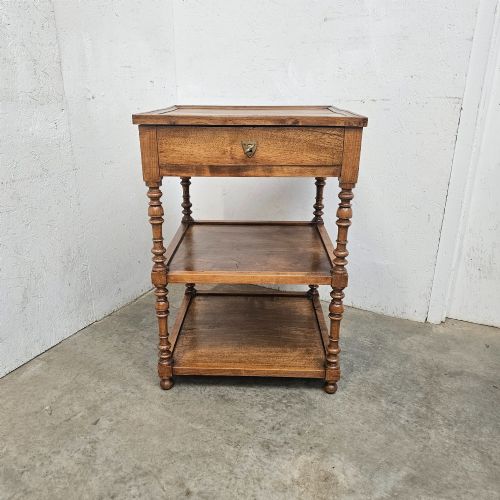
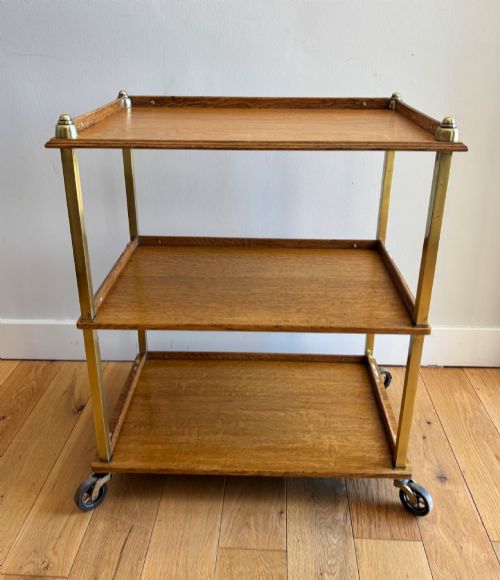
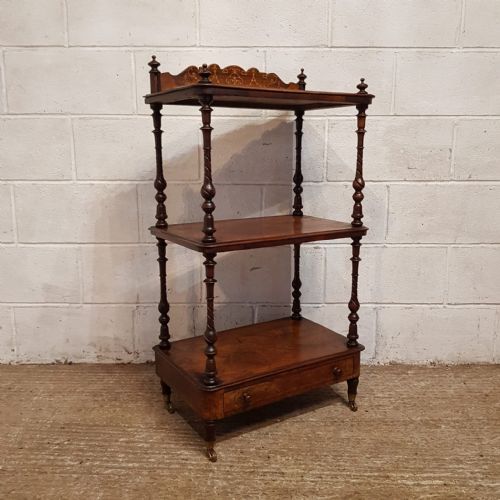
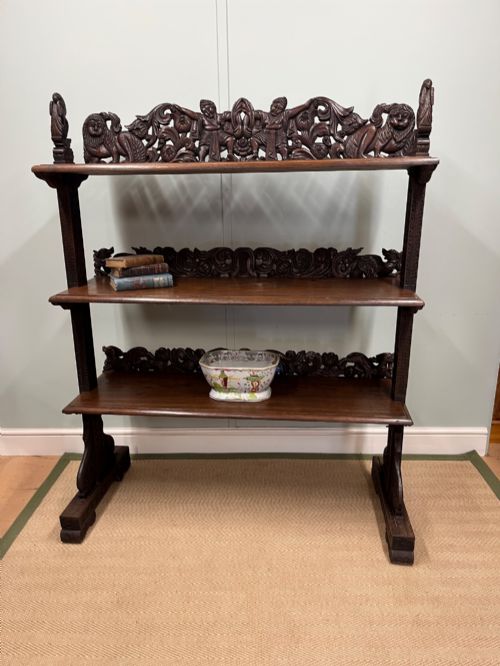


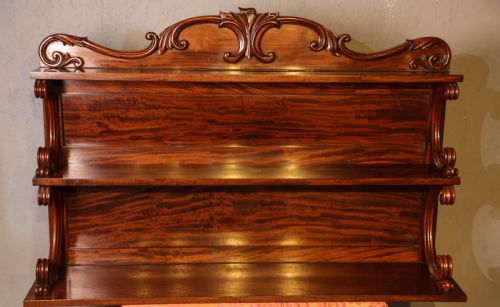


Three Tier Wooden Etagere
A three tier wooden etagere offers stacked display space in mahogany, walnut, and teak, bringing useful open shelving to traditional rooms.
Three Tier Wooden Etagere
A three tier wooden etagere is a multi-level display stand designed for holding books, ornaments, and small objects across graduated horizontal surfaces. These pieces appear frequently under related terms like whatnots, buffets, and wall shelves, reflecting their versatile storage history.
The pieces listed on this page span the Georgian, Regency, and Victorian eras, with nineteenth-century examples forming the core of the selection. Walnut and mahogany dominate the offerings, appearing alongside satin birch, teak, ebonised wood, and burr walnut.
Formations vary from freestanding corner units and bedside stands to trolley hybrids and wall-mounted shelves. Most examples maintain three distinct tiers supported by turned columns, slender uprights, or carved supports.
How they were made
Cabinetmakers constructed these frames using dense timbers like mahogany, walnut, and teak, often selecting figured veneers such as burr walnut or birdseye maple for the primary display surfaces. Turned wooden supports and vertical columns divide the tiers, secured with traditional joinery to bear the weight of books and porcelain.
Decorative detailing on nineteenth-century pieces includes marquetry inlay, ebonised finishes, and carved ornamentation in styles ranging from French Provincial to Gothic Revival. Some examples incorporate brass fittings, glass elements, or mirrored back panels to enhance the reflection of displayed objects.
Recorded forms include corner units, wall shelves, and trolley variants alongside standard freestanding three tier display stands.
What varies in quality
Quality in a three tier wooden etagere rests on the choice of timber and the crispness of the turning on the upright supports. Finely figured burr walnut or rich mahogany veneers elevate an ordinary shelf into a display piece of substantial visual weight.
Construction rigidity and the subtlety of decorative additions, such as marquetry panels or carved mouldings, separate standard utility stands from exhibition-grade furniture. The proportion between the shelf tiers and the slenderness of the supporting columns dictates the overall elegance of the silhouette.
Maple & Co
The Three Tier Wooden Etagere Glossary
- Etagere
- A piece of furniture consisting of a set of open shelves for displaying small objects or ornaments. These tiers are typically supported by slender columns or uprights.
- Whatnot
- A nineteenth-century multi-shelved stand used for displaying curiosities and books. It shares a similar form to the etagere and often appears in corner or freestanding formats.
- Buffet
- A low sideboard or tiered shelving unit used in dining spaces or parlours. Several nineteenth-century examples in teak and mahogany serve this structural function.
- Burr walnut
- A wood harvested from the warted burl growths of walnut trees, yielding a highly swirled grain pattern. Cabinetmakers prized this veneer for high-status Victorian display furniture.
- Marquetry
- Decorative inlay work where thin pieces of contrasting wood veneer are fitted together to form pictorial or geometric patterns on a surface.
Three Tier Wooden Etagere: Frequently Asked Questions
What is a three tier wooden etagere used for?
These pieces function as open display units for books, ceramics, and decorative objects in living spaces and hallways. Their stacked tiers maximise vertical room without dominating the floor area.
Historically, they served as utility stands in Victorian and Georgian rooms where households needed accessible surface area for ornaments or dining accessories.
How do I tell a Georgian etagere from a Victorian one?
Georgian examples tend to feature restrained mahogany frames with clean lines and simpler proportions, aligning with eighteenth-century neoclassical tastes. They often rely on structural elegance rather than heavy ornamentation.
Victorian pieces introduce richer timbers like burr walnut, ebonised finishes, and denser carving styles such as Gothic or Rococo Revival. They also embrace varied forms including mirrored back panels and complex turning.
Can I use an etagere as a bedside table?
Smaller three tier wooden etageres and bedside night stands fit well beside low period beds for holding lamps and books. Their open shelves provide immediate access to nighttime essentials.
When selecting one for a bedroom, check the height and footprint to ensure it matches the scale of the bed frame and surrounding furniture.
Are these shelves sturdy enough for heavy books?
Solid mahogany and walnut frameworks provide sufficient structural strength for standard collections of books and heavy ceramics. The stability depends heavily on the tightness of the upright joints and the thickness of the shelves.
Freestanding nineteenth-century units distributed weight across multiple tiers, though taller corner models benefit from careful placement against a wall.