

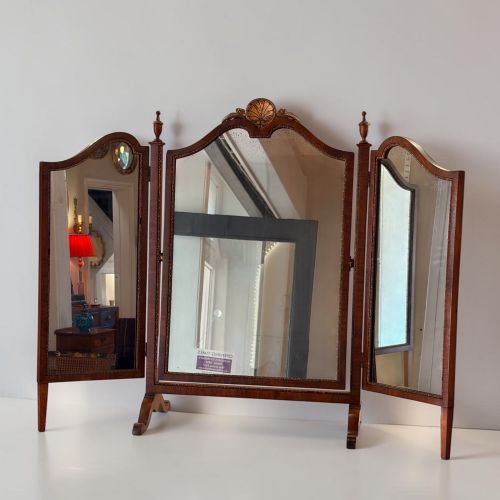
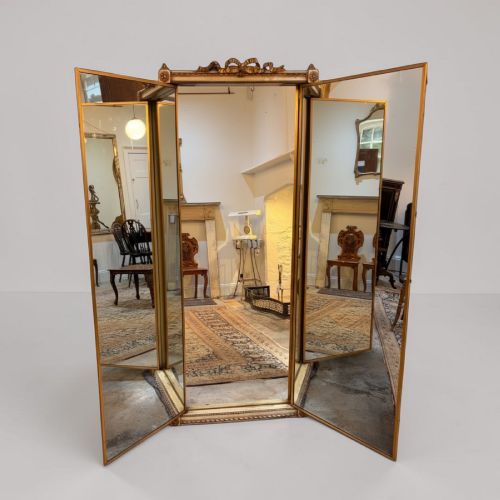
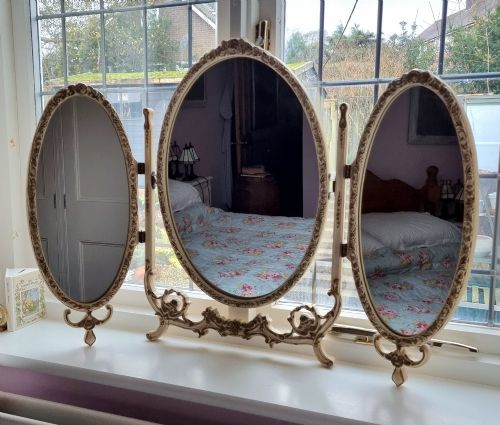


Three Fold Mirror
A three fold mirror provides three angles of reflection, bringing adjustable light and practical elegance to a dressing table or vanity.
Three Fold Mirror
A three fold mirror, often called a triptych or triple dressing table mirror, consists of a central glass panel flanked by two hinged side leaves that angle inward. These pieces appeared frequently from the late nineteenth century through the art deco era, encompassing Edwardian dressing mirrors and French neoclassical or rococo revival designs.
Most examples encountered here function as dressing table mirrors or vanity mirrors, designed to sit directly on furniture surfaces rather than hang as wall mirrors. The form allows the user to adjust the side panels for personal grooming, capturing light from multiple directions in a bedroom or dressing room.
The construction typically unites a sturdy wooden or metal frame with pivoting hinges, linking the main plate to movable wings. Variations span from walnut and mahogany frames to gilded gesso and polished brass, reflecting the shifting aesthetic tastes of the decades around nineteen hundred.
How they were made
Frames rely on traditional cabinetmaking techniques, utilising timbers such as mahogany, oak, and walnut, alongside cast brass and carved giltwood. Artisans joined corners securely to support the weight of heavy glass plates while allowing smooth movement at the hinges.
Surface decoration ranges from applied gesso and paint finishes, such as plummet grey, to polished brass embellishments and fine gilding. Glass panels were bevelled or flat-cut to fit precisely within their respective frames, secured by backing boards or metal pins.
Three Fold Mirror Retail Price Guide 2026
Typical asking prices for three fold mirror among the pieces listed under this phrase on Sellingantiques today, from the lower quarter to the upper quarter. They describe what is for sale here now, not the wider market.
What varies in quality
Quality rests in the substance of the materials and the precision of the mechanics, distinguishing heavy brass castings and solid hardwoods from lighter, plated alternatives. Smoothly operating hinges that hold their angle without sagging reveal the care put into the original construction.
The crispness of the carving in giltwood or gesso and the depth of the wood grain in mahogany or walnut separate standard production pieces from finer examples. Superior mirror glass retains clarity with minimal distortion across all three hinged panels.
The Three Fold Mirror Glossary
- Triptych mirror
- A three-panel mirror with a fixed central plate and two hinged side wings that fold inward. This format derives from traditional altarpieces adapted for domestic dressing furniture.
- Giltwood
- Timber carved and coated with a thin layer of gold leaf or metallic powder. It provides a bright, reflective surface popular in classical revival styles.
- Gesso
- A plaster-like mixture applied to wood frames as a base for carving and gilding. It allows for intricate, sharp ornamental detail.
- Bevelled glass
- Glass with edges cut and polished at an angle. This technique creates a decorative light-refracting border around the reflection.
- Edwardian
- Pertaining to the reign of King Edward VII, spanning the early twentieth century. Furniture from this period often reinterprets earlier neoclassical styles with lighter proportions.
Three Fold Mirror: Frequently Asked Questions
Where should a three fold mirror be placed?
These mirrors sit best on top of a dressing table, chest of drawers, or vanity where there is enough depth to support the footprint and allow the side wings to angle properly.
Positioning them near a natural light source maximises their ability to bounce illumination around a bedroom or dressing space.
How do the hinged side panels work?
The side leaves connect to the central frame using small brass or metal hinges that pivot horizontally. This allows the user to adjust the wings at various angles to see profile views.
Checking that these joints move smoothly without stiffness helps ensure the glass remains stable in position.
Are these mirrors meant to be hung on a wall?
Most examples function as freestanding dressing table mirrors designed to rest securely on a flat surface rather than suspend from wall fixings. Their weight distribution and folding design rely on a stable base.
Using them on furniture keeps the hinged panels balanced and prevents strain on the frame joints.
How do I identify an Edwardian version?
Edwardian pieces typically date from the turn of the twentieth century, often showing lighter frames in mahogany or inlaid woods, alongside simpler neoclassical lines.
They reflect a shift away from heavier Victorian styles toward more refined, domestic elegance.