
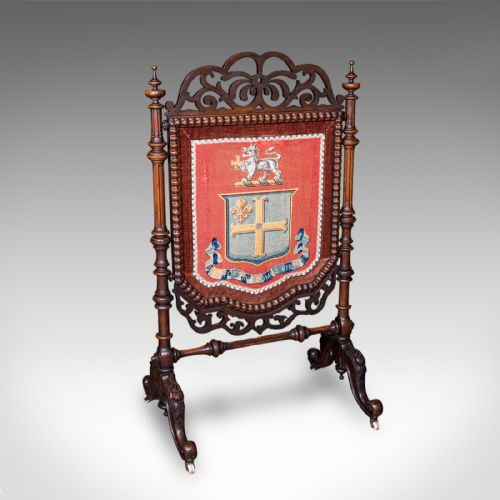
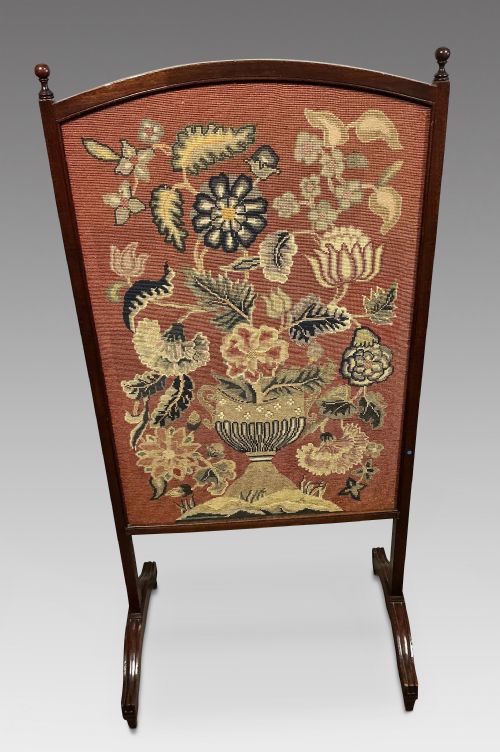


Tapestry Draught Screen
A tapestry draught screen keeps the room warm while framing hand-worked panels of wool, canvas, and silk.
Tapestry Draught Screen
A tapestry draught screen stands in the parlour or drawing room to block chills from doors and hearths, typically taking the form of a freestanding folding panel or a vertically mounted fire screen. The pieces collected under this search phrase span the eighteenth and nineteenth centuries, taking in Regency, Victorian, and Flemish Baroque styles.
Most examples encountered here are Victorian or nineteenth-century creations, utilising mahogany, walnut, rosewood, and broader timber frames to house intricate needlepoint, embroidered armorial panels, and pastoral scenes. Large room dividers and French Aubusson screens also appear, offering both domestic utility and decorative impact.
Buyers seeking a tapestry draught screen will find single panels and pairs designed for substantial country houses as well as more intimate domestic interiors. The craftsmanship reflects traditional woodworking combined with detailed textile work, connecting modern spaces directly to period methods.
How They Were Made
The framework relies on dense hardwoods such as mahogany, walnut, palisander, and rosewood, often carved with the decorative flourishes characteristic of Victorian and Regency design. These timbers provide the structural rigidity needed to support heavy internal frames without warping.
Inside these wooden mounts sit panels worked in wool, canvas, silk, and needlepoint, executed in techniques ranging from hand-woven pastoral imagery to intricate Flemish verdure compositions. Brass hardware frequently secures the folding joints and adjustable mounts.
Current listings feature pieces spanning the eighteenth to the nineteenth centuries, incorporating walnut, mahogany, rosewood, and brass alongside wool and silk textiles.
What Varies in Quality
Quality rests principally on the ambition of the textile work and the crispness of the timber carving. Finely rendered needlepoint with dense, varied stitches and rich wool and silk threads sits far above simpler, coarser embroidery.
The choice of cabinet wood dictates the baseline of the piece, with richly figured rosewood, palisander, and finely carved mahogany marking out the upper tier of production. Structural integrity in the joints and original brass fittings further distinguish standard domestic items from grander commissions.
The Tapestry Draught Screen Glossary
- Draught screen
- A movable barrier placed to prevent cold air currents from sweeping across a room. These pieces combine wooden frames with textile panels.
- Verdure
- A style of tapestry featuring lush botanical foliage and landscapes. These scenes typically show trees, leaves, and sometimes animals in rich greens and earthy tones.
- Aubusson
- A style of tapestry woven in the French town of the same name. They often depict pastoral or floral designs framed by classical borders.
- Needlepoint
- Hand embroidery stitched onto a stiff open-weave canvas foundation. It forms the primary decorative surface of many period screens.
- Palisander
- A dense, dark tropical hardwood valued for its rich grain and colour. Cabinet makers utilised it for high-status Regency and Victorian furniture.
Tapestry Draught Screen: Frequently Asked Questions
What is a tapestry draught screen used for?
These screens historically blocked cold drafts sweeping across large rooms from doors and unlit fireplaces. They also served to shield occupants from the intense heat of an open hearth.
Today they function primarily as decorative room dividers or striking focal points in period and contemporary interiors alike.
How do I date a tapestry screen?
Dating relies on combining the timber species, the style of the wood carving, and the technique used in the textile panel. Regency pieces often show lighter woods and classical lines, while Victorian examples lean towards heavier carved rosewood, walnut, and dense needlepoint.
The materials and mounting hardware provide further clues to the decade of manufacture, aligning with broader shifts in furniture design across the eighteenth and nineteenth centuries.
Where should I place a draught screen?
Position a screen where it can catch the light, allowing the detail of the wool, canvas, and silk needlework to be appreciated. They work effectively as partitions in large open spaces or as backdrops against plain walls.
Keep them away from direct, strong sunlight to protect the fragile dyed threads from fading over time.
Are these screens fragile?
The wooden frames are typically robust, but the antique textile panels require careful handling. Wool and silk threads can weaken after centuries of exposure to light and atmospheric changes.
Gentle cleaning and stable indoor humidity help preserve both the wooden structure and the delicate needlepoint embroidery.