

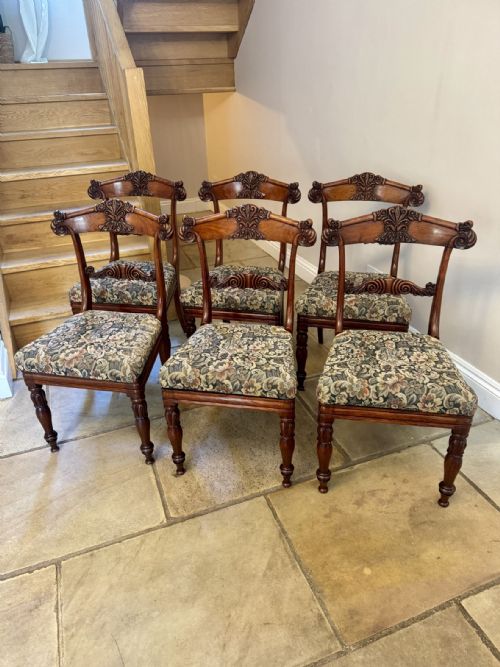


Tapestry Balloon Back Chairs
Tapestry balloon back chairs are curved-frame seating upholstered in needlepoint, offering graceful lines and traditional charm for period interiors.
Tapestry Balloon Back Chairs
When you search for tapestry balloon back chairs, you are looking at nineteenth-century seating characterised by rounded, loop-shaped upper frames and needlework textile covers. The form evolved through the Victorian and Regency eras, appearing primarily as dining chairs, nursing chairs, and salon chairs in walnut, rosewood, and mahogany.
On this page, the walnut and rosewood variants dominate the selection, frequently presented in sets of four or six alongside individual nursing or fireside chairs. These pieces capture the domestic tastes of the mid-nineteenth century, combining exposed timber frames with colourful upholstered panels.
How they were made
Cabinetmakers shaped the characteristic rounded back rails from dense hardwoods like walnut, rosewood, and mahogany, often employing steam-bending techniques to achieve the continuous curved profile. Carved details were then applied by hand to the crest rails and front legs.
The upholstery consisted of tapestry fabric or needlepoint worked in wool, secured over traditional stuffing and tied-in spring or webbing foundations. Ceramic castors and metal fittings occasionally appeared on the lower legs of heavier salon and armchair variants.
Tapestry Balloon Back Chairs Retail Price Guide 2026
Typical asking prices for tapestry balloon back chairs among the pieces listed under this phrase on Sellingantiques today, from the lower quarter to the upper quarter. They describe what is for sale here now, not the wider market.
Some nineteenth-century nursing chairs sat lower to the floor so ladies could tend the hearth without scorching their heavy skirts.
What varies in quality
The density and grain figure of the timber set the baseline for a chair's standing, with richly figured rosewood and carved walnut commanding greater regard than plain mahogany or ebonized finishes. The crispness of the hand-carved ornamentation on the balloon frame also distinguishes standard workshop output from finer examples.
Needlepoint upholstery condition and the tightness of the original frame joinery determine the integrity of each piece. Sets that retain matching needlework across multiple chairs demonstrate superior preservation compared to mismatched or later re-covered variants.
The Tapestry Balloon Back Chairs Glossary
- Balloon back
- A chair back shaped in a continuous loop resembling a balloon, popular during the Victorian period. This profile required skilled timber bending and joinery.
- Needlepoint
- A type of canvas work embroidery used for upholstery, often worked in wool with floral or pictorial designs. It forms the distinctive textile seat or back panels on these chairs.
- Regency
- An architectural and decorative style period dating from the early nineteenth century. Pieces from this era often feature classical restraint alongside rich woods like rosewood.
- Salon chair
- A smaller, decorative chair designed for a withdrawing room rather than formal dining. These often feature lighter frames and elaborate upholstery.
Tapestry Balloon Back Chairs: Frequently Asked Questions
What rooms suit tapestry balloon back chairs?
These chairs fit well into traditional dining rooms, studies, or sitting areas where period timber furniture is present. Their compact scale also makes individual nursing chairs suitable for bedrooms.
Pairing a set with a matching dining table or using single salon chairs as accents allows them to function practically while displaying nineteenth-century craftsmanship.
How do I identify a Victorian balloon back?
Look for the characteristic closed-loop timber top rail above the seat, combined with woods such as walnut, rosewood, or mahogany. Carved leaf or scroll motifs on the frame are typical of the era.
Construction methods, including hand-cut joinery and traditional upholstery foundations, help distinguish nineteenth-century production from later reproductions.
Were these chairs used for dining?
Dining chairs form a large part of the surviving evidence, often found in matching sets of four or six. Their sturdy hardwood frames and supportive curved backs made them practical for long meals.
Alongside dining variants, lower nursing chairs and upholstered fireside models served specific domestic seating needs in the nineteenth-century home.
How should I care for needlepoint upholstery?
Protect needlepoint seats from direct sunlight to prevent the wool yarns from fading over time. Gentle vacuuming with a low-suction attachment helps remove dust from the woven fibres.
Avoid harsh chemical cleaners on both the antique timber frame and the textile panel to preserve the original materials.