

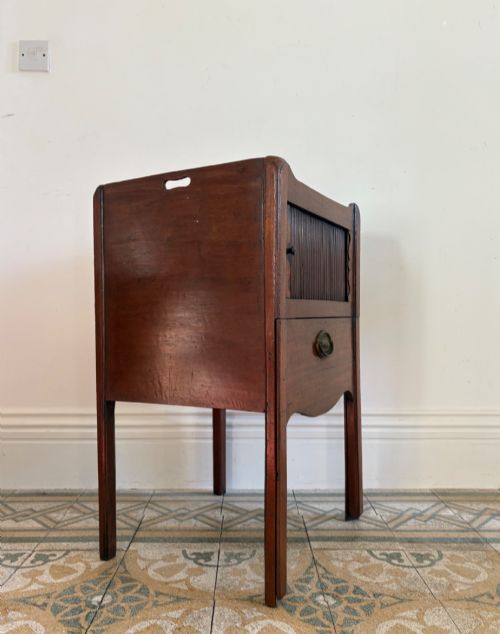


Tambour Front Bedside
A tambour front bedside solves the bedroom storage problem with a flexible wooden shutter that slides shut to hide what you keep beside the bed.
Tambour Front Bedside
When you search for a tambour front bedside, you are looking at compact bedside cabinets, nightstands, and commodes that use a slatted wooden shutter instead of a hinged door. These pieces date principally from the Georgian, Regency, and Victorian eras, alongside 19th-century French provincial examples.
The most common version you will meet on this page is the George III mahogany bedside commode or night table, often featuring a tray top to contain spills and small items. Walnut and satinwood variants appear less frequently, sometimes paired with marble tops in French pieces.
Forms range from straight-fronted cupboards to bow-front, serpentine, concave, and serpentine-fronted commodes. Many include brass hardware and delicate boxwood inlay, reflecting the prevailing cabinet-making styles of the 18th and 19th centuries.
What varies in quality
The smoothness of the sliding shutter separates superior examples from lesser ones, depending on how accurately the wooden slats align within their tracks. Timber selection also dictates value, with well-figured mahogany and crisp boxwood inlay showing superior workshop standards.
Structural integrity in the joints and the crispness of serpentine or bow-front shaping reveal the cabinet-maker's skill. Tray tops and dovetailed drawer construction further distinguish standard bedside tables from finer commodes.
Tambour Front Bedside Retail Price Guide 2026
Typical asking prices for tambour front bedside among the pieces listed under this phrase on Sellingantiques today, from the lower quarter to the upper quarter. They describe what is for sale here now, not the wider market.
The flexible shutter relies on hidden canvas backing, proving that invisible fabric holds up the dignity of Georgian storage.
The Tambour Front Bedside Glossary
- Tambour
- A flexible shutter formed of narrow wooden slats glued to a canvas backing that slides sideways in a track. This mechanism conceals the interior shelving of a bedside cabinet without needing clearance for a swinging door.
- Commode
- A low cabinet or chest of drawers designed for the bedroom. In 18th-century pieces, this term often describes bedside tables fitted with a cupboard or enclosed space.
- Tray top
- A raised rim around the top surface of a bedside table designed to prevent small objects from rolling off. This feature is particularly common on George III mahogany nightstands.
- Serpentine front
- A furniture front curved in a wave shape, convex at the centre and concave at the sides. It requires advanced woodworking skill to match the tambour slats to the curved track.
- Boxwood inlay
- Narrow strips of pale boxwood inserted into contrasting darker woods such as mahogany for decorative borders. This technique marks more refined 18th and 19th-century pieces.
Tambour Front Bedside: Frequently Asked Questions
What is a tambour front bedside?
A tambour front bedside is a small cabinet or nightstand featuring a sliding wooden shutter made of narrow slats on a canvas backing. This flexible door rolls around a track to open and close the storage space.
Cabinet-makers built these pieces during the Georgian, Regency, and Victorian periods, using timbers like mahogany and walnut to house bedside essentials out of sight.
How do I operate the tambour door?
The tambour shutter slides horizontally or vertically within recessed tracks cut into the frame of the cabinet. Pulling the handle guides the flexible wooden slats smoothly around the curve of the piece.
Keeping the tracks clean and free from excess wax ensures the canvas-backed slats continue to glide without sticking.
Where were these cabinets used?
These pieces stood beside beds in 18th and 19th-century bedrooms to hold chamber pots, night lights, and personal items. The enclosed cabinet kept private possessions neatly hidden behind the sliding shutter.
Today, they function as compact bedside tables that offer concealed storage for modern bedroom accessories while maintaining a period aesthetic.
How do I date a mahogany nightstand?
Dating relies on observing the overall style, such as George III tray top designs or Victorian proportions, combined with construction methods like hand-cut dovetails. Timber choice, such as solid mahogany or walnut, also points to specific manufacturing eras.
French 19th-century pieces often incorporate marble tops and distinct provincial proportions that separate them from British workshop traditions.