

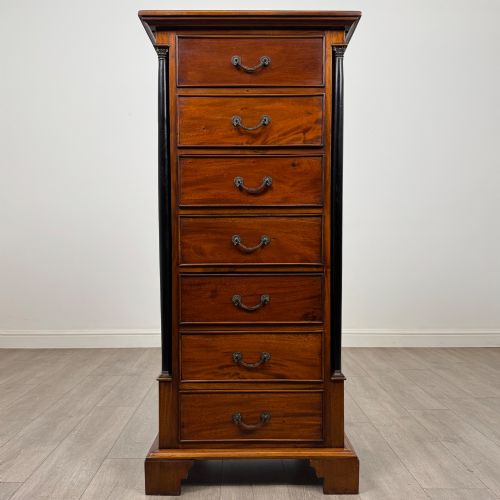
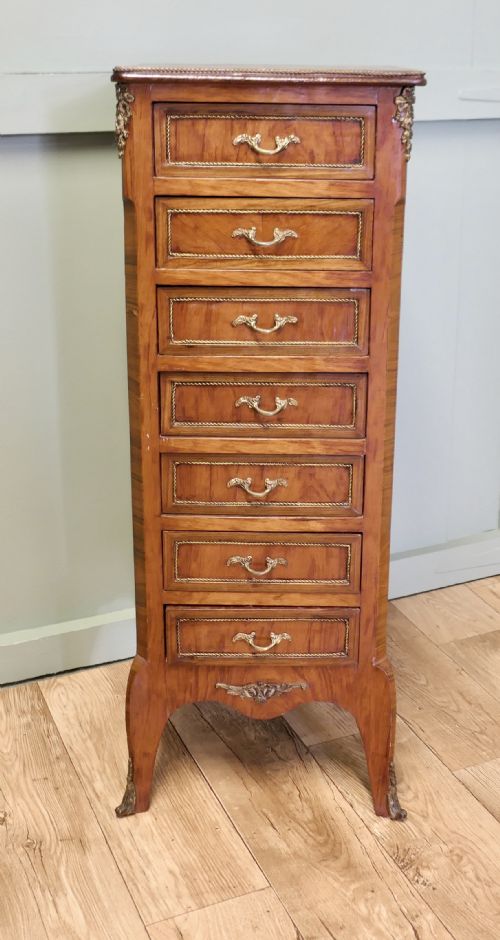


Tall Slim Chest Drawers
Tall slim chest drawers provide vertical storage without crowding a room, satisfying the need for generous capacity in a tight footprint.

Tall Slim Chest Drawers
A tall slim chest drawers stands upright with a narrow footprint, offering multiple tiers of storage in restricted floor spaces. These pieces appear across the Victorian, Edwardian, and Georgian periods, alongside revival styles.
Mahogany dominates the available selection, often found in Edwardian examples alongside walnut, pine, oak, and painted finishes. Formations vary from standard upright chests to bow fronts, Wellington chests, and tall banks of drawers.
Revival pieces sit alongside genuine period items from the nineteenth century and earlier. Buyers frequently encounter Edwardian mahogany designs alongside Victorian walnut and Georgian styles.
Materials and construction
Makers utilised solid timbers and veneers, selecting mahogany, walnut, oak, and pine for carcass construction. Inlaid decoration, brass hardware, and ebonised details frequently accent the timber surfaces.
Surfaces receive polish or paint finishes to highlight the natural grain of figured timbers like burr walnut and mahogany. Drawers are built with traditional joinery to support graduated stacking and heavy daily use.
Assessing quality and build
The choice of timber creates the primary distinction between standard pieces and finer examples. Figured veneers, decorative inlay, and substantial brass fittings elevate the presence of Edwardian and Georgian designs.
Construction precision dictates durability, particularly in the smooth operation of graduated drawers within a narrow frame. Untouched original finishes and intact hardware preserve the integrity of older items.
The Tall Slim Chest Drawers Glossary
- Wellington chest
- A tall, sturdy chest of drawers featuring a locking side flap that secures all the drawers at once. This nineteenth-century form maximises vertical storage in a narrow format.
- Bow front
- A convex curved drawer front that projects outward from the face of the chest. This shape softens the vertical lines of taller furniture.
- Graduated chest
- A set of drawers where the depth of each drawer decreases from bottom to top. This arrangement provides stability and visual balance to tall furniture.
- Kingwood
- An exotic timber prized for its rich colour and dark figuring, often utilised as a veneer on decorative furniture. It appears alongside walnut and mahogany in finer cabinets.
- Tallboy
- A tall chest of drawers, sometimes constructed in two sections with an upper chest resting on a lower base. The term describes elevated storage configurations.
Tall Slim Chest Drawers: Frequently Asked Questions
Where do tall slim chest drawers fit best?
These chests suit tight alcoves, hallways, and bedrooms where floor space is limited. Their vertical build provides substantial drawer capacity without occupying a wide area.
They pair well with bedside tables and wardrobes, offering organised storage for folded clothing and accessories.
How do I identify an Edwardian tall chest?
Edwardian examples often feature lighter mahogany timbers, sometimes with inlaid stringing or bow front profiles. Their construction reflects early twentieth-century manufacturing standards while retaining traditional proportions.
Many Edwardian pieces display finely figured wood grains and original brass handles characteristic of the period.
What is a Wellington chest?
A Wellington chest is a specific type of tall nineteenth-century chest distinguished by a hinged locking stile on one side. Swinging this flap open allows the drawers to be pulled out.
This locking mechanism was originally designed to secure valuable items and personal papers within the vertically stacked drawers.
Are pine chests older than mahogany ones?
Pine was commonly used for utilitarian furniture across various periods, including painted and Scandinavian pieces. Mahogany and walnut typically appeared in formal reception rooms and formal bedrooms.
Both timbers span multiple centuries, so individual construction details determine the exact age of a piece rather than the wood alone.