

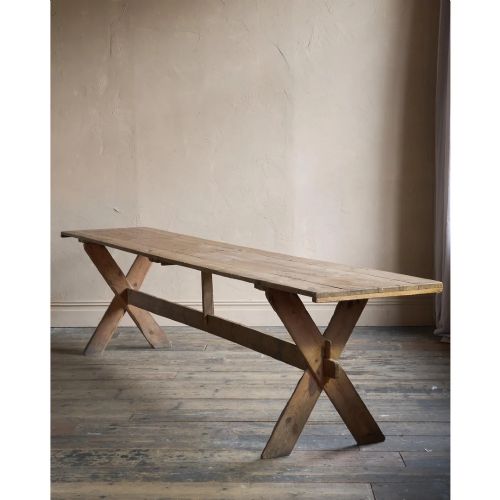
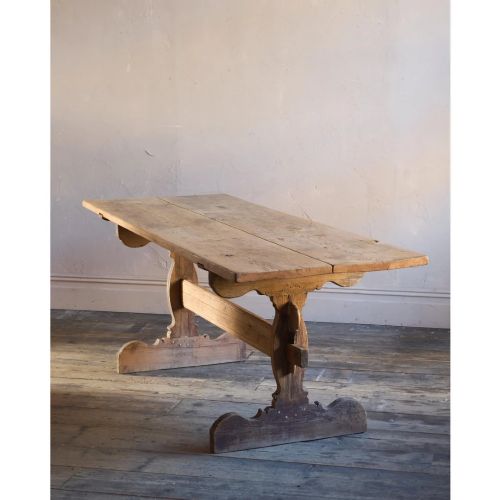


Swedish Country Dining Table
A Swedish country dining table brings honest proportions and simple utility to an interior, shaped by northern European domestic traditions.
Swedish Country Dining Table
A Swedish country dining table is typically a functional timber piece designed for everyday domestic life in rural Scandinavian homes. When you search for this phrase, you encounter forms that span several centuries, most frequently rooted in the nineteenth century.
The pieces listed here appear in various configurations, including trestle bases, drop-leaf slagbord designs, and kitchen or preparation tables. Pine and softwood dominate the inventory, often finished with traditional paint or left as weathered timber.
Scandinavian country and Gustavian influences shape the aesthetic of these items, balancing utilitarian construction with restrained regional detailing. You meet them in both generous proportions suited for large dining spaces and more compact formats.
How they were made
Carpenters constructed these tables predominantly from native softwood and pine, utilising solid timber planks for both tops and structural framing. Oak appears occasionally in specific structural components or earlier examples.
Surfaces frequently display traditional finishes such as Falu paint or layered painted wood treatments applied over the base timber. Over decades of use, these painted surfaces acquire a distinct weathered patina through natural wear.
Swedish Country Dining Table Retail Price Guide 2026
Typical asking prices for swedish country dining table among the pieces listed under this phrase on Sellingantiques today, from the lower quarter to the upper quarter. They describe what is for sale here now, not the wider market.
Many of these tables bear faint ink stains and knife marks from centuries of family meals and domestic work.
What varies in quality
The integrity of the original timber construction distinguishes superior examples from simpler utilitarian workshop pieces. Tables retain greater character when their structural joinery remains sound and the primary wood surfaces show honest age.
The application and retention of early paint layers contribute significantly to the visual depth of a table. Original Falu paint or historical surface treatments hold more interest than later refinishing efforts.
The Swedish Country Dining Table Glossary
- Slagbord
- A traditional Scandinavian dropleaf table featuring hinged leaves supported by swing-out wooden legs. This form allows the table to expand for dining and contract to save space.
- Falu paint
- A deep red or earth-toned paint originating from copper mines in Sweden, traditionally used to protect exterior and interior timber. It provides a distinct matte finish on historical furniture.
- Gustavian
- The Swedish neoclassical style spanning the late eighteenth century, characterised by restrained ornamentation and lighter proportions. It influences the cleaner lines found in rural Scandinavian furniture.
- Trestle table
- A form comprising two or more support frames connected by a horizontal stretcher beam underneath a top board. This construction offers robust stability for large dining surfaces.
- Preparation table
- A utilitarian work table historically used for food processing and domestic chores in large kitchens. These pieces often feature scrubbed timber tops and sturdy softwood frames.
Swedish Country Dining Table: Frequently Asked Questions
How do I clean a painted pine table?
Wipe the surface gently with a soft, slightly damp cloth to remove everyday dust. Avoid harsh chemical cleaners that can strip historical paint layers.
Dry the timber thoroughly immediately after cleaning to prevent moisture damage to the softwood underneath.
Can I use a preparation table for dining?
Preparation tables provide generous proportions and sturdy construction well-suited for daily meals and gatherings. Their original utilitarian design accommodates modern seating comfortably.
Consider the height and leg clearance beneath the apron to ensure standard dining chairs fit adequately.
What is the difference between pine and softwood?
Pine is a specific type of softwood commonly utilised by historical Scandinavian cabinetmakers for domestic furniture. Other softwoods may include fir or spruce species found locally in regional workshops.
Both materials yield durable furniture when constructed with traditional joinery techniques.
How do I identify an eighteenth century piece?
Look for construction traits specific to earlier hand-tool methods, such as pegged joints and hand-planed board surfaces. The timber often displays deep patination accumulated over generations.
Hardware and fasteners, where present, typically exhibit forged iron characteristics rather than modern machine-made screws.