

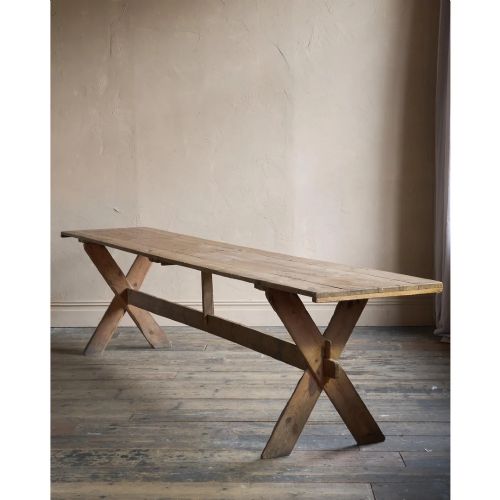
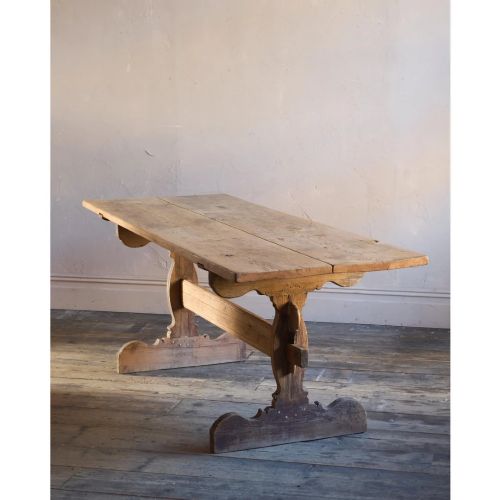


Scandinavian Rustic Kitchen Table
A scandinavian rustic kitchen table brings honest northern utility and scrubbed timber warmth directly to the heart of the modern home.
Scandinavian Rustic Kitchen Table
When you search for a scandinavian rustic kitchen table, you encounter robust forms shaped by daily domestic use across Swedish country houses. The pieces on this page span the eighteenth century, the nineteenth century, and nineteen forty, focusing heavily on nineteenth-century examples.
Dining tables, kitchen tables, preparation tables, and bakers tables dominate the offerings. These utilitarian objects often display trestle frames, X frames, or drop-leaf constructions.
Origins cluster firmly around Swedish country and Gustavian traditions, favouring unpretentious utility over ornamental excess. Every scandinavian rustic kitchen table reflects the practical demands of historic northern kitchens.
How they were made
Joinery relies on solid timber construction, utilising pine, oak, and general softwood to bear heavy domestic workloads. Carpenters built these tables to withstand rigorous daily preparation tasks without structural failure.
Surfaces frequently showcase applied paint or traditional Falu paint alongside bare timber. This combination of painted finishes and scrubbed wood protects the underlying timber while creating the distinctive aesthetic associated with the region.
Scandinavian Rustic Kitchen Table Retail Price Guide 2026
Typical asking prices for scandinavian rustic kitchen table among the pieces listed under this phrase on Sellingantiques today, from the lower quarter to the upper quarter. They describe what is for sale here now, not the wider market.
Listings span four distinct periods: the eighteenth century, eighteen seventy, the nineteenth century, and nineteen forty.
What varies in quality
Differentiation lies in the survival of original painted surfaces versus later stripped finishes. Tables retaining their early layers of paint or Falu red pigment carry greater historical integrity than those altered over time.
Proportion and frame construction also set examples apart. Simple trestle designs and X-frame supports demonstrate varying degrees of joinery refinement within vernacular furniture traditions.
The Scandinavian Rustic Kitchen Table Glossary
- Gustavian
- The Swedish interpretation of neoclassical design, named after King Gustav III. It blends French influence with restrained northern simplicity.
- Falu paint
- A traditional deep red paint originating from copper mines in Falun, Sweden. It provides durable protection for softwood surfaces.
- Trestle table
- A table comprising two or more support frames connected by a horizontal beam. This form maximises legroom and stability.
- Drop leaf
- A table featuring hinged flaps that fold down to save space. It offers flexible sizing for smaller rooms.
- Pine
- A common softwood used extensively in northern European vernacular furniture. It takes paint well and provides a sturdy work surface.
Scandinavian Rustic Kitchen Table: Frequently Asked Questions
How do I clean a painted wooden table?
Wipe surfaces gently using a slightly damp cloth without harsh detergents. Avoid soaking aged timber or historic paint layers.
Keep tables away from direct heat sources to prevent the old softwood from drying out or splitting.
Are these tables suitable for daily dining?
These tables were originally built for heavy kitchen preparation and daily family meals. Their robust construction handles everyday use comfortably.
Using placemats helps protect historic scrubbed pine or painted surfaces from moisture and heat rings during meals.
How do I identify a Gustavian style table?
Gustavian pieces often display restrained neoclassical lines, tapered legs, and pale painted finishes. They look more formal than pure country vernacular furniture.
Check for carved fluting or subtle panel details that distinguish this Swedish royal style from basic utilitarian workshop pieces.
What is Falu paint?
Falu paint is a traditional matte paint made from copper mine waste residue, linseed oil, and flour. It offers strong weather and wear resistance.
Historically used on Swedish buildings and furniture, it yields a characteristic deep red hue that ages with a chalky texture.