

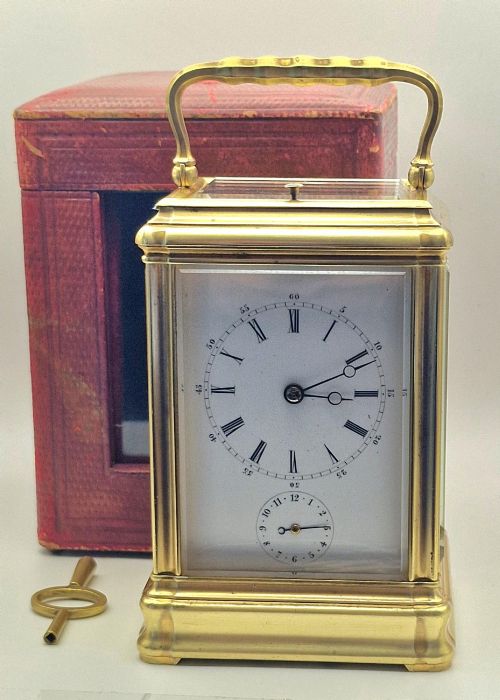
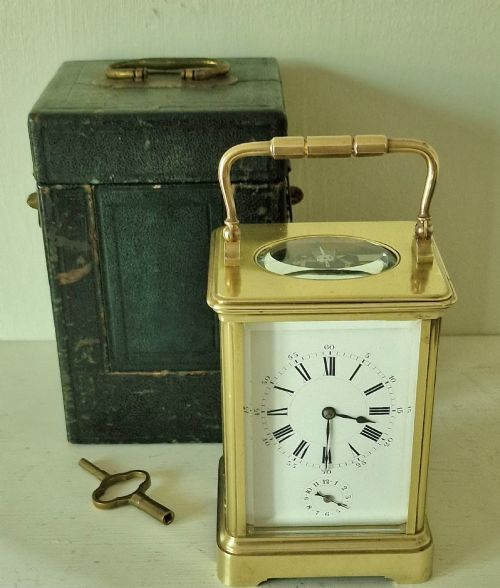
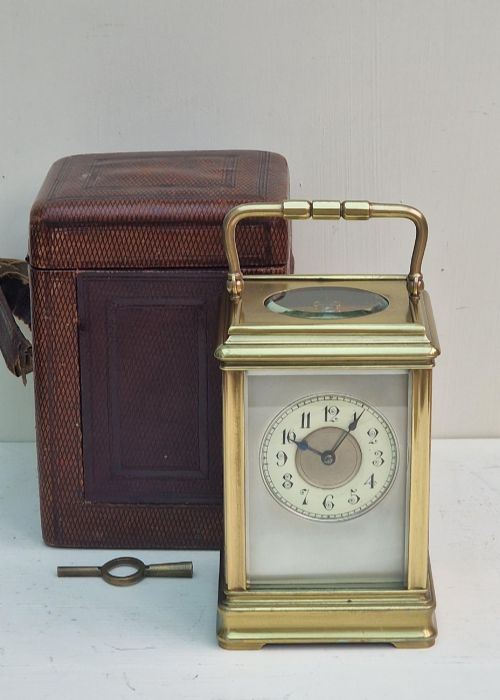
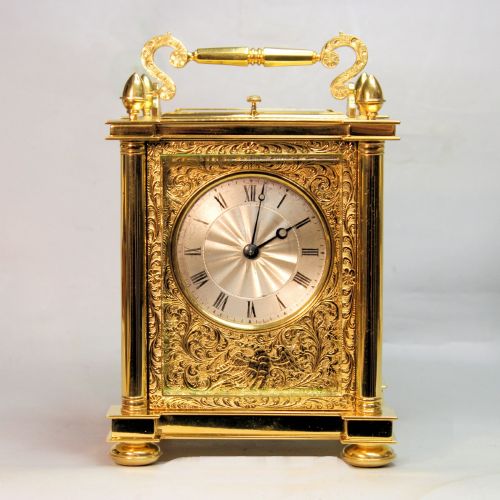


Strike Carriage Clock
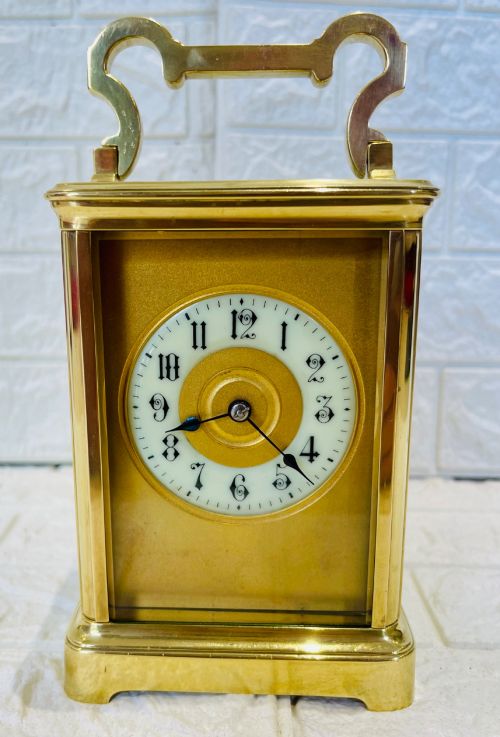
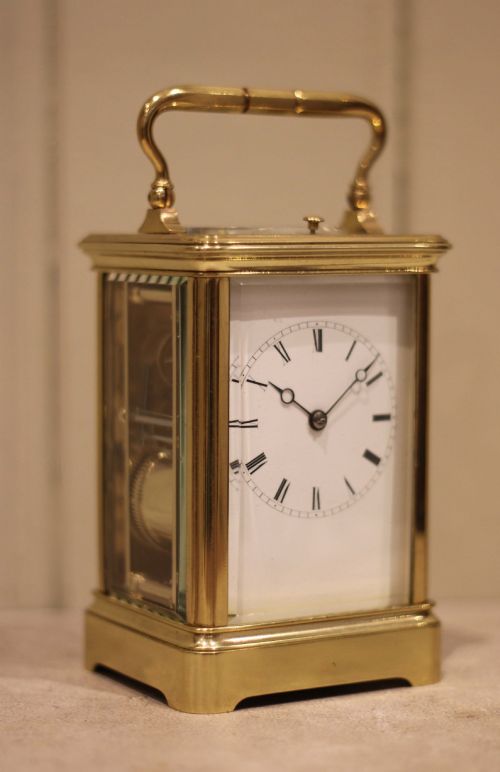
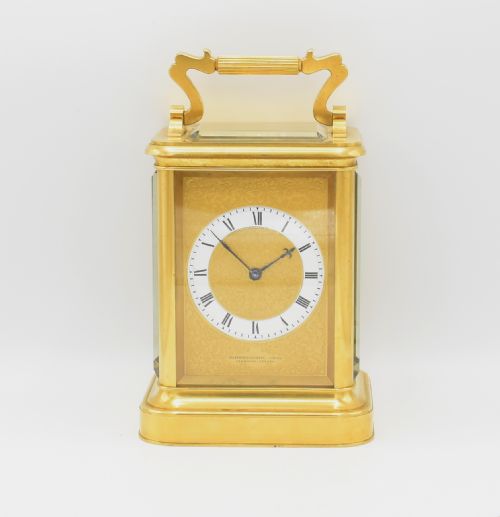
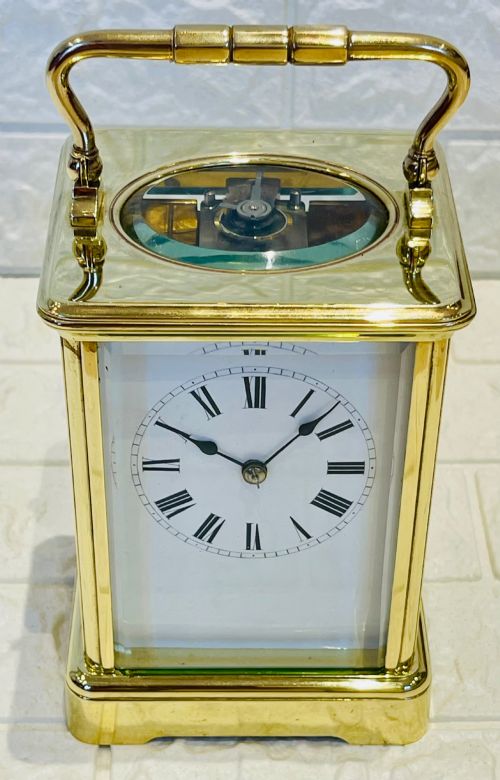
A strike carriage clock combines portable mechanical precision with audible timekeeping, offering the traditional charm of a bell or gong strike in a brass and glass case.
Strike Carriage Clock
A strike carriage clock is a portable timepiece designed for travel or domestic placement, most frequently encountered in nineteenth-century French and Victorian forms on this page.
These pieces range from simple hour-striking models to complex variants featuring repeat mechanisms, alarms, and quarter-hour strikes known as petite or grande sonnerie.
The selections span from mid-nineteenth-century English fusee movements to late-nineteenth-century French works housed in traditional brass frames such as gorge or doucine cases.
Materials and Construction
Cases utilise heavy cast brass and gilt brass frameworks fitted with bevelled glass panels to expose the internal gear train and escapement.
Dials and inset panels frequently incorporate white enamel with painted Roman numerals, sometimes accompanied by silvered metal masks or decorative contrasting materials.
Movements rely on steel pinions and brass wheels, driven by springs enclosed in barrels or powered by fusee chains in English examples.
Strike Carriage Clock Retail Price Guide 2026
Typical asking prices for strike carriage clock among the pieces listed under this phrase on Sellingantiques today, from the lower quarter to the upper quarter. They describe what is for sale here now, not the wider market.
Listings feature nineteenth-century brass, gilt brass, and glass cases, alongside leather travelling boxes and ebonised wood.
Distinctions in Quality
Quality depends on the complexity of the movement, separating basic hour strikers from sophisticated quarter-striking, repeating, and alarm mechanisms.
The finish of the metalwork and the crispness of the engraving on the gilt brass frame distinguish standard production from maker-signed pieces.
Retaining original travelling leather cases and matching numbers across the movement and components adds significantly to the integrity of the piece.
Drocourt·Henri Jacot·Cousens And Whiteside·Goldsmiths Alliance Ltd·C Detouche·T Martin And Co·Henry Jacob·Dwerrihouse And Bell·Ad Mougin·Delépine Barrois·Le Roy Et Fils
The Strike Carriage Clock Glossary
- Gorge case
- A stepped brass carriage clock case design with reeded mouldings around the top and bottom. This style provides a sturdy and formal housing for nineteenth-century French movements.
- Striking
- A mechanism that sounds the hours or fractions thereof on a bell or gong. This function operates independently of the timekeeping train.
- Repeating
- A mechanism that sounds the last hour or quarter-hour when a button or pendant is depressed. This function allows the time to be checked in darkness.
- Grande Sonnerie
- A striking system that sounds both the hours and the quarters automatically on every quarter-hour. This complex arrangement represents a high standard of clockmaking.
- Fusee
- A conical pulley used in clock movements to maintain even force on the gear train as the mainspring unwinds. This device is characteristic of English manufacture.
Strike Carriage Clock: Frequently Asked Questions
Why does the clock strike the wrong hour?
The strike train may have slipped out of sequence during transport or handling. This occurs if the hands are moved incorrectly.
Allow the strike to run down or advance the minute hand carefully past the hour to resynchronise the count.
Where should I place a carriage clock at home?
Position the piece on a stable, level surface away from direct sunlight, draughts, and sudden temperature shifts. Mantelpieces and side tables suit the glass panels well.
A firm foundation ensures the pendulum or balance wheel maintains a steady beat for accurate timekeeping.
How do I tell an English strike carriage clock from a French one?
English pieces often house fusee movements inside heavier wooden or brass cases, whilst French examples predominantly utilise platform escapements and spring barrels in gilt brass frames.
Examining the back plate and movement layout generally reveals the origin of the craftsmanship.