

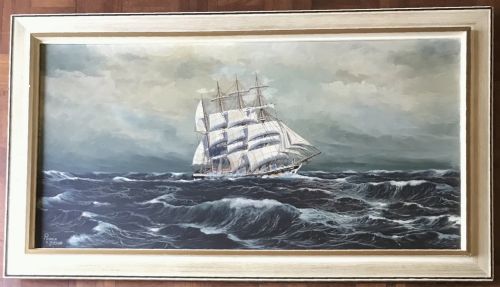
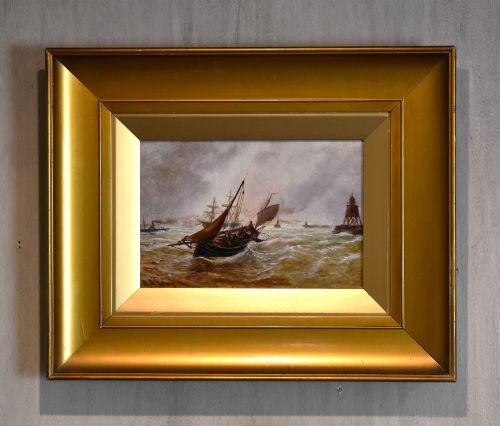


Stormy Sea Art
These stormy sea art pieces capture the raw power of coastal gales and troubled waters on canvas, board, and paper.
Stormy Sea Art
When you search for stormy sea art, you encounter maritime paintings and watercolours that record dramatic ocean conditions and coastal danger. The pieces on this page span the nineteenth century, the Victorian era, and the early twentieth century.
Most examples you meet are oil paintings on canvas or board, alongside watercolours and charcoal works. They depict sailing ships, lighthouses, and choppy waters from British and European coastal locations.
Subjects range from specific vessels like the Cutty Sark to dramatic shipwrecks and harbour scenes associated with the Staithes School. These works offer a direct window into historical maritime encounters.
How they were made
Artists built these compositions using oil on canvas, oil on board, and watercolour pigment on paper. The application of paint captures the movement of heavy seas and the turbulent atmosphere of coastal squalls.
Gilt frames often accompany the oil paintings, providing a traditional boundary for the dramatic marine scenes. Support materials range from prepared canvas to solid board and fine paper.
Stormy Sea Art Retail Price Guide 2026
Typical asking prices for stormy sea art among the pieces listed under this phrase on Sellingantiques today, from the lower quarter to the upper quarter. They describe what is for sale here now, not the wider market.
At least one nineteenth-century artist clearly got salt in their tea while painting windswept lighthouses.
What varies in quality
Quality rests in the artist's ability to render the weight of water and the atmospheric tension of a gale. Works by established regional painters demonstrate a surer handling of light and maritime detail than anonymous studio pieces.
The immediacy of the brushwork and the preservation of the pigment separate ordinary decorative watercolours from compelling artistic records of the sea. Framing and the condition of the paper or canvas further distinguish individual examples.
Bernard Benedict Hemy·Percy Brooke·William Kay Blacklock·William Boyce
The Stormy Sea Art Glossary
- Oil on board
- A painting executed on a rigid wooden or composition panel rather than stretched canvas. This surface provides a firm support often favoured by nineteenth-century painters working outdoors.
- Watercolour pigment
- A water-soluble paint applied to paper to create translucent washes of colour. It requires a swift hand to capture transient coastal weather.
- Staithes School
- A group of artists influenced by French Impressionism who worked in the Yorkshire fishing village. They recorded the daily life and coastal environment of the North Sea.
- Maritime fine art
- Artwork dedicated to ships, seascapes, and coastal views. It encompasses both calm harbours and dramatic stormy scenes.
Stormy Sea Art: Frequently Asked Questions
What is stormy sea art?
Stormy sea art comprises historical paintings and watercolours depicting dramatic maritime weather, sailing ships in peril, and rugged coastal lighthouses. These works record the hazards of the ocean through the eyes of nineteenth and early twentieth-century artists.
Such pieces range from detailed oil paintings on canvas to expressive watercolours on paper. They focus heavily on British coastal scenes and notable maritime moments.
How should I hang these marine paintings?
Marine paintings require stable wall spaces away from direct sunlight and damp conditions to protect canvas and paper. Good lighting enhances the dark tones and dramatic lighting typical of stormy water scenes.
Pairing these works with traditional period frames helps preserve their historical context. Ensure the wall fixings match the weight of the heavier oil and gilt frame combinations.
How do I identify a Victorian seascape?
Victorian seascapes often feature dark, brooding palettes, dramatic shipwreck narratives, and heavy gilt framing. The handling of maritime subjects in these works reflects nineteenth-century romanticism and technical precision.
Signatures, dates, and framing styles provide further clues to the period. Watercolour and oil mediums from this era display distinct paper weights and canvas preparations.
What subjects appear in these works?
Common subjects include tall-masted sailing ships caught in choppy waters, coastal lighthouses against grey skies, and fleets returning to harbour. Specific locations such as Whitby and Staithes frequently anchor the compositions.
Artists also recorded historical vessels and dramatic coastal topography across Britain and Portugal. Each subject offers a distinct perspective on human interaction with the sea.