
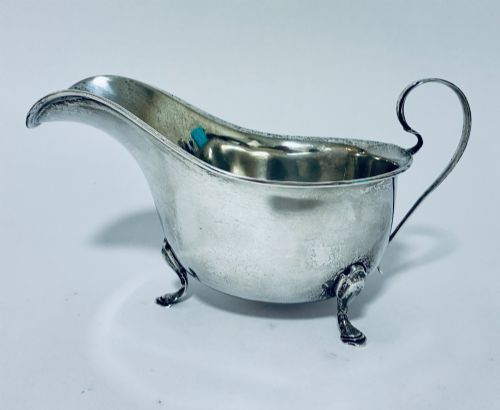
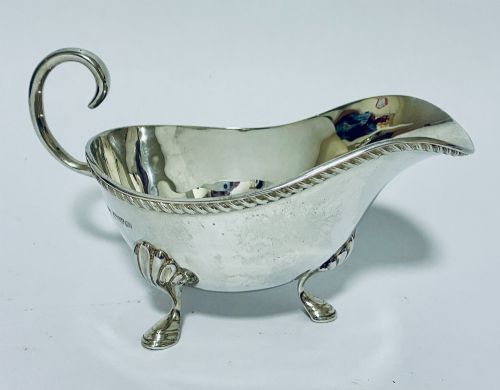
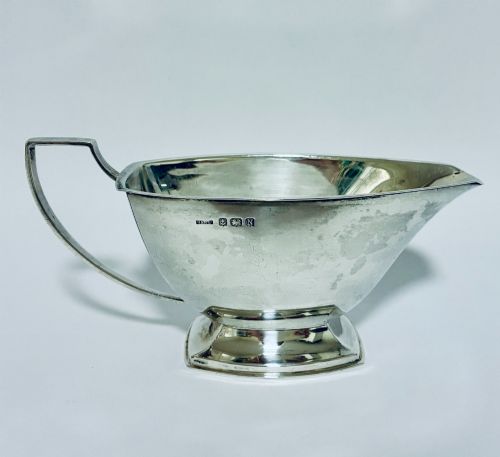
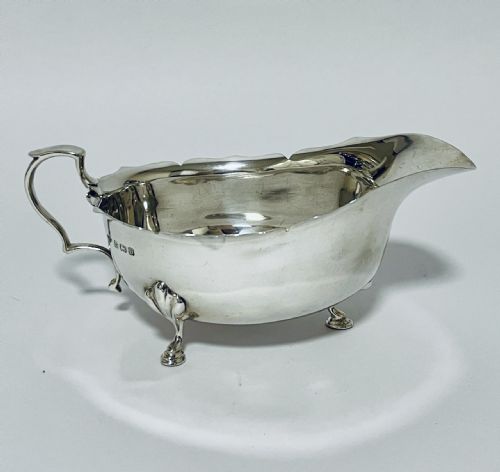
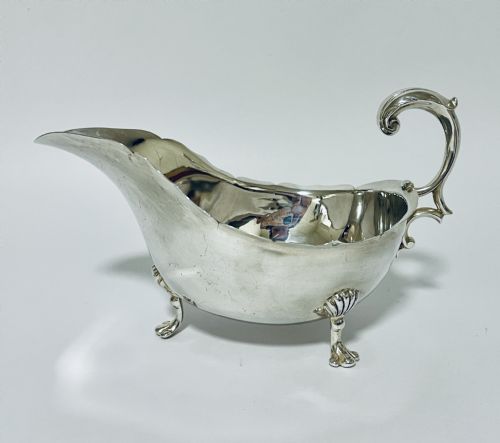
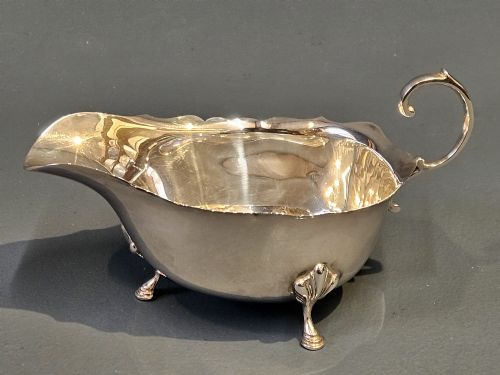

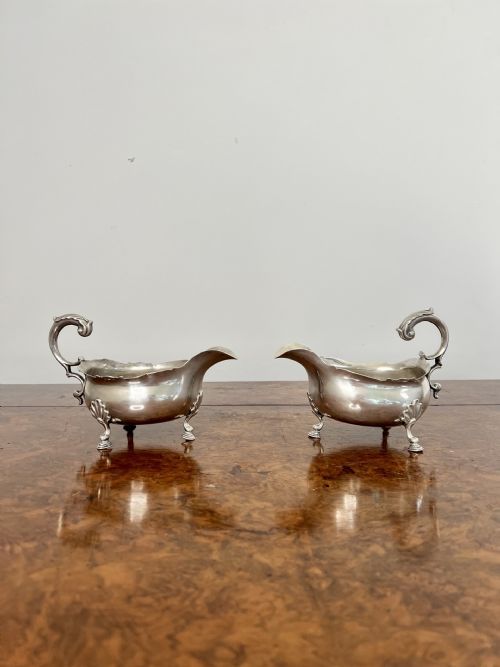


Sterling Silver Gravy Jug
These sterling silver gravy jug pieces bring dependable silver service to the table, spanning Georgian elegance through to Art Deco designs.
Sterling Silver Gravy Jug
A sterling silver gravy jug, frequently catalogued as a sauce boat or sauceboat, serves as a traditional vessel for pouring sauces and gravies at the dining table. When you search for a sterling silver gravy jug, you encounter functional serveware designed with a wide pouring lip and a sturdy handle.
The examples available on this page stretch from the eighteenth century through the Victorian era and into the mid-twentieth century. Most pieces you meet originate from periods such as the Georgian, Victorian, Edwardian, and Art Deco eras.
Forms vary from plain, classic George III vessels to naturalistic Victorian creations featuring acorn designs and heavy double-lip configurations. Matching pairs and individual items appear regularly across these English periods.
Materials and construction
Silversmiths constructed these jugs from solid sterling silver, shaping the metal through traditional hammering, casting, and soldering techniques. Makers often added cast handles and decorative rims to reinforce the structure of the vessel while providing a secure grip.
Makers applied surface finishing ranging from polished plain silver to detailed chased or embossed naturalistic ornamentation. Hallmarks struck directly into the silver record the city of assay, the date letter, and the maker's mark.
Some Victorian silversmiths observed acorns closely enough to cast tiny oak leaves and cups right onto the bellies of their pouring vessels.
Assessing quality and craftsmanship
Quality rests upon the weight of the silver, the crispness of any chased or embossed detail, and the balance of the handle and spout. Heavier gauge silver provides a substantial feel in the hand and resists denting during everyday use.
The refinement of the casting in handles and feet distinguishes standard production from superior output. Crisp, clear hallmarks and well-executed stylistic details indicate skilled workshop production.
WALKER AND HALL·Asprey
The Sterling Silver Gravy Jug Glossary
- Sauce boat
- A ceramic or metal vessel shaped like a small boat, used for serving sauces or gravies at the table. These items often feature an integrated base and a prominent spout for pouring.
- Sterling silver
- An alloy of silver containing 92.5 percent silver and 7.5 percent other metals, usually copper. This standard ensures durability while maintaining the bright lustre of pure silver.
- Hallmark
- A series of official marks stamped on items made of precious metals in the United Kingdom. These marks verify the purity of the metal, the assay office, and the year of manufacture.
- Chasing
- A metalsmithing technique where the artisan pushes metal from the front using hammers and punches to create raised surface decoration. This method enhances the texture of floral or naturalistic motifs.
- George III
- The period of British history spanning from 1760 to 1820, associated with neoclassical design and elegant, restrained silver forms.
Sterling Silver Gravy Jug: Frequently Asked Questions
What is the difference between a gravy jug and a sauce boat?
The terms are often used interchangeably by makers and dealers to describe the same pouring vessel used at the dining table. Both formats provide a deep reservoir and a lip designed to deliver sauce smoothly.
Historically, individual makers and different periods favoured one term over the other in their ledgers and catalogues. Today, searching for either term yields the same functional style of silver serveware.
How do I identify the date of a silver gravy jug?
You identify the date by examining the hallmarks stamped into the metal by the assay office. These marks include a specific letter code that corresponds to the year the piece was tested and marked.
Reference books and online registers list these date letters to help you trace the exact year of production. Additional maker's marks and standard silver purity symbols appear alongside the date letter.
Are these silver gravy jugs safe to use for food?
Sterling silver is food-safe and has been utilised for dining utensils and serveware for centuries. Regular use does not harm the metal provided appropriate cleaning methods are followed.
Wash the pieces in warm soapy water and dry them promptly with a soft cloth. Avoid harsh abrasive cleaners that can scratch the polished surface or wear down chased details.
Why do some gravy jugs have two lips?
Double-lip gravy jugs feature a pouring spout at both ends of the vessel to allow easy passing across a long dining table. This design lets diners on either side pour sauce without needing to rotate the jug.
These pieces were particularly popular during periods when formal dining required efficient service among larger groups. The balanced design maintains symmetry while doubling the practical utility of the item.