

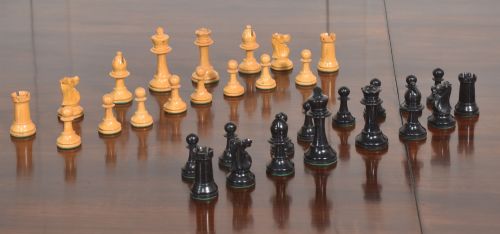


Staunton Chess Pieces
Staunton chess pieces provide the definitive silhouette for the game, offering balanced wooden forms designed for serious play and lasting use.
Staunton Chess Pieces
Staunton chess pieces represent the standard pattern established in the Victorian era, prized by players and collectors alike for their clear differentiation of rank. When exploring staunton chess pieces on this page, the buyer encounters sets dating from the nineteenth and early twentieth centuries, spanning the Victorian and Edwardian periods.
The selections include complete chess sets housed in traditional formats, alongside related folding boards and draughts. Most examples adhere to the classic Staunton design, though alternative configurations such as St George and Calvert patterns occasionally appear.
Originating primarily from English workshops of the nineteenth century, these sets demonstrate the enduring popularity of standardised proportions. Collectors frequently encounter pieces rendered in contrasting timbers, often weighted to improve stability during play.
Materials and manufacture
Makers fashioned these sets using dense hardwoods such as boxwood for the pale side and ebony or rosewood for the dark side, while more affordable alternatives utilised ebonised wood. Workshops also employed baize, felt, and occasionally brass to line the bases and weights.
Master turners shaped each piece on a lathe, cutting intricate details into knights and coronets by hand before polishing the wood to a smooth finish. Weighted sets incorporated internal lead or metal elements to achieve a heavier, more tactile feel on the board.
Staunton Chess Pieces Retail Price Guide 2026
Typical asking prices for staunton chess pieces among the pieces listed under this phrase on Sellingantiques today, from the lower quarter to the upper quarter. They describe what is for sale here now, not the wider market.
The listings span the nineteenth century and the early twentieth century, featuring boxwood, ebony, rosewood, and brass components.
Assessing quality and craftsmanship
Quality in these sets rests upon the crispness of the carving, particularly on the knight heads, which reveal the hand of a skilled artisan. Superior examples display uniform turning across every piece, with balanced proportions and consistent wood grain.
The presence of maker marks or signatures from notable nineteenth century firms elevates a set, alongside the retention of original weighted bases and matching period storage boxes.
Jaques·Whitty·British Chess Company·F. H. Ayres·Calvert
The Staunton Chess Pieces Glossary
- Staunton pattern
- The standard design of chess pieces introduced in the mid nineteenth century, characterised by architectural king and queen crowns and horse head knights. This style remains the official standard for tournament play.
- Boxwood
- A dense, pale wood traditionally used for the white side of a chess set. Its fine grain permits intricate turning without splintering.
- Ebonised wood
- Common fruitwood or boxwood treated with a dark stain to imitate ebony. This technique offered a practical alternative for the darker pieces.
- St George
- An earlier nineteenth century chess pattern preceding the universal adoption of the Staunton style. These pieces generally feature a more compact and stocky profile.
- Weighted
- A description of chess pieces fitted with internal lead weights to improve stability during play. This addition provides a satisfying heft when moving across the board.
Staunton Chess Pieces: Frequently Asked Questions
How do I date an old chess set?
Dating relies on examining the turning style of the coronets, the shape of the knight ears and manes, and the materials used for weighting and base felt. Maker signatures and registry marks also provide precise chronological markers.
Comparing the proportions against documented nineteenth and early twentieth century patterns helps confirm whether a set belongs to the Victorian or Edwardian eras.
Why are some pieces heavier than others?
Many nineteenth century sets incorporated lead weights into the bases to prevent the pieces from tipping over easily during rapid or competitive play.
Unweighted sets feel significantly lighter in the hand and were typically produced for travel or economy.
How should I store antique chess sets?
Antique wooden pieces require stable indoor humidity and protection from direct sunlight to prevent the timber from splitting or warping over decades.
Storing them in a lined wooden box or fitted mahogany case keeps the individual pieces secure and protects the polished finish from abrasion.
What is the difference between ebony and ebonised wood?
Genuine ebony is a naturally black, heavy tropical hardwood used directly for the dark pieces in high quality sets. Ebonised wood is typically boxwood or fruitwood that has been stained black to simulate the appearance of ebony.
Examining the base or any minor wear points usually reveals the lighter underlying timber on ebonised examples.