
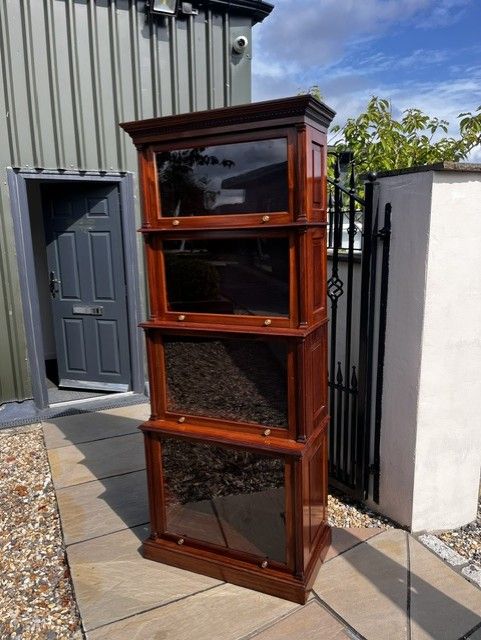

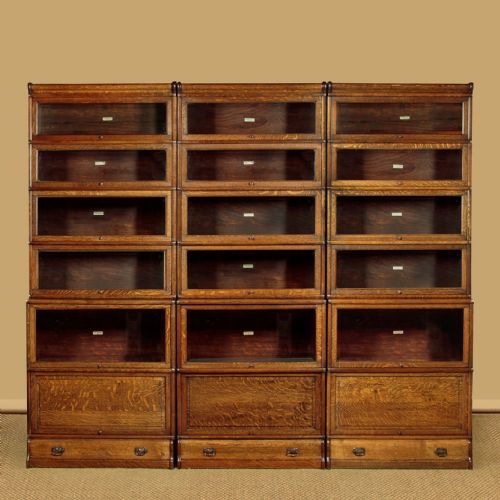


Stacked Sectional Shelves
Stacked sectional shelves organise your library with modular flexibility, offering individual glass-fronted tiers that lift and slide to protect your volumes.
Stacked Sectional Shelves
When you search for stacked sectional shelves, you encounter modular bookcases designed with independent tiers that stack vertically without permanent fixings. These practical pieces allow you to expand your shelving as your library grows, making them a sensible choice for both studies and living spaces.
The versions most commonly met on this page date from the Edwardian era through to the nineteen thirties. These include solid mahogany and oak barrister bookcases, alongside Art Deco examples, all retaining their characteristic glazed upward-lifting doors.
How they were made
These bookcases employ solid oak and mahogany timbers, often paired with glass viewing panels and brass or metal mechanism fittings. Individual sections are constructed with rebated joints so they interlock securely when piled one upon another.
Makers utilised leaded or clear glass within framed wooden doors, hung on pivoting metal arms that allow the pane to slide smoothly into the recess above the books. This clever engineering protects volumes from dust while maintaining easy access.
Listings feature oak and mahogany timbers alongside glass, brass, and metal materials across Edwardian and Art Deco periods.
What varies in quality
The distinction between standard utility furniture and superior examples lies in the selection of timber and the precision of the stacking mechanism. Finer pieces display carefully figured mahogany or quarter-sawn oak grains across matching tiers.
Hardware execution also defines the upper tier of manufacture, where heavy brass fittings and smooth-running door actions ensure each section operates independently without binding or catching.
Heal's·Globe Wernicke·Lebus
The Stacked Sectional Shelves Glossary
- Barrister bookcase
- A modular office or library cabinet featuring glazed sectional tiers designed to lift and slide inward. These were originally patented to protect legal volumes from dust and moisture.
- Sectional
- Built in separate, interchangeable vertical tiers that sit directly on top of one another. This construction allows the entire cabinet to be disassembled for transport.
- Quarter-sawn oak
- Timber cut radially from the log to produce distinctive growth ring patterns known as medullary rays. This method yields more stable boards less prone to warping.
- Cornice
- The decorative moulded projection sitting at the very top of the bookcase structure. It caps the uppermost tier to finish the architectural silhouette.
Stacked Sectional Shelves: Frequently Asked Questions
How do sectional shelves stay together?
Each tier rests upon the one beneath it using interlocking wooden lips or pin connections rather than permanent fixings.
The weight of the stacked sections combined with the internal alignment keeps the entire bookcase stable during everyday use.
Are the glass doors removable?
The glazed doors typically operate on scissor-action metal arms that guide the glass upward and into the cabinet recess.
While these mechanisms can be detached for cleaning or transport, they are designed to remain permanently installed during normal operation.
Can I add more tiers later?
Adding extra sections depends entirely on finding matching dimensions, timber species, and manufacturer specifications from the same period.
Because modular cabinets vary significantly between makers, exact matches for depth and height require careful measurement.
How do I clean antique oak?
Maintenance requires only a soft, dry cloth to remove dust from the timber surfaces and glass panels without disturbing the finish.
Harsh chemical cleaners and modern polishes should be avoided to preserve the integrity of the original polish and wax.