





Square Spirit Decanter
These square spirit decanter pieces are heavy-based vessels designed to hold whisky or brandy, prized for their stable geometric form and brilliant refractive surfaces.
Square Spirit Decanter
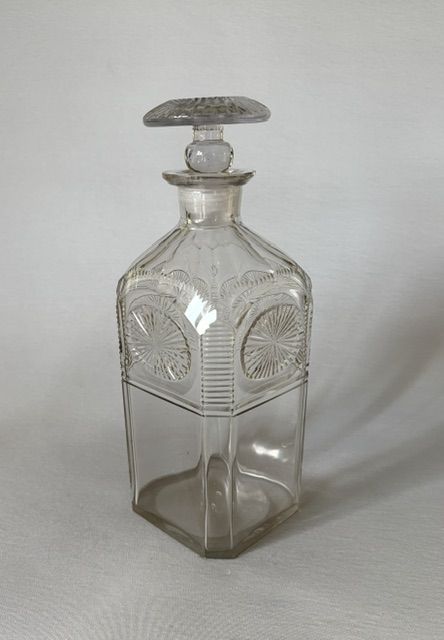
When you search for a square spirit decanter, you encounter solid vessels shaped with flat panel sides and tapered or straight profiles. These pieces originate from the Victorian, Edwardian, and mid-century periods, capturing the changing domestic tastes of their respective eras.
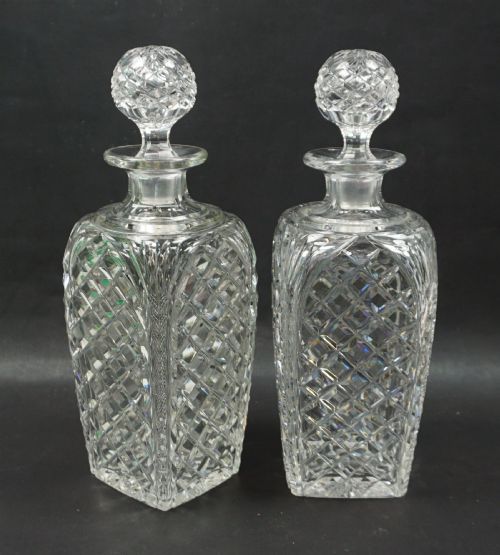
The versions most commonly met on this page are English and Scottish decanters, often found singly or in pairs. They serve as functional barware designed to sit securely on sideboards or within fitted tantalus frames without tipping.
Makers and manufacturers ranging from local potteries or workshops to established silversmiths like Freeman & Son Ltd and Mappin & Webb contributed to these forms. Their utility spans from holding scotch and whiskey to Napoleon brandy.
How they were made
These items rely on glass, cut crystal, and lead crystal bodies shaped to form flat-sided square sections. Artisans applied wheel-cutting techniques to create facets that catch ambient light across the body.
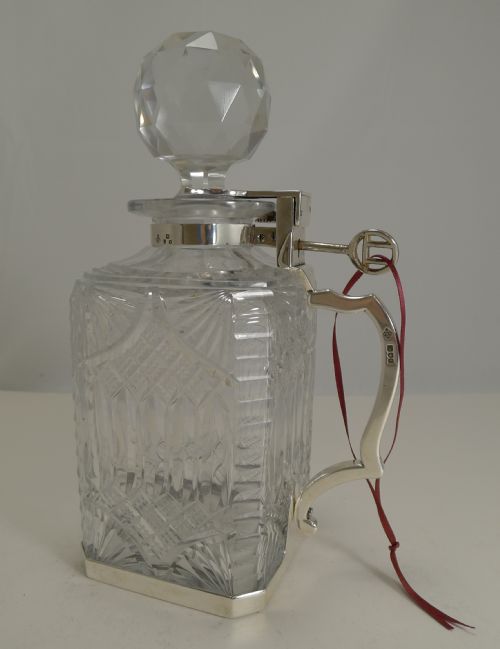
Mounts and collars formed from sterling silver, silver gilt, and standard silver provide secure necks and hinged stoppers. Hallmarks stamped into the metal components indicate the assay office, standard, and date of manufacture.
Square Spirit Decanter Retail Price Guide 2026
Typical asking prices for square spirit decanter among the pieces listed under this phrase on Sellingantiques today, from the lower quarter to the upper quarter. They describe what is for sale here now, not the wider market.
Listings on this page span the Victorian, Edwardian, and mid-21st century periods, utilising cut glass, crystal, and sterling silver.
What varies in quality
Quality rests upon the crispness of the glass cutting and the weight of the crystal body. Sharp, deep facets demonstrate greater skill than soft, rounded surface patterning.
The presence and execution of silver gilt or sterling silver mounts elevate a piece. Hallmarked collars and locking mechanisms indicate higher production standards and workshop pedigree.
Freeman & Son Ltd·Mappin & Webb
The Square Spirit Decanter Glossary
- Silver gilt
- Silver that has been coated with a thin layer of gold on its surface. This finish provides the visual warmth of gold alongside the structural integrity of silver.
- Hallmark
- An official stamp or series of marks applied to precious metals. These marks indicate the purity of the silver, the maker, and the year of assay.
- Cut crystal
- Glass containing metal oxides that is shaped by grinding and polishing wheel cuts. The high refractive index creates intense brilliance.
- Tapered decanter
- A vessel whose body narrows gradually from the shoulder toward the base or from base to neck. This profile adds stability and visual balance to square forms.
- Locking decanter
- A spirit container fitted with a specialised metal collar and key mechanism. This design prevented unauthorized access to the contents in domestic settings.
Square Spirit Decanter: Frequently Asked Questions
What is a square spirit decanter?
A square spirit decanter is a heavy glass or crystal vessel with a flat-bottomed, four-sided body designed to hold liquor such as whisky or brandy.
These pieces utilise geometric profiles to remain stable on sideboards and tables during use.
How do you date a decanter?
Dating relies on the style of the glass cutting, the shape of the neck, and any accompanying metal hardware.
Silver collars often bear hallmarks that allow for precise identification of the assay year and maker.
Were these sold in pairs?
Many examples survive as matched pairs or sets of multiple bottles intended for different spirits.
Single decanters also appear frequently, often featuring specialised silver mounts or locking mechanisms.
What spirits do they hold?
These vessels were historically manufactured to contain scotch, whiskey, and brandy for formal entertaining.
The tight-fitting stoppers helped preserve the contents and prevent evaporation over time.