


Spindle Back Open Armchair
These spindle back open armchair examples range from Georgian country classics to Edwardian salon seating, offering timeless comfort and honest British craftsmanship.
Spindle Back Open Armchair
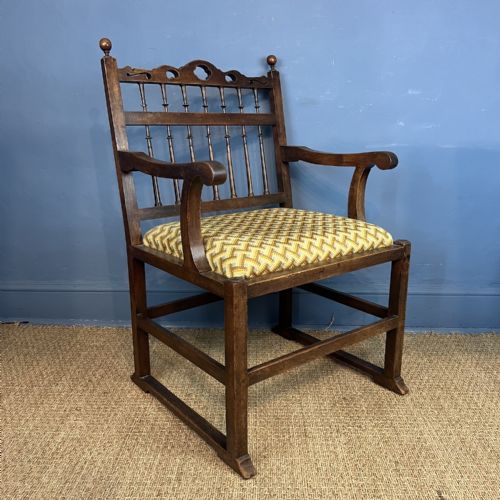
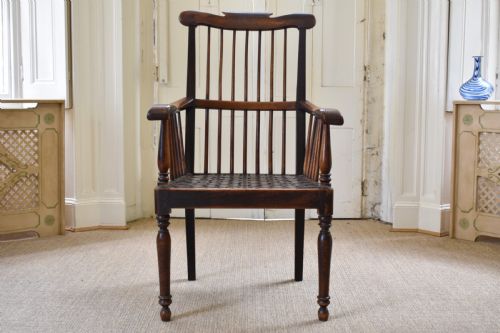
When you search for a spindle back open armchair, you are looking for timber framed seating defined by vertical turned spindles supporting the backrest and an open arm construction. These chairs bridge the gap between sturdy rustic seating and refined period parlour furniture.
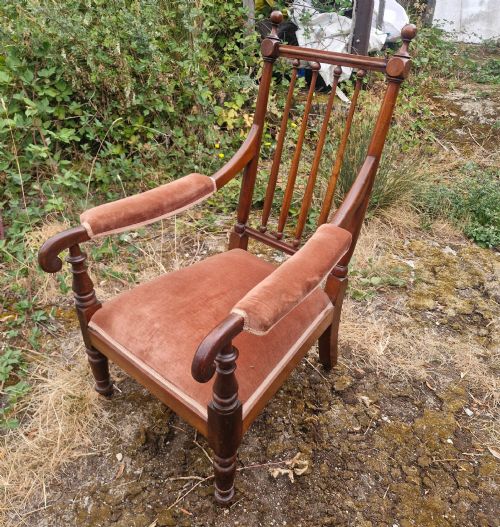
The versions you are most likely to meet on this page span the Georgian, Victorian, and Edwardian eras, executed in woods such as elm, mahogany, beech, and oak. They appear in forms ranging from English country Windsor variants to simulated rosewood stickback designs and attributed Arts and Crafts pieces.
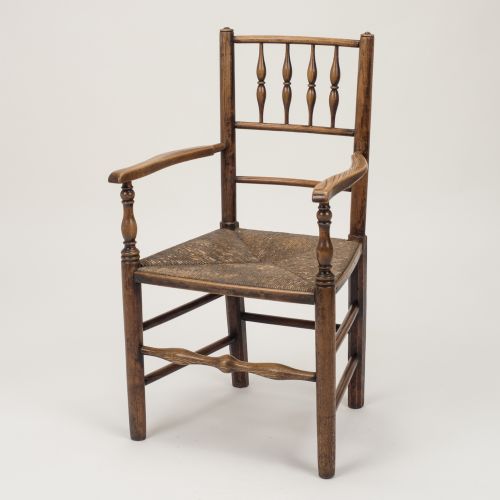
Country examples often feature rush seats and robust timber combinations like laburnum and ash, whilst formal iterations utilise mahogany or beech with upholstered or fabric pads. Each piece carries the distinct structural vernacular of its period of origin, from early nineteenth century country workshops to late Victorian domestic interiors.
Materials and construction methods
Maker construction relies on traditional timber selection, pairing durable native woods such as elm, ash, and beech for country chairs with finer imported mahogany for formal urban pieces. Spindles are typically turned on a lathe and fitted into steam bent or mortised frames.
Surface finishes include simulated rosewood painting alongside polished mahogany and natural waxed grain on country timbers. Seats frequently incorporate woven rush, solid shaped wood, or later button back upholstery fabrics.
Listings feature timbers including mahogany, elm, beech, and oak, alongside upholstery materials like velvet and textile.
Evaluating quality and execution
Quality in these chairs lies in the crispness of the spindle turning, the tight integration of the joints, and the selection of timber figure. Finer pieces demonstrate careful grain matching and well proportioned arm bow construction.
Simpler country versions show their merit in the honesty of their vernacular framing and the patina accumulated across centuries of domestic use, whereas formal salon chairs depend upon refined carving and balanced proportions.
Liberty of London
The Spindle Back Open Armchair Glossary
- Spindle back
- A chair back constructed from a series of slender, turned vertical wooden rods. These provide lightweight structural support while maintaining visual transparency.
- Rush seat
- A seating surface woven from dried marsh grasses. This traditional technique provides a resilient and pliable base for country chairs.
- Stick back
- A minimalist form where back members are inserted directly through the seat rather than into a framed backrest. It is characteristic of utilitarian and Windsor seating.
- Country chair
- Furniture produced by regional makers using local timber for domestic utility rather than urban fashion. They often combine woods like elm, ash, and beech.
- Open armchair
- A seating design featuring armrests that are left unpadded or open beneath, distinguishing them from fully upholstered enclosed armchairs.
Spindle Back Open Armchair: Frequently Asked Questions
What is a spindle back open armchair?
It is a wooden chair featuring vertical turned spindles forming the backrest and open arms at the sides. These pieces range from sturdy country seating to formal Edwardian parlour chairs.
They combine structural support with light visual weight, making them versatile additions to both traditional and contemporary interiors.
How do I date a spindle back armchair?
Dating relies on identifying the timber species, the turning style of the spindles, and construction techniques like joinery and seat weaving. Georgian and Regency pieces show different turning profiles compared to later Victorian and Edwardian examples.
Examining the wear patterns and tool marks also helps establish the era of manufacture.
Were these chairs used for dining?
Country and salon armchairs served various domestic functions, including as desk chairs, hall chairs, or occasional seating in parlours and bedrooms. Their open arms allowed generous room for voluminous historical garments.
While some sturdy country versions sat around communal tables, many functioned primarily as single accent chairs.
How do I care for a rush seat?
Rush seating requires stable indoor humidity and gentle cleaning with a dry brush to remove dust. Direct sunlight and excessive moisture should be avoided to prevent the natural fibres from becoming brittle.
Applying occasional light conditioning helps preserve the flexibility of the woven material.