

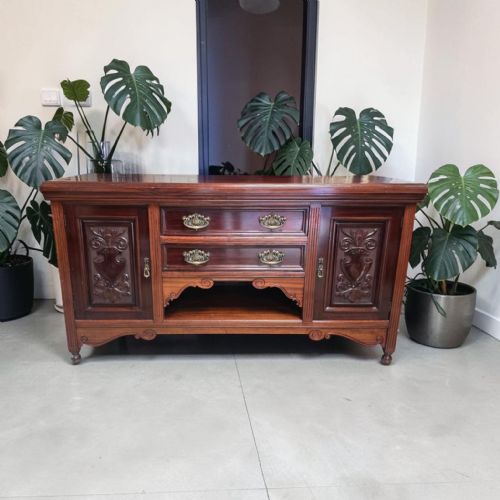


Solid Mahogany Dining Table
A solid mahogany dining table brings dense grain and deep colour to a room, offering a sturdy surface built for daily meals and long-term use.
Solid Mahogany Dining Table
A solid mahogany dining table encompasses formal dining tables alongside related forms like Pembroke tables, refectory pieces, and breakfast tables spanning the Georgian, Victorian, and 1920s periods.
The most likely version to meet on this page is a Victorian or Georgian drop leaf, extending, or refectory dining table constructed entirely from mahogany, sometimes accompanied by brass fittings.
These pieces originate across the nineteenth and early twentieth centuries, reflecting styles such as Regency, George IV, Gothic Revival, and Art Nouveau alongside standard Victorian and Georgian cabinet-making.
Materials and construction methods
Makers built these tables primarily from solid mahogany timber, often pairing the dense dark wood with brass components for castors, hinges, or extending mechanisms.
Some multi-material or transitional examples incorporate walnut alongside the primary mahogany structure, particularly in later Art Nouveau interpretations.
Solid Mahogany Dining Table Retail Price Guide 2026
Typical asking prices for solid mahogany dining table among the pieces listed under this phrase on Sellingantiques today, from the lower quarter to the upper quarter. They describe what is for sale here now, not the wider market.
The listings on this site span the Georgian, Victorian, and Edwardian eras, featuring mahogany alongside brass and walnut.
Markers of finer craftsmanship
Quality rests in the selection of timber grain, the solidity of the mahogany construction, and the proportion of the frame across different periods like Regency or Early Victorian.
Tables featuring complex extending mechanisms or integrated drop-leaf supports demonstrate higher levels of mechanical ingenuity from their period workshops.
M. D. Miller & Sons
The Solid Mahogany Dining Table Glossary
- Mahogany
- A dense tropical hardwood prized for its deep reddish-brown colour and fine grain. It forms the primary structural material for these tables.
- Drop leaf
- A table design featuring hinged flaps on the sides that fold down to save space or lift up to create a larger surface.
- Refectory table
- A long, narrow dining table traditionally built for communal dining halls. These examples use sturdy wooden frames suited for large gatherings.
- Pembroke table
- A small rectangular table with two hinged drop leaves on opposing sides. It often serves domestic utility in smaller rooms.
- Regency
- A stylistic period spanning the early nineteenth century. Furniture from this era draws heavily upon classical Greco-Roman motifs.
Solid Mahogany Dining Table: Frequently Asked Questions
How do I maintain a mahogany surface?
Keep the wood away from direct heat sources and strong sunlight to prevent the deep reddish-brown grain from fading or drying out over time.
Apply natural beeswax periodically to nourish the mahogany and maintain a soft sheen without building up synthetic residues.
Can I use an extending table daily?
Extending mechanisms on these tables are built for regular adjustment, allowing you to seat larger groups when necessary and reduce the footprint for everyday family meals.
Take care when pulling apart the leaves to ensure the internal wooden runners slide evenly without straining the joints.
How do I identify a Georgian table?
Georgian tables typically display restrained classical proportions, solid mahogany construction, and understated woodwork that prioritises structural balance over heavy ornamentation.
Look for structural clues beneath the tabletop, such as hand-cut joinery and period-appropriate timber thickness that predate mass-produced manufacturing.
What fits in a smaller dining room?
Drop-leaf Pembroke tables or smaller centre tables provide flexible surfaces that can tuck against a wall when not in use for meals.
Measure your floor space carefully to ensure chairs can pull out comfortably even when drop leaves are folded down.