
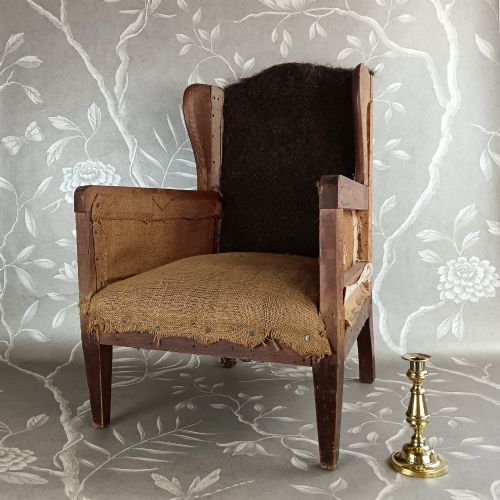
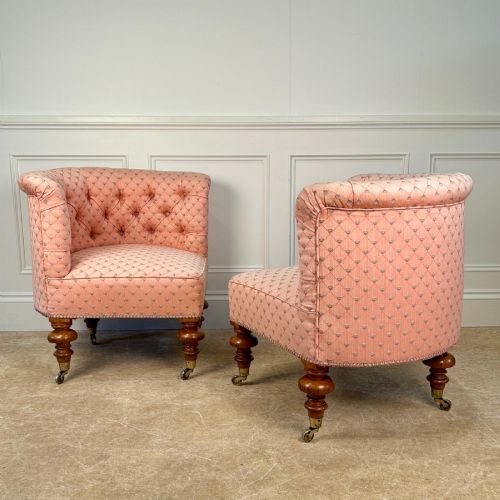


Small Upholstered Armchair
These small upholstered armchairs offer compact comfort across periods from Regency to the early twentieth century.
Small Upholstered Armchair
A small upholstered armchair provides compact seating across multiple historic styles, including Victorian, Edwardian, and Regency designs. Buyers seeking a small upholstered armchair often encounter low bedroom chairs, nursing chairs, and library chairs built for smaller sitting spaces. The selection ranges from nineteenth-century mahogany frames to early twentieth-century child wingbacks and salon seats.
Makers such as Whytock & Reid and Howard and Sons occasionally appear among these compact seats, alongside stamped pieces. Frames emerge in oak, mahogany, walnut, and beech, frequently paired with fabric or textile upholstery. Alongside single armchairs, the record includes pairs, corner chairs, and small settees sharing identical stylistic traits.
What varies in quality
The refinement of the timber frame determines much of the distinction, separating simple vernacular pieces from pieces bearing crisp carving, fine inlay, or maker stamps. Proportions remain balanced on finer examples, whether executed in the Louis XV style, Queen Anne Revival, or Regency manner.
The integrity of the upholstery work and the selection of textile materials influence the overall character. Maker attributions, such as Whytock & Reid or Howard and Sons, elevate specific examples above standard workshop production.
One clever little folding campaign chair managed to travel across the nineteenth century straight into a modern sitting room.
Whytock & Reid·Howard and Sons·CVS
The Small Upholstered Armchair Glossary
- Wingback
- An armchair featuring protective side panels designed to shield the sitter from draughts. These panels extend upward from the arms to the backrest.
- Campaign chair
- A portable folding seat originally constructed for travel and military use during the nineteenth century. These items utilise collapsible timber frames and brass hinges.
- Ebonised
- Timber treated with a dark finish to imitate expensive ebony wood. This technique appears frequently on nineteenth-century beech and mahogany frames.
- Buttoned
- An upholstery technique where indentations are formed in the padding by pulling thread or cord tight and securing it with buttons. This creates a diamond pattern across the backrest.
- Library chair
- A low, supportive seat intended for reading rooms and domestic studies. These chairs prioritise comfort and compact dimensions for prolonged sitting.
Small Upholstered Armchair: Frequently Asked Questions
What periods do these armchairs cover?
The pieces span from the Regency era through the Victorian and Edwardian periods up to the early twentieth century. Styles range from classical revival designs to country house seating.
Different decades brought distinct decorative preferences, such as French painted finishes or inlaid mahogany woodwork.
Where were these chairs used?
These compact seats suited bedrooms, libraries, nurseries, and smaller parlour spaces where standard furniture proved too large. Nursing chairs and fireside models offered low seating for specific domestic tasks.
Child versions accommodated younger family members in domestic interiors.
How do I identify a maker?
Certain pieces carry stamps, signatures, or paper labels from workshops and retail firms. Quality of timber selection and specific joinery methods also point toward established makers.
Recorded makers include Howard and Sons and Whytock & Reid.
What woods were used for frames?
Cabinetmakers utilised hardwoods like mahogany, oak, walnut, and beech for structural durability. Softer timber and painted surfaces also appear across various regional workshops.
Inlay work and ebonised treatments added decorative contrast to the primary wood.