



Small Mahogany Bookstand
These small mahogany bookstand pieces are compact, timber-built storage units designed for desk or floor use, offering swift access to daily reading.

Small Mahogany Bookstand
When you search for a small mahogany bookstand, you are looking at practical desk or floor-standing furniture created to hold moderate volumes within easy reach. The pieces on this page span the Victorian and Edwardian eras, with a strong showing of Edwardian examples alongside late Victorian predecessors.
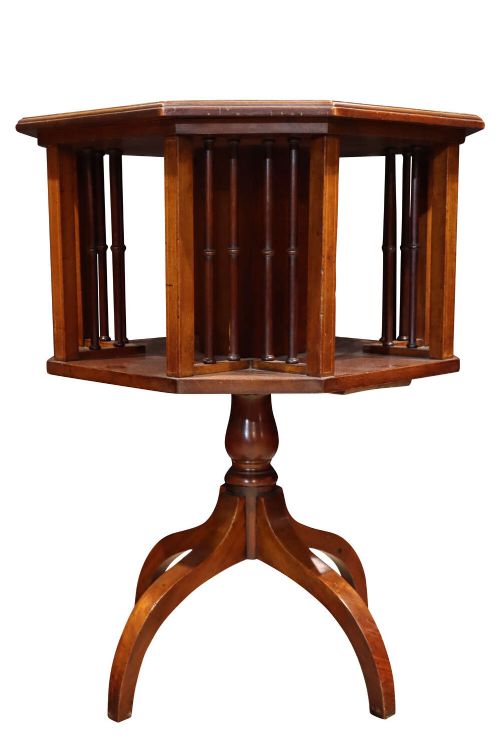
Revolving formats dominate the selection, often taking the form of square tier structures that turn smoothly on a central spindle or base. Alongside floor models, you will encounter table top variants designed to sit upon a surface without consuming floor space.
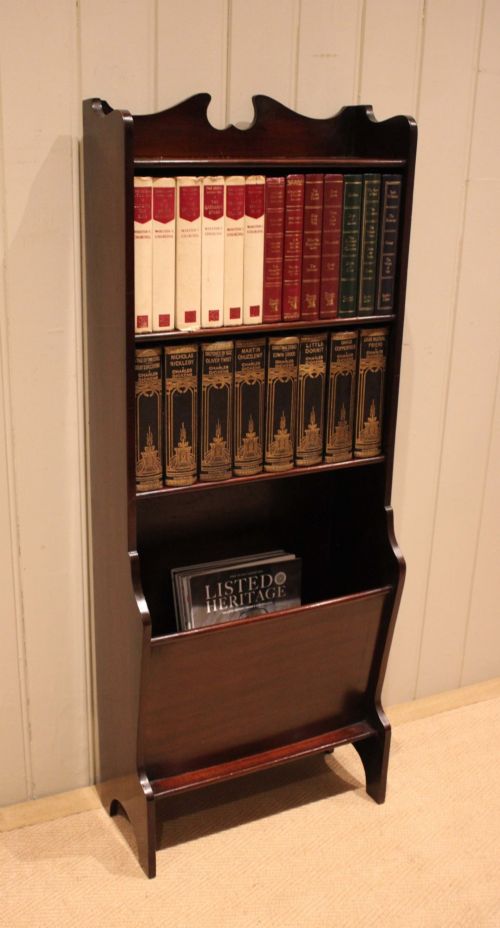
Forms range from simple functional book stands and bookcases to elaborate revolving designs fitted with magazine racks or delicate line inlay. Makers of the period drew upon traditional cabinet-making skills to produce these sturdy yet compact items for domestic studies and libraries.
How they were made
Makers built these pieces primarily from solid mahogany and mahogany veneers, selected for deep grain and rich colour. Workshops enhanced the timber using contrasting boxwood and satinwood inlay to create geometric borders or delicate Sheraton-style motifs.
Internal mechanisms frequently incorporated iron or brass components to ensure smooth rotation on revolving bookstands. Joinery relied on traditional cabinet techniques, uniting shelves and slatted or panelled dividers securely to the main carcase.
Small Mahogany Bookstand Retail Price Guide 2026
Typical asking prices for small mahogany bookstand among the pieces listed under this phrase on Sellingantiques today, from the lower quarter to the upper quarter. They describe what is for sale here now, not the wider market.
What varies in quality
The degree of hand-cut inlay and the crispness of the timber grain separate standard utility pieces from finer examples. Superior models display precise contrasting boxwood and satinwood strings rather than plain surfaces.
Smoothness of rotation and stability of the underlying spindle mechanism determine the functional merit of a revolving bookcase. Solid timber thickness and the preservation of original polished surfaces also dictate the standing of an individual piece.
The Small Mahogany Bookstand Glossary
- Revolving bookcase
- A freestanding or table top tier structure fitted with a hidden internal mechanism that allows the entire unit to spin on a base. This design lets a reader access multiple shelves of books from a single seated position.
- Inlay
- A decorative technique where thin pieces of contrasting wood, such as satinwood or boxwood, are set flush into the mahogany surface to form patterns. It was particularly favoured during the Edwardian Sheraton Revival period.
- Edwardian
- A stylistic period spanning the reign of King Edward VII, characterised by lighter furniture forms and a revival of eighteenth-century neoclassical motifs. Pieces from this era often incorporate delicate stringing and bright mahogany tones.
- Late Victorian
- The final decades of the nineteenth century, producing sturdier and more sombre cabinet work than the succeeding Edwardian years. Objects from this time show solid construction and darker timber finishes.
- Magazine rack
- An integrated side compartment or slatted section designed to hold periodicals upright alongside standard book storage. This feature appears on specific multi-use variants.
Small Mahogany Bookstand: Frequently Asked Questions
What is a small mahogany bookstand?
A small mahogany bookstand is a compact piece of nineteenth or early twentieth-century furniture designed to hold a curated selection of volumes. They include static desk stands and revolving floor models.
These items were manufactured to save space while keeping reference books or current reading close at hand in studies, libraries, and drawing rooms.
How do I tell Victorian from Edwardian pieces?
Victorian examples tend to exhibit heavier timber proportions, deeper finishes, and simpler functional lines without extensive decoration. They reflect the more robust taste of the later nineteenth century.
Edwardian pieces generally showcase lighter mahogany tones, delicate boxwood and satinwood inlay work, and refined Sheraton Revival influences reflecting a shift toward graceful domestic interiors.
How does a revolving bookcase work?
A revolving bookcase rests upon a concealed central pivot or ball-bearing mechanism enclosed within a sturdy cross-base. This allows the stacked tiers of books to turn freely in either direction with minimal effort.
The engineering ensures that a heavy load of volumes remains balanced and accessible from any angle in the room.
Where should I place a table top model?
Table top variants sit comfortably upon large office desks, side tables, or sturdy chests of drawers where books are frequently consulted. Their compact footprint requires minimal surface area.
Ensure the supporting furniture is level and stable to allow smooth rotation if the bookstand itself is designed to turn.