


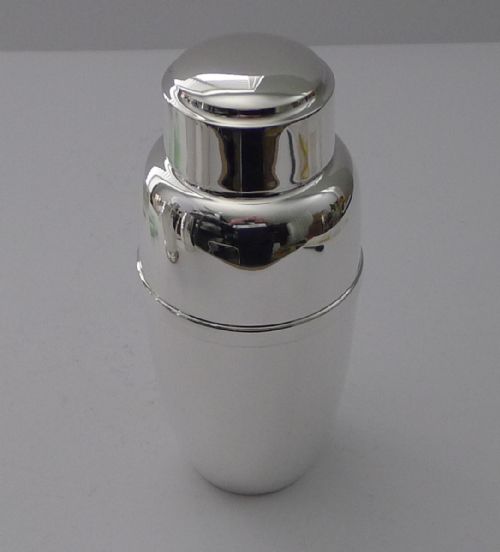


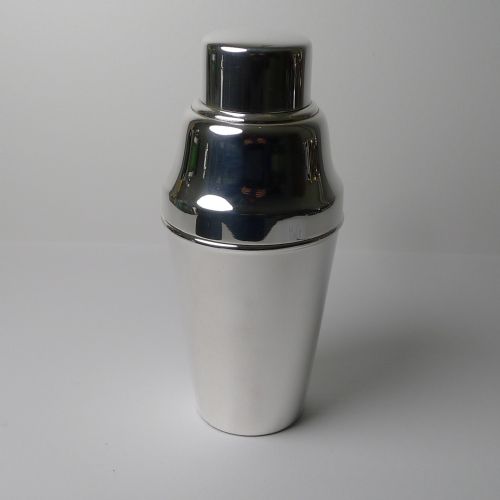

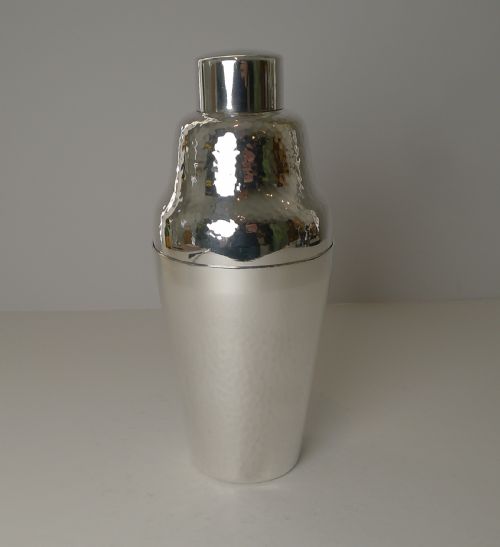

Silver Plated Cobbler Shaker
These silver plated cobbler shakers bring genuine Art Deco style and practical barware history straight to your cocktail trolley.
Silver Plated Cobbler Shaker
A silver plated cobbler shaker combines a main body, a strainer lid and a cap into a single three-piece barware vessel. When you search for this phrase, you find notable examples primarily shaped during the Art Deco and Mid-Century Modern periods.
The most common pieces on this page originate from English, French, German and Swiss makers working through the 1920s, 1930s, 1940s and 1960s. These range from standard one-pint capacity vessels up to large two-and-a-quarter pint shaker formats.
Many designs incorporate functional additions such as an integral lemon squeezer nestled inside the top components. Others rely purely on sleek silhouettes and balanced proportions to deliver classic cocktail preparation.
How they were made
Makers formed these vessels using base metal, electroplated nickel silver, or standard silver plate over a sturdy metal core. This application of a silver layer provided the bright finish characteristic of quality barware without the solid silver cost.
Surface decoration frequently involved mechanical engine-turned patterns etched directly into the metal body. Workshops also utilised smooth cylindrical or tapered profiles that defined the modernist aesthetic of the era.
Listings span several decades, led by the 1930s alongside examples from the 1920s, 1940s and 1960s.
What varies in quality
The distinction between standard production items and premier pieces rests upon the weight of the metal and the precision of the fit between components. Heavier gauge metal gives the shaker a solid, reassuring balance in the hand.
J. B. Chatterley & Sons·Hukin & Heath·C S Green & Co.·Adie Brothers·William Suckling Ltd.·Mappin & Webb·Carl Deffner·Lutz & Weiss
The Silver Plated Cobbler Shaker Glossary
- Cobbler shaker
- A three-piece cocktail shaker consisting of a base, a lid with a built-in strainer, and a cap. This configuration allows for easy pouring without requiring a separate bar strainer.
- EPNS
- Electroplated Nickel Silver. This denotes a base metal core of nickel alloy coated with a layer of pure silver.
- Engine turned
- A decorative technique involving precise geometric patterns mechanically engraved into the metal surface. It creates a textured appearance that catches the light during use.
- Integral lemon squeezer
- A built-in citrus reamer fitted beneath the lid components. It allows users to juice fruit directly into the shaker body before mixing.
Silver Plated Cobbler Shaker: Frequently Asked Questions
What is a cobbler shaker?
A cobbler shaker is a three-piece cocktail mixing vessel comprising a main container, a straining lid, and a small sealing cap.
This design became particularly popular during the Art Deco period, offering a self-contained unit for preparing mixed drinks.
How do I clean my silver plated shaker?
Wash the interior and exterior gently with warm soapy water and a soft cloth, drying thoroughly straight afterwards.
Avoid abrasive scourers or harsh chemical dips that might strip away the outer silver plate over time.
Are these shakers suitable for daily cocktail making?
Most surviving examples were built for genuine bar use and remain entirely functional for mixing drinks today.
Checking that the metal components still fit tightly together ensures no liquids leak past the rims during vigorous shaking.
How can I tell the period of a shaker?
Dating relies on stylistic markers such as geometric engine-turned engraving, maker marks stamped to the base, and specific modernist silhouettes.
The majority of pieces originating from European workshops span the decades between the 1920s and the 1960s.