


Silver Oil Vinegar Cruet
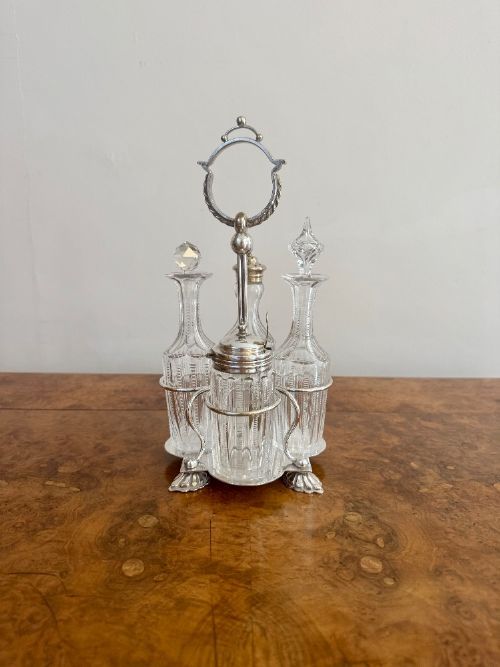
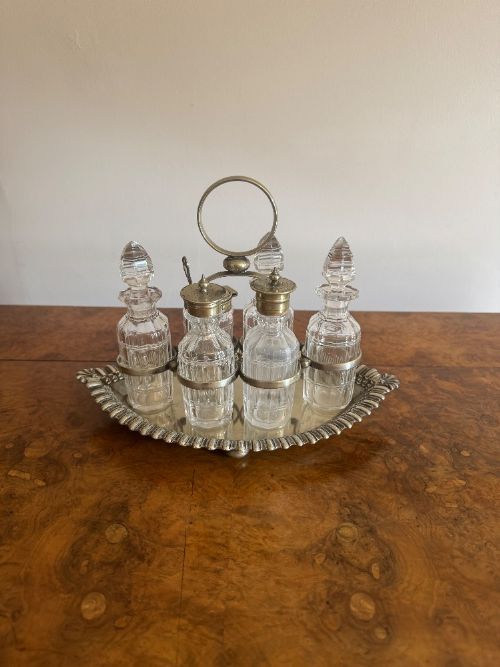
A silver oil vinegar cruet holds the dressings for the table, combining cut glass bottles with stands of sterling silver, silver plate, and ebonised wood.
Silver Oil Vinegar Cruet
A silver oil vinegar cruet brings together condiment stands, bottle frames, and paired dressing flasks spanning the Georgian, Victorian, Edwardian, and Art Deco periods. These pieces appear as multi-bottle frames holding cruet bottles, casters, and mustard pots alongside dedicated oil and vinegar pairs.
Edwardian silver plated sets and Victorian silver mounted stands dominate the forms on this page, reflecting dining customs from the nineteenth and early twentieth centuries. Georgian sterling silver examples and earlier George II formats also occur, offering architectural frames fitted with cut glass bottles.
The objects serve the dining table by keeping condiments orderly, utilising stands with handles and feet designed for passing between guests. Cruet sets and standalone oil and vinegar bottles survive from dates ranging across the eighteenth, nineteenth, and twentieth centuries.
Distinctions in Manufacture and Survival
Quality rests in the weight of the silver or the thickness of the plating, the clarity of the cut glass bottles, and the completeness of the set. Original matching bottles matching the stand elevate a piece above those assembled later from mixed parts.
The crispness of cast decorative details on the stand and the legibility of hallmarks provide a measure of the maker's hand. Survival of original stoppers and undamaged glass bottle rims separates well-preserved examples from those with replacement components.
Materials across the inventory include sterling silver, silver plate, cut glass, and ebonised wood.
Charles Thomas Fox·Elkington & Co·Hester Bateman·Mappin Brothers·Wade Wingfield Wilkins·Walker & Hall·William Hutton & Sons
The Silver Oil Vinegar Cruet Glossary
- Cruet stand
- A frame or tray, usually fitted with a handle, designed to hold multiple condiment bottles and casters for the dining table.
- Caster
- A small jar with a perforated top used for shaking sugar or dry spices over food.
- Hallmark
- An official stamp applied to precious metals indicating the standard of purity, the assay office, and the year of manufacture.
- Silver plate
- A layer of silver fused to a base metal core, commonly utilised in nineteenth-century manufacturing for domestic tablewares.
- Ebonised wood
- Timber treated to resemble ebony, providing a dark contrasting base for silver mounts in Georgian and Victorian designs.
Silver Oil Vinegar Cruet: Frequently Asked Questions
What is a silver oil vinegar cruet used for?
These sets hold oil and vinegar for dressing food at the dining table, often alongside mustard pots and pepper casters.
Guests used the matched bottles to dispense condiments directly onto their plates during formal meals.
How do I date a silver cruet set?
Dating relies on maker marks, assay office stamps, and stylistic details such as Edwardian plating or Georgian silver forms.
Matching the registry numbers and hallmarks against historical records confirms the exact decade of manufacture.
Are the glass bottles usually original?
Many sets retain their original cut glass bottles, though breakage over time meant replacements were common.
Examining the fit inside the silver frame and the matching wear patterns helps determine if the bottles belong to the stand.
How do I clean antique silver cruet stands?
Gentle cleaning with a soft cloth and specialist silver polish preserves the surface without removing the thin plating or hallmarks.
Glass components lift out easily for washing in warm soapy water away from the metal mounts.