


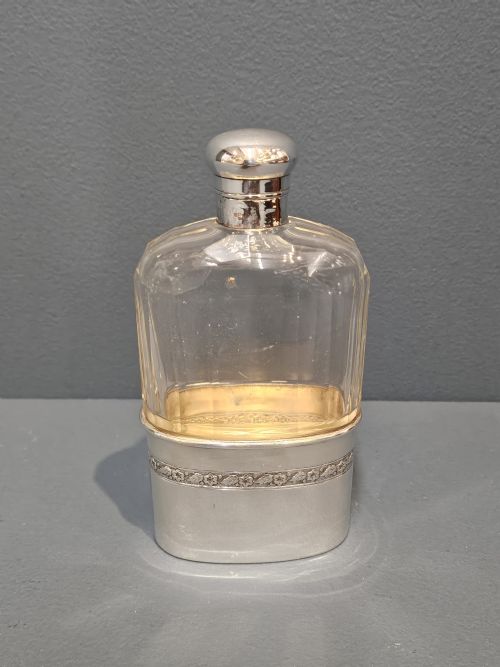


Silver Glass Pocket Flask
A silver glass pocket flask is a pocket companion for spirits, combining glass and precious metal mountings for travel and field sports.
Silver Glass Pocket Flask
When searching for a silver glass pocket flask, collectors encounter portable spirit containers designed for pocket transport during the Victorian, Edwardian, and Art Deco periods. These items typically combine glass bodies with sterling silver or silver plate mounts, often incorporating removable cups at the base.
The selections span from the 1870s through the 1930s, encompassing styles from Late Victorian to George V and early twentieth-century designs. Most examples serve as hip flasks or spirit flasks, while occasional scent bottles also appear within the material record.
Originating primarily from workshops in London, Birmingham, Sheffield, Chester, and Glasgow, these pieces reflect the social habits of hunters, travellers, and gentlemen of the late nineteenth and early twentieth centuries. The standard configuration pairs a glass vessel with a tight-fitting silver screw cap and a lower cup.
Materials and construction
Makers utilised clear glass, cut glass, cut crystal, and occasionally blue opaline glass to form the main body of the vessel. These glass components were mouth-blown and wheel-cut or moulded to fit snugly inside metal mounts.
Sterling silver and silver plate form the caps, collars, and removable cups, frequently ornamented with hammered finishes, floral patterns, or gilding. Some flasks feature partial coverings of leather or crocodile leather bound around the central glass section.
Evaluating craftsmanship and detail
Quality rests in the precision of the metal mounts, the clarity and depth of the cut glass, and the integration of auxiliary elements like removable cups and hinged lids. Heavier gauge silver and thick-walled crystal indicate superior production.
Makers such as Asprey or James Dixon demonstrate greater attention to detail through crisp hallmarks, secure closures, and refined leather or crocodile skin coverings that fit the contours of the glass body without slackness.
Asprey London·James Dixon & Sons·W A Ellwick Ltd
The Silver Glass Pocket Flask Glossary
- Removable cup
- A metal cup fitting over the lower portion of the flask body, held by friction or a bayonet mount. It detaches for drinking spirits in the field.
- Hallmark
- A series of stamped official marks on precious metal indicating the assay office, standard of silver, and date letter. These marks verify the origin and age of the piece.
- Silver gilt
- Sterling silver that has been coated with a thin layer of gold on the interior or exterior surface. This treatment protects the silver from tarnishing through contact with alcohol.
- Cut glass
- Glass decorated by grinding facets or patterns into the surface using a rotating wheel. It provides weight, grip, and sparkle to the body of the flask.
- Mary Gregory glass
- Glassware decorated with white enamel silhouettes depicting children in pastoral settings. This technique occasionally appears on liquor flasks from the early twentieth century.
Silver Glass Pocket Flask: Frequently Asked Questions
What is a silver glass pocket flask used for?
These flasks were designed to carry spirits, whisky, or liquor securely in a pocket during outdoor pursuits, hunting, and travel.
The captive or screw-top lids prevent leakage while the glass and metal construction withstands regular handling.
How do I tell Victorian flasks from Edwardian ones?
Victorian examples date from 1837 to 1901 and often feature heavier mounts, ornate hand-engraving, and substantial cut glass bodies.
Edwardian pieces, spanning 1901 to 1910, frequently incorporate cleaner lines, hammered surfaces, or leather bindings influenced by changing tastes.
Why do some flasks have cups on the bottom?
The lower section houses a detachable metal cup held in place by a snug friction fit or a short twist. Users remove this cup to pour and consume their drink while away from home.
Many surviving pieces retain this original matching component.
How should I clean a vintage spirit flask?
The glass interior can be rinsed with warm water and mild bottle-cleaning brushes to remove old residue. Metal mounts require gentle polishing with a non-abrasive cloth to preserve the silver and hallmarks.