
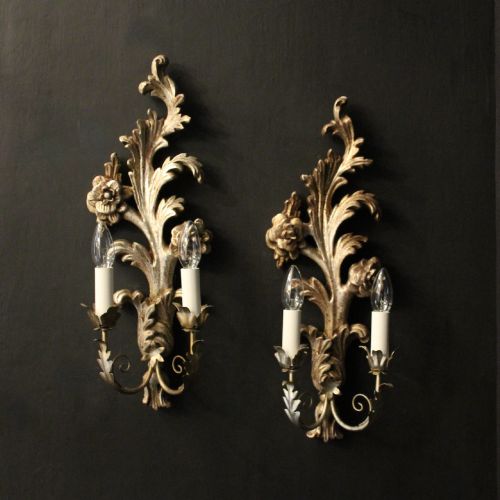


Silver Gilt Sconces
Silver gilt sconces bring warm reflection to panelled walls through centuries of Florentine and French craftsmanship.
Silver Gilt Sconces
Silver gilt sconces are decorative wall lights designed to hold candles or illuminate rooms by reflecting candlelight off metallic and gilded surfaces. When you search for silver gilt sconces, you encounter wall lights spanning from the seventeenth century through the early decades of the twentieth century. These pieces primarily take the form of twin, triple, or four-arm wall lights manufactured in wood, carved wood, and giltwood.
The selection leans heavily towards Florentine and French designs, including Florentine Rococo, Italian Rococo Revival, and French Louis XVI style. You also meet examples incorporating crystal, metal, gesso, and iron alongside the dominant carved wood constructions. Many of these wall sconces reflect regional aesthetic traditions from Italy and France, capturing diverse historical periods within a single category.
How they were made
Makers constructed these wall lights using carved wood and giltwood as the primary structural foundations. Craftsmen applied silver leaf and gesso to wooden bases to achieve the luminous metallic finish characteristic of silver gilt. Iron and brass appear in specific structural or arm components, particularly in pieces featuring gilt metal elements.
Decorative details rely on traditional carving techniques to render motifs associated with the Baroque, Rococo Revival, and Florentine styles. Crystal additions appear on select French examples to enhance the reflective quality of the lighting. The integration of silver leaf over gesso creates the distinctive dual-tone appearance balancing silver and gold hues.
Listings span four distinct periods: the seventeenth century, nineteen hundred, nineteen twenty, and nineteen thirty.
What varies in quality
The crispness and depth of the wood carving distinguish finer sconces from simpler productions. Relief work on Florentine giltwood and French styles demonstrates the hand of the artisan through clean edges and well-defined decorative motifs. Superior pieces maintain the integrity of their gesso and silver leaf application across intricate scrollwork and arms.
Material selection also dictates the hierarchy of quality among these wall lights. Solid carved wood foundations with substantial gesso layers outlast simpler metal or composite constructions. The harmony between the metal elements, such as brass or iron components, and the primary wooden body reflects the care taken during assembly.
The Silver Gilt Sconces Glossary
- Giltwood
- Wood that has been coated with gold leaf or a gold-coloured metallic finish. This technique provides a luminous ground for interior decoration.
- Silver Leaf
- Extremely thin sheets of silver applied to a prepared surface such as gesso. It creates a cool metallic lustre distinct from traditional gilding.
- Gesso
- A plaster-like mixture applied to wood surfaces to create a smooth base for gilding or silvering. It allows carvers to achieve sharp, durable detail before applying metal leaf.
- Florentine
- A regional style originating in Florence, often characterised by ornate carved scrolls and rich surface treatments. These pieces frequently employ silver giltwood to catch ambient light.
Silver Gilt Sconces: Frequently Asked Questions
What periods do these wall lights represent?
The available pieces span from the seventeenth century through early twentieth-century revivals. Seventeenth-century examples display robust Baroque proportions, while later pieces embrace Florentine Rococo and French Louis XVI aesthetics.
Twentieth-century production often reinterprets earlier historicist styles using traditional carving and gilding methods. This continuity of technique makes distinguishing exact decades rely on material wear and structural joinery.
How do French and Florentine sconces differ?
French sconces frequently incorporate crystal drops and refined Louis XVI detailing alongside silver gilding. Their designs emphasise symmetry and classical architectural restraint.
Florentine sconces lean towards elaborate carved giltwood with vigorous scrollwork and multiple candle arms. They prioritize tactile richness and deep relief carving over geometric symmetry.
Can these sconces be wired for electricity?
Many historical wall lights are adapted for modern electrical wiring while preserving their original aesthetic. Electric fittings are usually integrated discreetly through the backplate and along the arms.
Original candle holders may be retained as dummy candles housing modern lamp holders. Professional electricians ensure the internal wiring accommodates the weight and structure of antique metal and wood arms.