





Silver Fish Knives Forks
Silver fish knives forks are dining implements that bring period elegance to the table, and collectors prize them for their fine engraving and matched sets.
Silver Fish Knives Forks
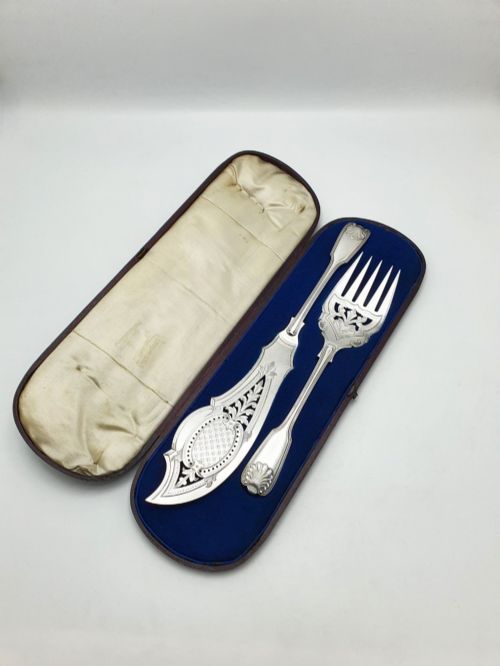
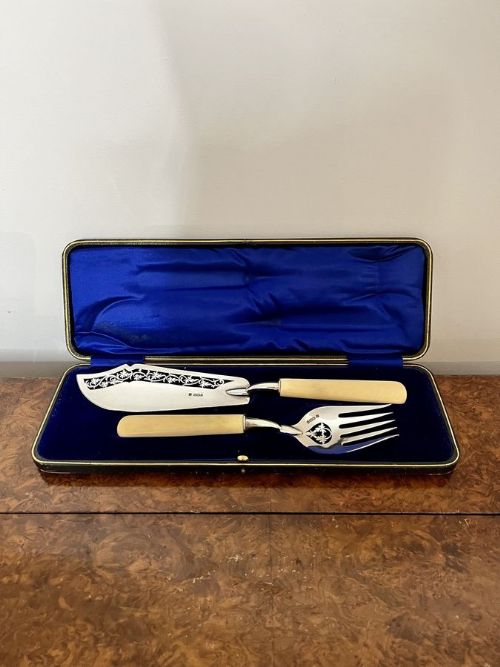
Silver fish knives forks appear primarily in Victorian and Edwardian iterations, spanning the nineteenth and early twentieth centuries. These dining sets range from single serving knives and forks to larger canteens for twelve persons, often nestled in velvet or oak fitted boxes.
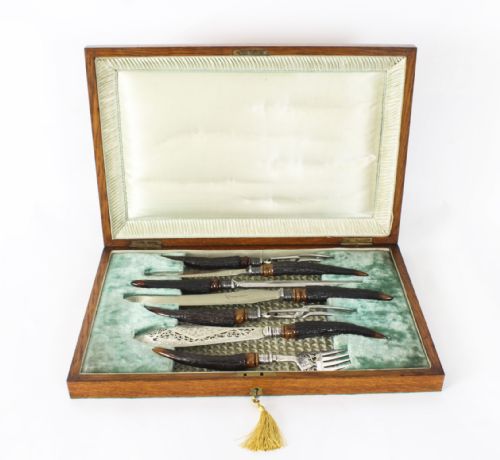
The form encompasses dedicated fish servers alongside complete place settings for six or twelve guests. Many examples incorporate bone, stag antler, horn, or mother of pearl handles, paired with blades or tines shaped specifically for the consumption of fish.
Originating largely from English workshops, these utensils reflect the formal dining customs of the Victorian and Edwardian eras. Buyers encounter both solid sterling silver versions and durable silver plate variations across these periods.
Materials and construction
Craftsmen utilised sterling silver or silver plate for the functional business ends of the cutlery, often incorporating steel blades where additional rigidity was required. Handles were frequently fashioned from organic materials such as bone, stag antler, horn, and mother of pearl, secured with silver ferrules.
Decoration relied heavily on hand engraving, featuring hunting scenes, dog motifs, or elaborate foliate patterns across the blade surfaces. Cased sets demonstrate meticulous interior fitting, utilising velvet lining and polished wood boxes to house the cutlery securely.
Silver Fish Knives Forks Retail Price Guide 2026
Typical asking prices for silver fish knives forks among the pieces listed under this phrase on Sellingantiques today, from the lower quarter to the upper quarter. They describe what is for sale here now, not the wider market.
Listings demonstrate a transition from Victorian silver-plated antler-handled servers to Edwardian canteens and mother of pearl sterling place settings.
Evaluating quality and craftsmanship
Quality rests in the harmony between the metalwork and the organic handles, where well-matched sets show consistent grain and colour across every piece. The crispness of the engraved decoration on the blade determines the level of artistry applied by the maker.
Waring & Gillows·Mappin & Webb·Martin Hall
The Silver Fish Knives Forks Glossary
- Ferrule
- The small metal band joining the handle to the blade or tine. It provides structural strength and a neat visual transition.
- Canteen
- A fitted box or chest designed to house a complete set of cutlery. These are frequently lined with velvet and divided into custom slots.
- Server
- A larger knife and fork pairing utilised for portioning fish at the table. They often feature wider blades and more elaborate engraving.
- Albany Pattern
- A specific nineteenth-century cutlery design featuring raised foliate or scrolling decoration along the handle border. It appears on both solid silver and plated services.
Silver Fish Knives Forks: Frequently Asked Questions
What are silver fish knives forks used for?
These implements were designed specifically for formal dining, allowing guests to separate fish flesh from bones without using steel blades that might react with the food. The wide knife blade acts as a spatula to lift the flesh, while the tines assist in clearing bones.
Today, collectors utilise them for dinner parties or display them within original fitted canteens. They represent a specific period of domestic dining history.
How do I care for silver fish knives forks?
Hand washing in warm soapy water with a soft cloth preserves the metal and protects organic handles like bone or mother of pearl. Avoid soaking pieces with antler or horn components to prevent warping.
Store them in dry conditions, ideally within their fitted velvet or wooden boxes, to minimise tarnishing. Regular gentle polishing maintains the engraved detail without wearing away the silver.
How do I date silver fish knives forks?
Dating relies on stylistic clues, case construction, and hallmarks stamped onto the metal components. Victorian examples often feature deep hand engraving and stag antler or bone handles, while Edwardian versions frequently showcase refined silver plating.
Accommodating boxes, such as oak canteens, also provide chronological markers through their lining materials and joinery. Hallmarks on sterling pieces offer precise assay office and year indicators.
What is the difference between silver plate and sterling?
Sterling silver consists of solid precious metal meeting a specific legal purity standard, whereas silver plate involves a thin layer of silver bonded over a base metal foundation. Sterling pieces often bear assay office hallmarks indicating their metal content.
Silver plate offers durability and visual similarity at a different production tier. Both types feature prominently in antique dining sets from the nineteenth and twentieth centuries.