
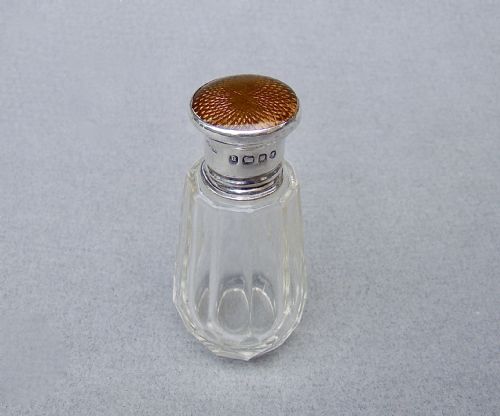


Silver Enamel Scent Bottle
A silver enamel scent bottle brings together precious metal and colourful vitreous work, appealing to collectors who prize vanity items from the early twentieth century.
Silver Enamel Scent Bottle
A silver enamel scent bottle combines a glass or crystal vessel with a decorated metal mount or lid, serving as a portable container for perfume.
The versions most frequently encountered on this page date from the Edwardian period and the Art Deco era, often showcasing geometric patterns or coloured finishes.
These pieces range from small pocket vessels to larger dressing table atomizers, reflecting the changing styles of twentieth-century vanity accessories.
How They Were Made
Makers formed the vessels from clear, cut, or frosted glass and mounted them with sterling silver collars, lids, or outer cages.
Craftsmen applied enamel directly onto the metal or utilised guilloche techniques, cutting intricate geometric patterns beneath translucent coloured layers.
Some Edwardian ladies carried these tiny glass bottles filled with smelling salts to counter the restrictive tightness of fashionable corsets.
What Varies in Quality
The precision of the engine-turned engraving beneath the translucent enamel dictates much of the visual depth and refinement in these objects.
The integrity of the vitreous surface, the weight of the silver mount, and the crispness of the maker marks distinguish standard production pieces from finer workshop examples.
Henry Perkins·Karl Palda·Mappin and Webb·James Fenton·Charles May·George Edwin Walton·James Deakin and Sons·Wolfsky and Co·Richard Comyns·Greenberg and Co·Cohen and Charles·J Grinsell and Sons·The Adie Brothers·Levi and Salaman·Alexander Clark·Kimberley and Hewitt Ltd·Walker and Hall·The Corke Brothers
The Silver Enamel Scent Bottle Glossary
- Guilloche enamel
- A decorative technique where a metal surface is mechanically engraved with repetitive patterns before a transparent enamel layer is applied. This method allows light to reflect through the coloured glass finish.
- Sterling silver
- An alloy consisting of silver and other metals, typically copper, standardised for purity in silverware and mounts. Hallmarks on these components indicate the assay office and year of manufacture.
- Atomizer
- A vanity device fitted with a bulb mechanism to spray perfume in a fine mist rather than pouring it directly. Many Art Deco examples pair this function with coloured glass bodies.
- Bristol blue
- A deep cobalt blue glass traditionally produced in England and frequently paired with contrasting metal lids. It remains a distinctive signature of nineteenth and early twentieth-century scent containers.
Silver Enamel Scent Bottle: Frequently Asked Questions
How do I date a silver enamel scent bottle?
Examine the hallmarks stamped on the silver collar or mount, which indicate the assay office and specific year of production. Stylistic indicators, such as geometric Art Deco motifs or Edwardian floral designs, also help narrow down the decade of manufacture.
Comparing the closure style and glass cutting techniques with documented examples from known makers provides further chronological context for the piece.
Were these bottles meant for travel?
Many smaller examples were designed to fit securely inside evening bags or travel cases for personal use away from the dressing table. Secure screw or hinged lids prevented leakage during transit.
Larger atomizers and heavy crystal bottles stayed stationary on dressing trays, serving as decorative fixtures in domestic bedrooms.
What is guilloche enamel?
Guilloche is a decorative process where a metal substrate is precision-machined with intricate geometric patterns using a rose engine lathe. A translucent layer of coloured enamel is then fused over the engraving, allowing the underlying pattern to show through.
This technique was particularly popular during the Art Deco and Edwardian periods for vanity sets and scent containers.
How should I clean these pieces?
Dust the glass and enamel surfaces gently with a soft, dry cloth to avoid scratching the vitreous layer. Keep moisture away from the interior if the original lining or stopper is fragile.
Polish the silver mounts carefully with a specialist cloth, taking care not to let abrasive polishes come into contact with the enamelwork.