

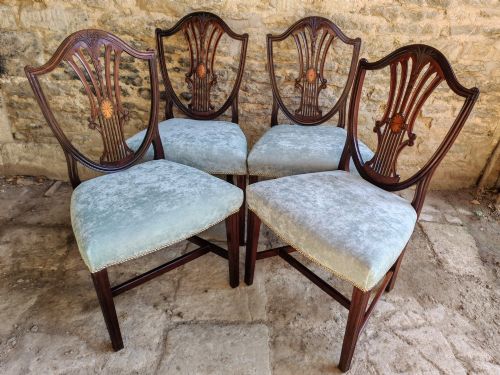
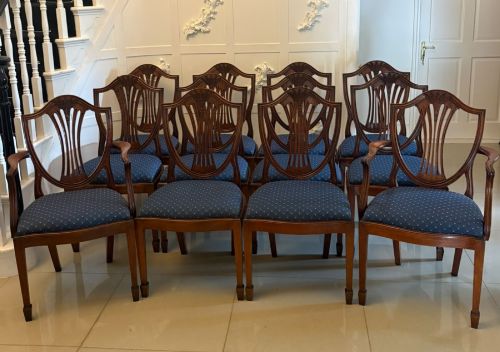
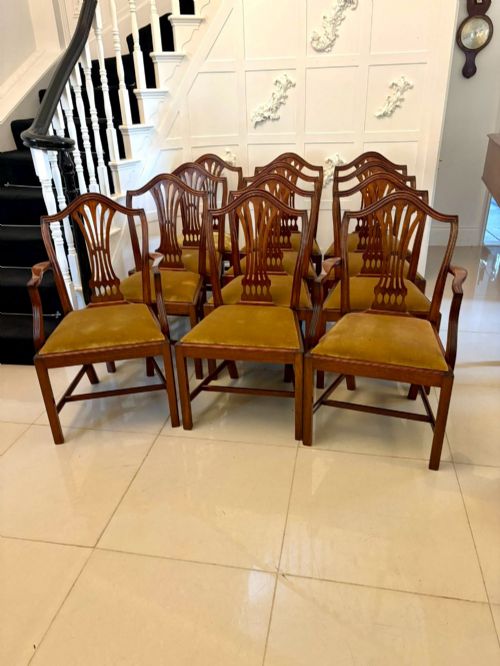
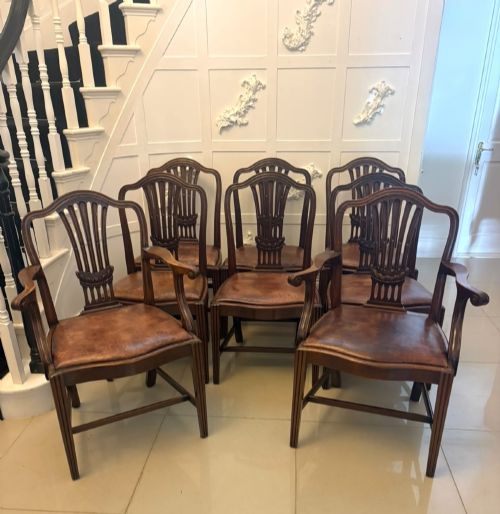
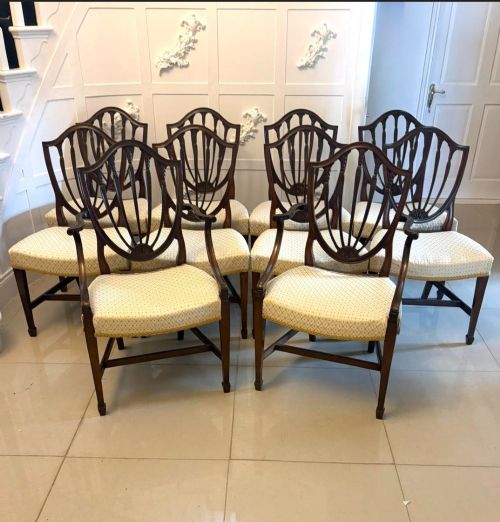
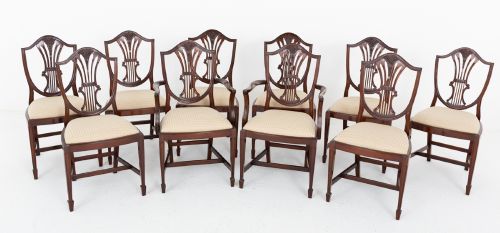
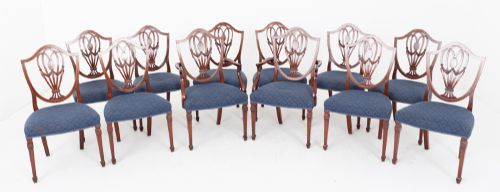
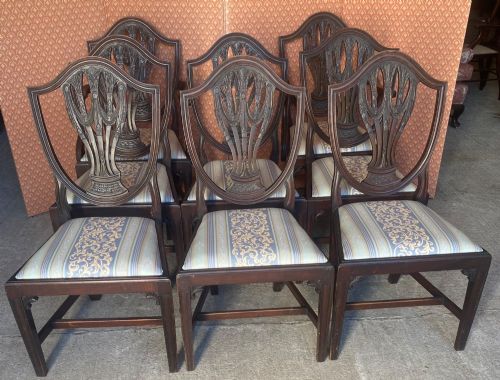
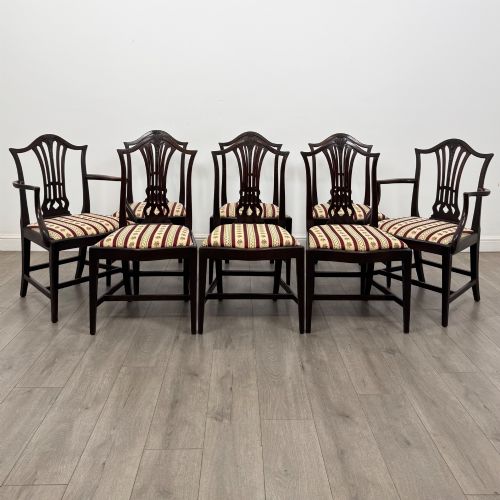
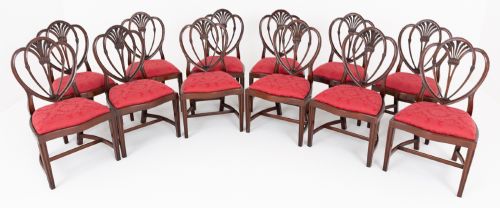
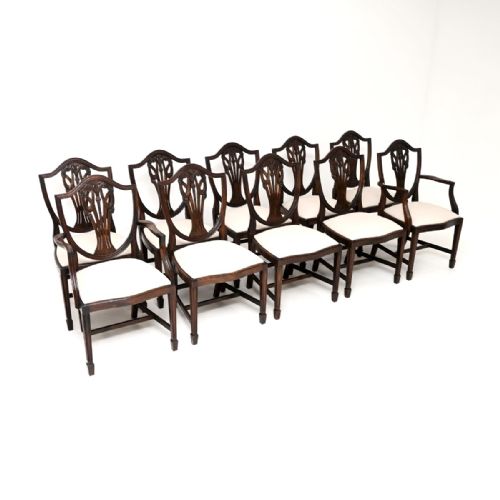
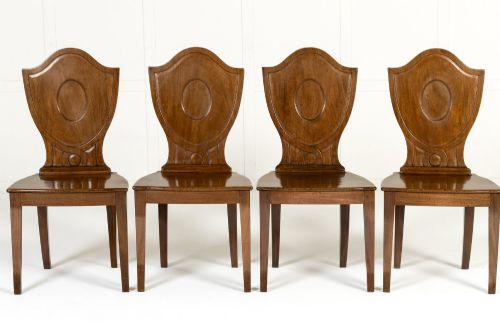


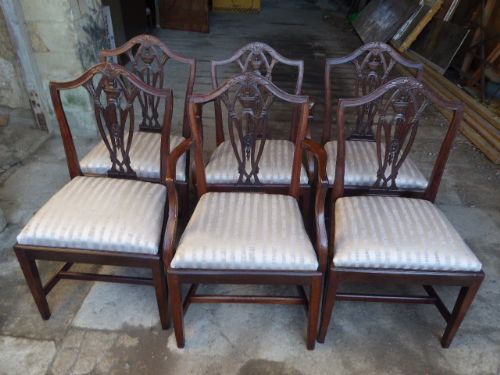
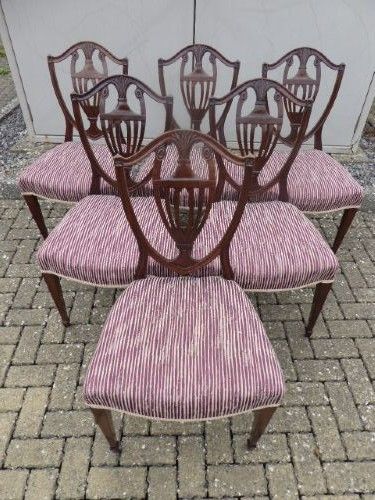
Shield Back Dining Set
A shield back dining set brings together carved mahogany seats rooted in Georgian and revival design, ready to anchor a dining room.
Shield Back Dining Set
A shield back dining set consists of multiple matching chairs sharing the distinctive arched and curved splat shaped like a heraldic shield. These groupings primarily emerge from the eighteenth century, the Victorian era, and subsequent revival periods spanning the nineteenth and twentieth centuries.
Sets frequently appear in formations of six, eight, ten, or twelve pieces, often incorporating armchairs alongside side chairs. The form draws heavily upon the design vocabulary associated with George Hepplewhite and Georgian cabinetmakers, adapted through Edwardian and later revivals.
Buyers encounter numerous revival interpretations produced during the Edwardian period and the early twentieth century alongside genuine eighteenth-century examples. Mahogany serves as the predominant timber across these eras, occasionally joined by maple or satinwood.
Materials and construction methods
Cabinetmakers constructed these frames using solid mahogany, selected for its strength and rich grain, shaping the intricate shield splats through careful hand carving. Workshops incorporated brass fixings and structural joinery to ensure stability across larger suites of chairs.
Seats utilised traditional upholstery methods, employing webbing, stuffing, and coverings of fabric, velvet, leather, or textile. Inlaid details and contrasting wood accents frequently appeared on revival pieces to emulate earlier decorative schemes.
Shield Back Dining Set Retail Price Guide 2026
Typical asking prices for shield back dining set among the pieces listed under this phrase on Sellingantiques today, from the lower quarter to the upper quarter. They describe what is for sale here now, not the wider market.
Listings span the eighteenth century, Victorian era, Edwardian period, and twentieth-century revivals, constructed predominantly in mahogany with leather or fabric upholstery.
Assessing quality in design and execution
Quality rests upon the crispness of the carved splat and the proportion of the shield frame, where finely articulated piercing and reeded legs distinguish superior work from simpler production. The integrity of the timber and the cohesion of a matched set determine its standing.
Original upholstery configurations and period leather retainment elevate historical character, whereas later mismatched replacements alter the consistency of a large suite. Consistency across all chairs in a set dictates how successfully the ensemble functions together.
Maple and Co
The Shield Back Dining Set Glossary
- Shield back
- A chair back shaped in the outline of a heraldic shield, typically enclosing a carved wooden splat.
- Hepplewhite style
- A late eighteenth-century design aesthetic characterised by elegance, light proportions, and shield or oval chair backs.
- Carver
- An armchair designed to match a set of dining side chairs, usually placed at the head of a table.
- Splat
- The central vertical piece of wood running from the seat to the top rail of a chair back.
- Revival
- A later period style that copies or adapts the design principles of an earlier historical era.
Shield Back Dining Set: Frequently Asked Questions
How many chairs come in a typical set?
Sets generally range from four to twelve chairs, frequently arranged with a combination of standard side chairs and paired carver armchairs.
Larger suites often reflect Edwardian or twentieth-century revival production intended for substantial dining spaces.
How do I distinguish eighteenth-century originals from revivals?
Original pieces display eighteenth-century construction techniques, timber patina, and hand-tool marks consistent with that period.
Revivals from the Victorian, Edwardian, and later twentieth-century eras exhibit cleaner machine-assisted joinery and standardised sizing.
What wood was used for these chairs?
Mahogany serves as the primary timber across the vast majority of these dining sets, valued for its durability and deep reddish-brown tone.
Occasional variations incorporate maple or satinwood accents to highlight specific decorative details.
Are carver chairs always included?
Carvers appear in many larger sets, usually numbering two amongst a larger count of standard side chairs.
Smaller sets frequently consist entirely of armless side chairs designed to fit neatly beneath a dining table.