
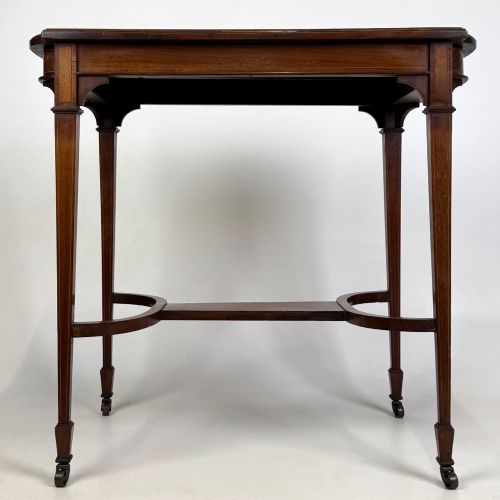
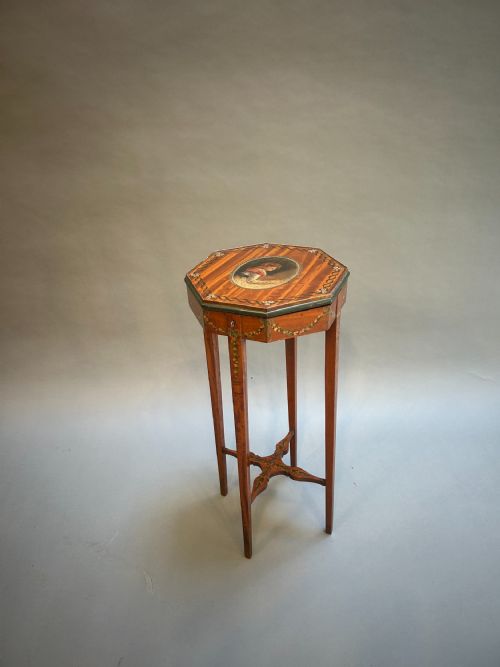
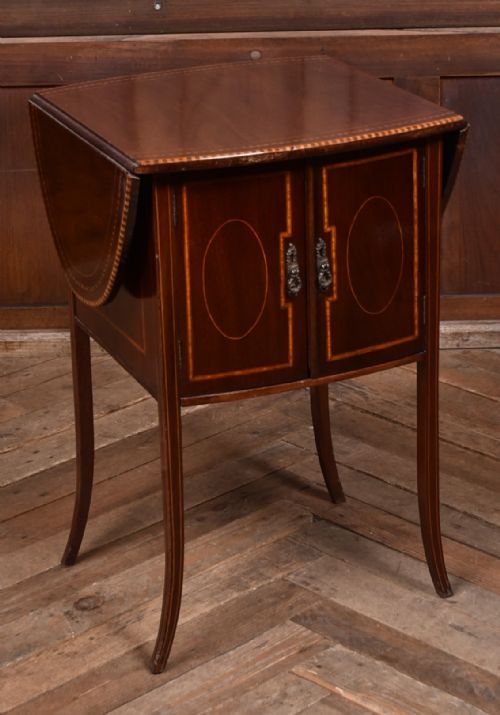


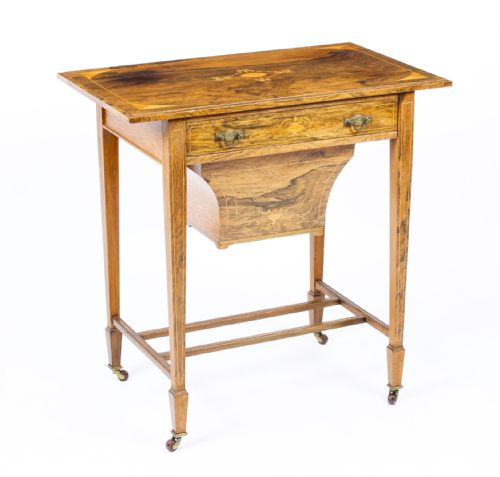


Sheraton Revival Work Table
These sheraton revival work table pieces bring refined geometry and delicate inlay to a room, offering functional surfaces built for sewing and writing.
Sheraton Revival Work Table
A sheraton revival work table sits among the refined occasional and sewing furniture produced during the late nineteenth and early twentieth centuries. Buyers search for these pieces to bring eighteenth-century elegance into domestic spaces through lighter proportions and classical lines.
The versions most commonly met on this page belong to the Edwardian period and the late nineteenth century. These items take the form of side tables, occasional pieces, and sewing tables featuring drop leaves, lift-up tops, and fitted interiors.
Makers of this era drew heavily on neoclassical vocabulary, producing forms in mahogany, satinwood, and rosewood. The resulting furniture balances decorative marquetry with practical compartments designed for needlework and correspondence.
Materials and Construction
Construction relies on timbers such as mahogany, satinwood, and rosewood, often formed as solid frames or applied veneers over secondary woods. Workshops utilised boxwood inlay and painted decoration to delineate borders, panels, and classical motifs.
Surface details frequently incorporate hand painting and marquetry work alongside fitted compartments of brass and leather. These integrated elements demonstrate the cabinetmaker's skill in combining storage with refined exterior decoration.
Lift-up tops reveal tiny hidden compartments that once kept stray thimbles and needles from rolling away during afternoon parlor sewing.
Assessing Quality
Quality reveals itself in the crispness of the boxwood inlay and the precision of the hand painting across the top and sides. Superior examples display tighter grain matching in satinwood or mahogany and smoother movement in drop-leaf and lift-up mechanisms.
The sophistication of the internal fittings and the retention of original brass hardware elevate an individual piece. Lesser examples rely on heavier proportions or simpler surface decoration with minimal attention to internal detail.
The Sheraton Revival Work Table Glossary
- Marquetry
- The art of forming decorative patterns by fitting together small pieces of wood veneer. This technique creates complex pictorial motifs on table tops.
- Satinwood
- A durable hardwood with a lustrous yellowish sheen. It served as a primary surface timber for fine nineteenth-century cabinet work.
- Drop-Leaf
- A table design featuring hinged flaps that fold down to save space. These leaves extend the surface area when supported by hinged brackets.
- Work Table
- A specialised piece of furniture containing drawers or fabric bags for sewing supplies. These tables combined domestic utility with formal parlor display.
- Boxwood Inlay
- Narrow strips of pale wood inserted into contrasting darker timbers. This linear decoration frames table borders and highlights structural edges.
Sheraton Revival Work Table: Frequently Asked Questions
How do I date an Edwardian work table?
Dating relies on timber selection, construction methods, and stylistic markers recorded in the evidence. Pieces from this era often combine mahogany or satinwood with boxwood inlay and painted neoclassical motifs.
Comparison with documented nineteenth-century examples helps distinguish Edwardian revivals from earlier work.
Were these tables used for sewing?
Many examples incorporate lift-up tops or internal compartments specifically designed for sewing materials and small tools. They served as versatile items placed beside seating areas for domestic handwork.
Over time, owners also utilised them simply as side or occasional display tables.
How do I care for satinwood surfaces?
Satinwood requires gentle dusting with a dry, soft cloth to protect the polished finish and delicate veneers. Direct sunlight and excessive moisture should be avoided to prevent fading and timber movement.
Maintaining stable room humidity preserves both the wood and any surrounding painted decoration.