


Sheraton Revival Sofa
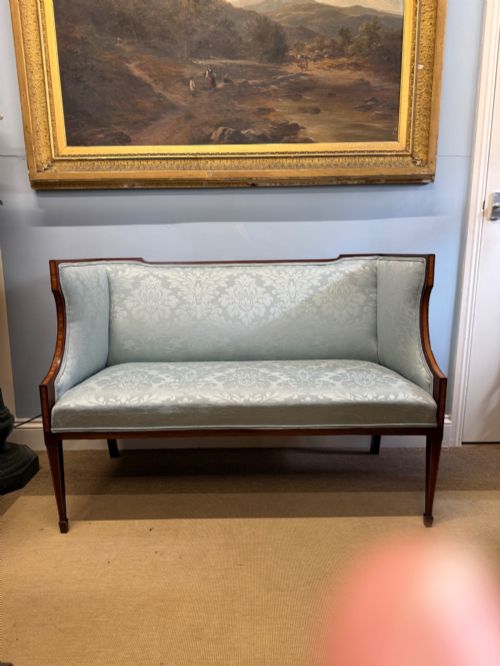
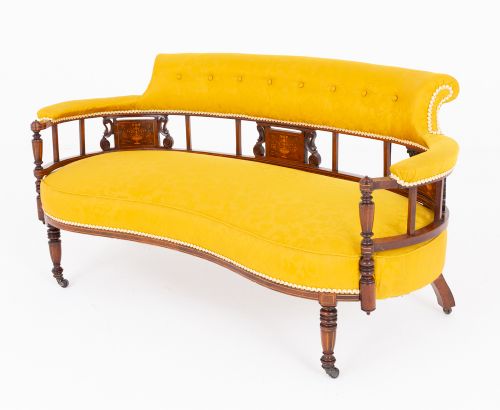
These sheraton revival sofa examples bring late nineteenth and Edwardian drawing rooms to life with inlaid mahogany, painted satinwood, and rosewood frames.
Sheraton Revival Sofa
When you search for a sheraton revival sofa, you are looking at nineteenth-century and early twentieth-century seating that revives neoclassical lightness. The pieces on this page span the Victorian, late Victorian, and Edwardian periods, taking the form of two-seater settees and salon sofas.
Most examples you will meet are constructed from mahogany with satinwood inlay, though rosewood and painted finishes also appear. They were designed for the parlour and drawing room, offering upright comfort rather than deep lounging.
Makers of these settees drew heavily on eighteenth-century design books, translating classical proportions into lighter domestic furniture. You will find them described variously as settees, couches, and salon sofas across the Victorian and Edwardian decades.
What varies in quality
Quality rests in the crispness of the timber inlay and the restraint of the neoclassical ornament. Finer pieces display meticulous hand-cut stringing and balanced proportions, whereas simpler examples rely on more modest surface decoration.
The choice of primary timber also dictates the tier, with figured mahogany and rosewood framing sitting above simpler painted carcasses. The original integrity of the frame and the retention of subtle carved details separate the finest drawing-room examples from standard production.
Listings span the Victorian, late Victorian, and Edwardian eras, predominantly featuring mahogany and satinwood.
The Sheraton Revival Sofa Glossary
- Satinwood
- A lustrous tropical timber used extensively for veneers and stringing during the neoclassical revival. Its golden yellow hue provides a sharp visual contrast against dark mahogany frames.
- Stringing
- A narrow inlay of contrasting wood set flush into the surface of a panel or leg. This linear detail defines the geometric panels characteristic of the style.
- Settee
- A medium-length upholstered seat with a back and arms, designed for more than one person. They formed a central part of nineteenth-century parlour suites.
- Canework
- Woven cane panels utilised for backrests and seats on lighter occasional seating. It offers both decorative texture and structural flexibility.
- Parlour suite
- A matched set of seating and occasionally tables designed for a formal reception room. Surviving pieces often share identical inlay and timber characteristics.
Sheraton Revival Sofa: Frequently Asked Questions
Where did these sofas sit in the home?
These pieces belonged in the formal drawing room or parlour where guests were received and entertained. Their lighter frames allowed them to be repositioned easily around the room compared to heavier earlier furniture.
They served as decorative seating rather than places for heavy lounging, matching the formal entertaining habits of the period.
How do I date a sheraton revival sofa?
Dating relies on examining the timber preparation, the secondary woods used in the frame, and the style of the inlay. Late Victorian and Edwardian pieces frequently combine mahogany with satinwood stringing and subtle neoclassical motifs.
Construction methods such as machine-cut elements or specific upholstery webbing can help distinguish an 1880 piece from a 1910 example.
Are these sofas comfortable for daily use?
These settees were built with upright proportions and firm padding intended for formal sitting rather than sleeping or slouching. Many surviving examples retain or have been restored with traditional sprung upholstery.
If you plan to use one daily, check whether the current padding meets your personal preference for support.
What maintenance do inlaid timber frames need?
Inlaid furniture requires stable indoor humidity to prevent the tiny stringing veneers from lifting or shrinking away from the primary timber. Regular dusting with a soft dry cloth and occasional application of appropriate wax keeps the polish nourished.
Keep them away from direct heat sources and strong sunlight to protect the satinwood and rosewood surfaces from fading.