
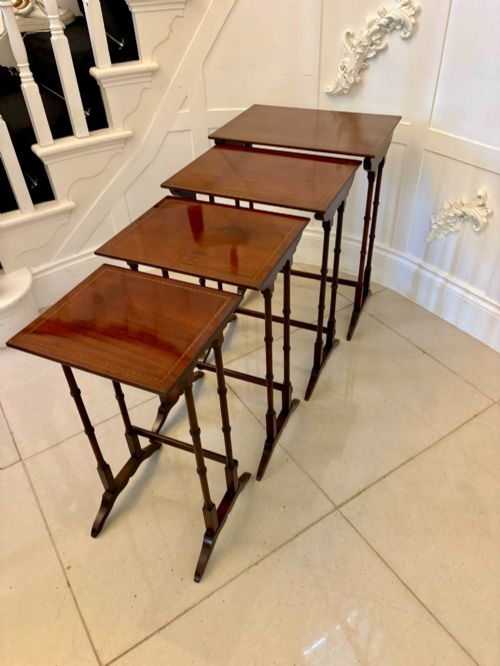

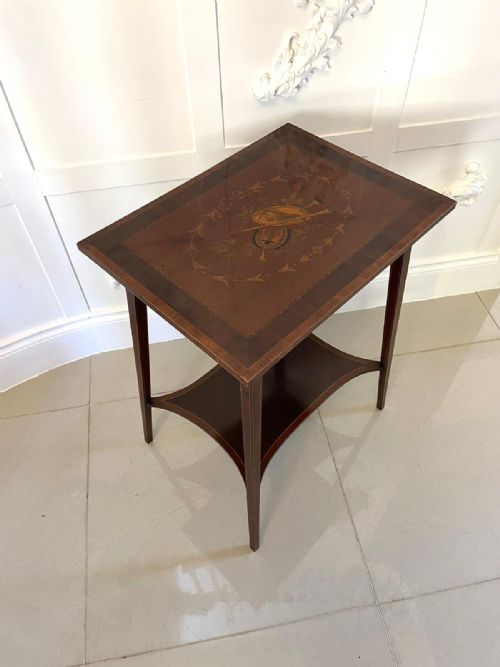


Sheraton Revival End Table
These sheraton revival end table pieces offer refined inlay and delicate proportions, bringing Georgian elegance into Edwardian and late Victorian rooms.
Sheraton Revival End Table
When you search for a sheraton revival end table, you encounter graceful occasional tables, side tables, and nesting sets built during the Edwardian period and late nineteenth century. The examples on this page span the 1880s through to the early 1900s, drawing heavily on eighteenth-century neoclassical design principles.
Most pieces you meet here take the form of occasional and lamp tables, often rendered in rich mahogany or bright satinwood. Makers of this era adapted classic proportions to suit contemporary sitting rooms, creating versatile surfaces for lamps and small objects.
The selection includes rectangular, circular, and oval tops, alongside useful two-tier designs and nested sets. These variations reflect how late nineteenth and early twentieth-century households utilised compact, movable furniture in principal rooms.
Materials and construction
Cabinet makers relied primarily on mahogany and satinwood as the principal timbers, often accentuating the surfaces with contrasting boxwood and ebony stringing. Marquetry details add floral or classical motifs to the top surfaces, executed with precise veneer work.
Painted decoration appears on several satinwood tables, showing delicate brushwork alongside standard inlay. Brass fittings and mounts occasionally secure structural elements or adorn lift-up tops.
The underlying joinery supports lightweight yet stable frames designed for daily use in drawing rooms and boudoirs. Timbers are selected for grain pattern and colour contrast, particularly where banding meets the primary field.
The listings span from 1880 through the Edwardian era, featuring satinwood and mahogany underpinned by boxwood inlay.
Assessing quality and execution
The refinement of the marquetry and stringing separates standard commercial production from the finest workshops. Crisp, tight joints in the inlay work indicate careful hand execution rather than hurried assembly.
Timber selection dictates visual depth, with well-figured mahogany and choice satinwood providing a richer surface than plain alternatives. The delicacy of the turned legs and the precision of the painted details further distinguish superior examples.
Proportion and balance remain critical to the overall success of each piece. Tables that maintain light, harmonious lines without feeling fragile demonstrate a surer command of the revival style.
The Sheraton Revival End Table Glossary
- Sheraton Revival
- A late nineteenth and early twentieth-century design movement that reinterpreted the neoclassical furniture forms of Thomas Sheraton. These pieces adopt slender legs, fine stringing, and classical urn or floral motifs.
- Marquetry
- The art of applying pieces of veneer to a structure to form decorative patterns and pictures. Makers used contrasting woods to create detailed tabletop designs.
- Stringing
- Thin lines of inlay set flush into the surface of a piece to outline panels, drawers, or table edges. Boxwood and ebony provide the contrasting tones.
- Satinwood
- A durable, lustrous timber with a golden sheen, frequently used for high-status occasional tables during the Edwardian era. It provides a pale, reflective ground for painted or inlaid decoration.
- Occasional Table
- A small, movable table intended for specific, non-permanent uses around a room. These forms dominate the revival period due to their versatility.
Sheraton Revival End Table: Frequently Asked Questions
What is a sheraton revival end table?
A sheraton revival end table is a late nineteenth or early Edwardian small table inspired by eighteenth-century neoclassical designs. These pieces typically feature light timbers and delicate decorative inlay.
They function as versatile surfaces for lamps, books, and decorative objects in domestic interiors.
How do I date these tables?
Dating relies on examining the timber preparation, secondary woods, and the specific style of the inlay. Pieces on this page generally date from the 1880s to the Edwardian period.
Construction methods and wear patterns help confirm whether a piece belongs to the late nineteenth-century revival or standard Edwardian production.
Where were these tables used?
These tables served primarily in drawing rooms, parlours, and boudoirs as convenient movable surfaces. Their compact footprints made them easy to place beside seating or in corners.
Many designs incorporate lower shelves or nesting functions to maximise utility in smaller spaces.
Are painted tables authentic?
Painted satinwood tables represent a documented aesthetic within the revival period. Artisans applied floral and classical motifs directly onto the timber surface.
These painted details complement the inlaid stringing found on related mahogany and satinwood pieces.