




Sheraton Revival Bedside Tables
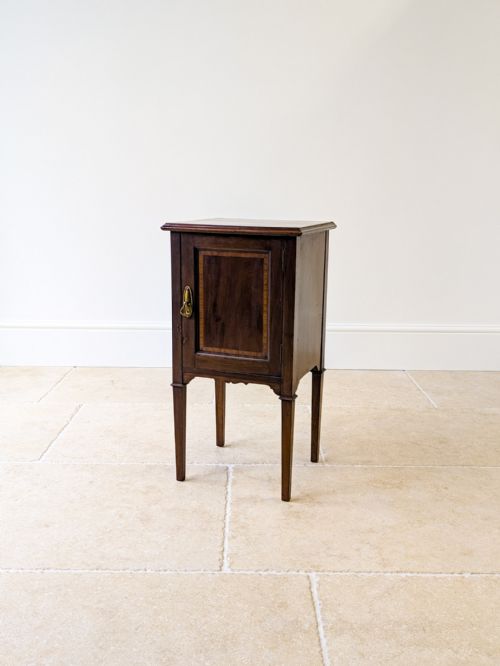
These Sheraton Revival bedside tables bring refined Edwardian elegance and inlaid timber to the bedroom.
Sheraton Revival Bedside Tables
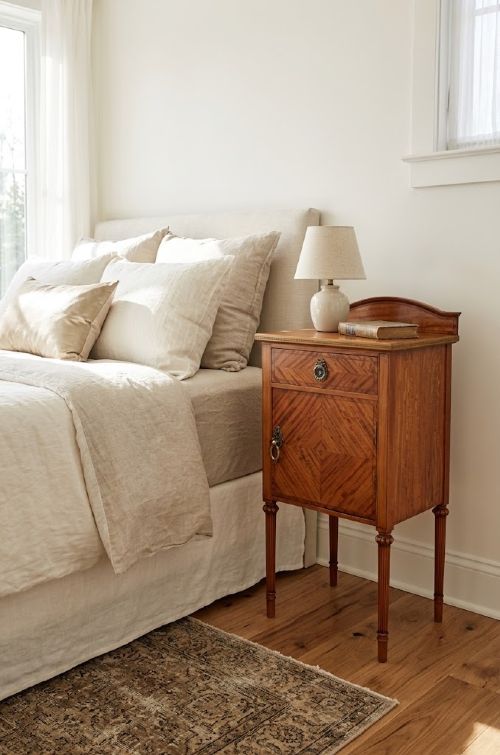
Sheraton Revival bedside tables span the late nineteenth century and the Edwardian period, appearing primarily as bedside cabinets, cupboards, and chests. These practical forms offer enclosed storage alongside decorative tabletops suitable for a bedroom setting.
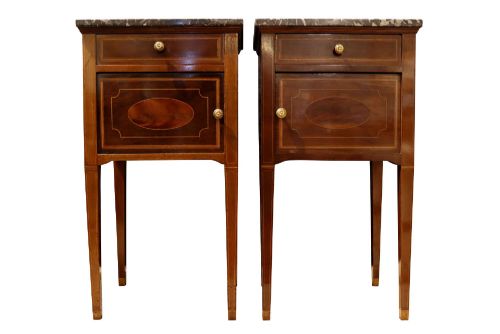
The selection here encompasses both single pieces and matched pairs executed in specific regional traditions. The primary origins represented are English workshops working within Victorian and Edwardian aesthetics.
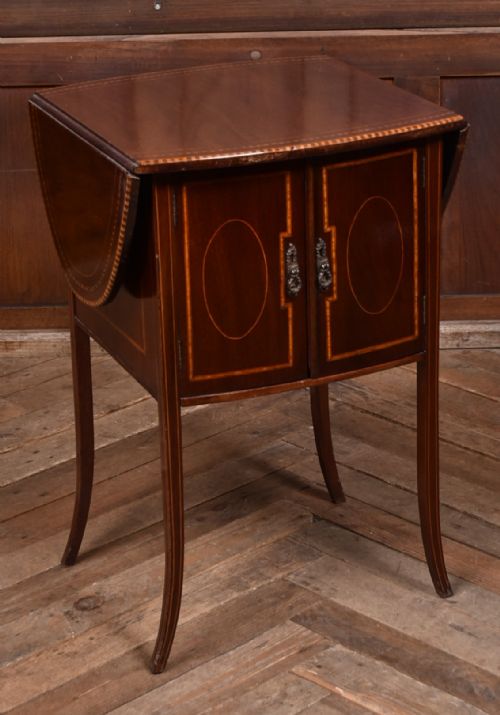
Forms vary from standard bedside cabinets to drop-leaf tables and occasional side tables. The overarching design vocabulary draws on eighteenth-century neoclassical motifs adapted for domestic use at the turn of the twentieth century.
How they were made
Construction relies heavily on select timbers such as mahogany and satinwood, frequently enhanced by contrasting inlaid woods and boxwood stringing. Artisans also employed rosewood alongside brass hardware for hinges, handles, and gallery details.
Surface ornamentation often includes hand-painted detailing and marquetry work embedded directly into the wood. Mirror glass occasionally appears within the design scheme to augment the light reflecting properties of these compact cabinets.
Sheraton Revival Bedside Tables Retail Price Guide 2026
Typical asking prices for sheraton revival bedside tables among the pieces listed under this phrase on Sellingantiques today, from the lower quarter to the upper quarter. They describe what is for sale here now, not the wider market.
Some cabinets hide their treasures behind curved bow fronts while others rely on drop-leaf sides for unexpected flexibility.
What varies in quality
The sophistication of the timber selection and the precision of the marquetry dictate the upper tier of these pieces. Fine grain satinwood and complex inlaid wood motifs separate exceptional examples from simpler mahogany carcases.
Execution of hand-painted detailing and the crispness of boxwood stringing determine the visual refinement of individual cabinets. Uniformity across matched pairs further influences the overall standing of the furniture.
The Sheraton Revival Bedside Tables Glossary
- Sheraton Revival
- A design style inspired by the late eighteenth-century neoclassical furniture of Thomas Sheraton, popularised during the late Victorian and Edwardian eras. This movement favours slender proportions, satinwood veneers, and classical inlay.
- Marquetry
- The art and craft of applying pieces of veneer to a structure to form decorative patterns and pictures. Craftsmen utilise various coloured woods to create pictorial scenes or geometric borders.
- Boxwood
- A dense, pale wood frequently used for contrasting stringing and fine inlay lines. Its neutral tone provides a sharp boundary against darker timbers like mahogany and rosewood.
- Bow Front
- A convex curved cabinet front that projects outward in an arc. This curved form requires advanced woodworking skill to shape the timber and fit the corresponding doors or drawers.
Sheraton Revival Bedside Tables: Frequently Asked Questions
What periods do these bedside tables date from?
These pieces date predominantly from the Edwardian era and the late nineteenth century, spanning from the Victorian period through to the early twentieth century.
Craftsmen produced these revival items to satisfy contemporary demand for lighter, neoclassical furniture forms.
What timbers are most common?
Mahogany and satinwood form the primary structural and surface materials across these listings.
Cabinet makers frequently supplemented these base timbers with rosewood, boxwood stringing, and elaborate inlaid wood details.
Do these tables come in pairs?
Several listings comprise matched pairs of bedside cabinets rather than single items.
These paired configurations allow for symmetrical placement on either side of a bed.
How do cabinets differ from side tables?
Cabinets and cupboards provide enclosed storage space behind doors or within chests of drawers.
Tables such as drop-leaf or occasional formats offer open surfaces without internal compartment storage.