



Serpentine Top Desk
A serpentine top desk brings rhythmic, undulating curves to a room, offering a fluid silhouette shaped by skilled hands.
Serpentine Top Desk
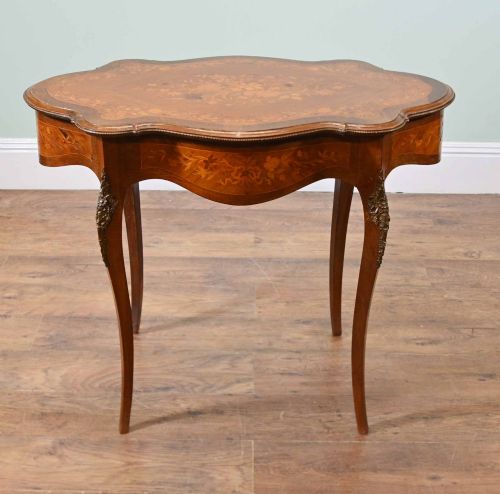
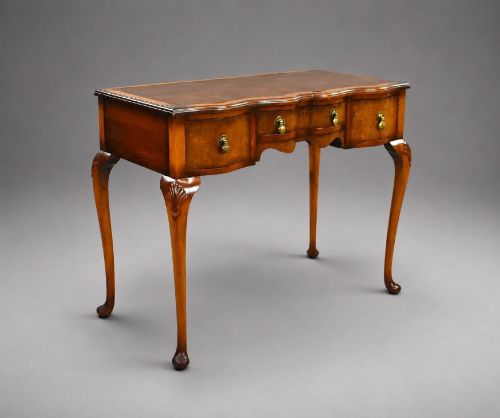
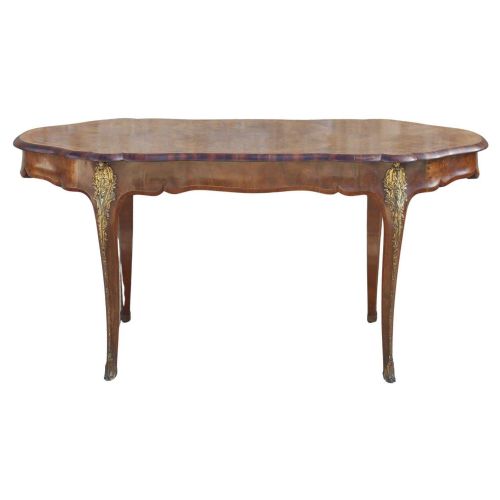
A serpentine top desk presents a distinctive undulating front or edge, moving outward at the centre and curving inward at the sides, or vice versa. These pieces appear across various periods from the Georgian era through to the early twentieth century, taking the form of large partners desks, kneehole desks, and smaller writing tables.
The versions most commonly met here span the nineteenth century and the revival styles of the early twentieth century. Walnut, burr walnut, and mahogany dominate the selection, often accompanied by inlaid details, leather inserts, and cabriole legs.
Buyers look for these desks to introduce movement and architectural interest into a study or library. The undulating outline softens the rigid geometry usually found in office furniture while maintaining practical writing surfaces.
How they were made
Cabinetmakers constructed the undulating carcass of a serpentine top desk using solid timber frames faced with carefully chosen veneers such as burr walnut, mahogany, and satinwood. The curved drawer fronts and bowed perimeters required precise sawing and bending techniques to maintain structural integrity along the grain.
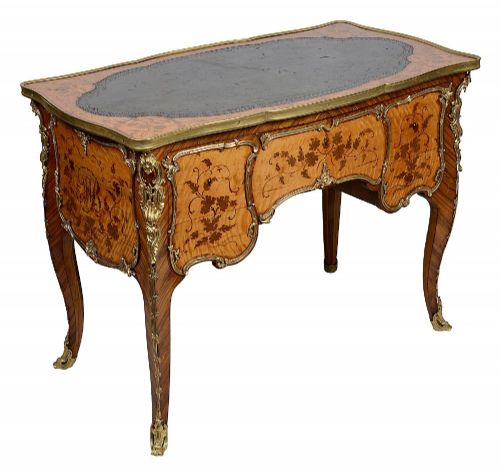
Surface ornamentation involved marquetry inlay, ormolu mounts, and brass hardware, complemented by inset leather writing surfaces. Skilled joiners shaped cabriole legs and bracket feet to support the dynamic weight distribution of the curved timber forms.
The selection encompasses freestanding writing tables, pedestal desks, partners desks, and lowboys, alongside related French bureau plat forms.
What varies in quality
The distinction between standard examples and the finest pieces lies in the choice of timber figurations and the crispness of the carved mouldings. Superior desks display tightly matched burr walnut or figured mahogany veneers that follow the complex curves without buckling or splitting.
Internal construction standards also separate grades of manufacture, visible in the dovetail joints of the drawers and the weight of the cast ormolu mounts. A well-executed serpentine profile maintains a consistent, harmonious rhythm from every viewing angle.
The Serpentine Top Desk Glossary
- Serpentine
- A shape characterised by a recessed centre flanked by convex projections, or a convex centre flanked by concave curves. This undulating line appears frequently on eighteenth and nineteenth-century case furniture.
- Partners desk
- A large double-sided desk designed for two people to work opposite one another, equipped with drawers and cupboards on both faces. These substantial pieces often feature leather-lined tops and pedestal bases.
- Burr walnut
- Timber taken from the gnarled growth of a walnut tree, yielding dense, swirling grain patterns. Cabinetmakers used these highly decorative veneers on prominent surfaces like desk tops and drawer fronts.
- Ormolu
- Gilded bronze used for decorative mounts, handles, and sabots on furniture. This decorative technique adds metallic contrast to timber surfaces, particularly on French revival pieces.
- Cabriole leg
- A furniture leg that curves outward at the knee and tapers inward toward the foot, mimicking animal limbs. This form is common on Queen Anne and Louis XV style writing tables.
Serpentine Top Desk: Frequently Asked Questions
What is a serpentine top desk?
A serpentine top desk is a writing table or pedestal desk featuring an undulating front edge that curves outward and inward in a continuous wave. This distinctive silhouette adds decorative movement to traditional study spaces.
Such desks appear in various timber types, including mahogany and burr walnut, across multiple historical periods and revival styles.
How do I date a serpentine desk?
Dating involves examining the secondary timbers, construction methods, hardware, and stylistic revival cues. Georgian pieces display different dovetailing and proportions compared to nineteenth-century or Edwardian revival examples.
Moulding profiles and veneer thickness also provide clues to the era of manufacture.
Were these desks used for writing?
These pieces served primarily as writing tables, library desks, and bureau plats for correspondence and estate management. Many include inset leather panels designed to provide a smooth surface for quill or pen work.
Pedestal variations offered substantial interior storage for stationery, documents, and ledgers.
How do I care for a walnut desk?
Maintenance requires keeping the timber away from direct sunlight and extreme temperature fluctuations to prevent veneer cracking. Regular dusting with a soft, dry cloth preserves the polish on the wood.
Leather inserts benefit from occasional specialist conditioning to keep the material supple.
What is a partners desk?
A partners desk is a large double-sided workspace built to accommodate two people sitting face-to-face. They include drawers and cupboards accessible from both the front and the back.
These substantial items often form the focal point of large libraries or studies.