

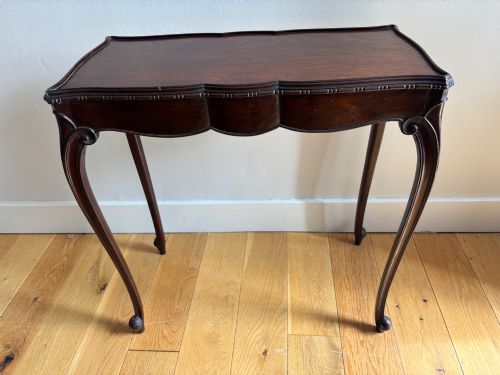


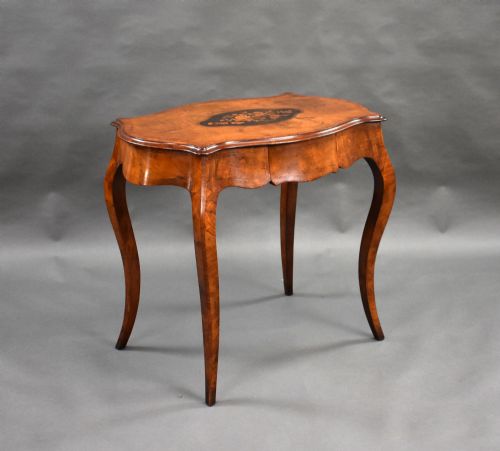


Serpentine Parlor Table
These serpentine parlor table pieces bring nineteenth-century reception rooms alive, offering distinct wood figures and shaped tops that anchor a traditional interior.
Serpentine Parlor Table
A serpentine parlor table functions as a centre, occasional, or side table within a formal room, displaying curved edges that define its distinct silhouette. Most examples found here date from the Victorian and Edwardian eras, spanning the mid-nineteenth century through to the early twentieth century.
The form encompasses centre tables, tilt-top tables, and basket-base designs intended to stand freestanding in a room rather than against a wall. Makers of these pieces utilised rich timbers like walnut, mahogany, and rosewood to create striking visual focal points for entertaining guests.
Victorian Rococo Revival and Louis XV Revival influences frequently appear alongside straightforward Edwardian interpretations of earlier Georgian designs. These stylistic choices dictate the degree of carved decoration, inlay work, and overall scale of the table.
Materials and construction methods
Cabinetmakers built these tables using solid carcase woods faced with figured veneers, particularly burr walnut, which provided intricate natural patterns across the table top. Walnut and mahogany serve as the primary foundational timbers across the available selection.
Surface decoration frequently involves complex marquetry and fruitwood inlay combined with boxwood lines to frame the serpentine edges. Ormolu mounts, brass fittings, and carved gilt wood details appear on pieces influenced by French rococo tastes.
Serpentine Parlor Table Retail Price Guide 2026
Typical asking prices for serpentine parlor table among the pieces listed under this phrase on Sellingantiques today, from the lower quarter to the upper quarter. They describe what is for sale here now, not the wider market.
Current listings demonstrate a concentration of Victorian walnut and Edwardian mahogany, featuring both French rococo revival influences and traditional British forms.
Assessing quality and execution
Quality reveals itself in the selection of veneer timbers, where tightly curled burr walnut and balanced grain alignment elevate a piece far above plain timber surfaces. The crispness of hand-cut fruitwood and boxwood inlay further distinguishes superior cabinet work.
Underpinning the top, the complexity of the timber turning, the stability of pedestal basket bases, and the integration of carved mounts determine the structural integrity and aesthetic weight of the table.
The Serpentine Parlor Table Glossary
- Serpentine
- A curved edge configuration featuring a convex centre flanked by concave curves, creating a fluid S-shape along the perimeter of the table top. This profile requires precise woodworking to maintain symmetry.
- Burr Walnut
- Timber harvested from the growth excrescences of walnut trees, yielding highly figured, swirling grain patterns. Cabinetmakers sliced this wood into thin veneers for decorative table tops.
- Marquetry
- The art of applying decorative veneer pieces in various woods, metals, or shells to form pictorial or geometric patterns. On these tables, floral and scroll motifs frequently adorn the central surface.
- Ormolu
- Gilded bronze furniture mounts cast and chased by hand to add metallic ornamentation. This technique appears predominantly on pieces finished in French revival styles.
- Looe Table
- A large round or oval card table designed for playing nineteenth-century games like loo. These examples often incorporate tilt-top mechanisms for convenient storage when not in use.
Serpentine Parlor Table: Frequently Asked Questions
How do I date a Victorian centre table?
Dating a Victorian centre table involves examining the secondary timbers, construction joints, and stylistic revival influences present in the design. Mid-nineteenth-century examples frequently utilise heavy burr walnut veneers and robust pedestal bases with carved scrollwork.
Later Victorian and Edwardian pieces often exhibit lighter proportions, drawing inspiration from earlier Georgian cabinetry or French Louis styles. The integration of boxwood inlay and specific brass hardware also helps narrow the period of manufacture.
Where should I place an antique occasional table?
An antique occasional table suits a living room, drawing room, or hallway where it can function as a freestanding focal point or a functional surface. Centre tables look best positioned away from walls to showcase their shaped serpentine tops and detailed bases from all angles.
Protecting the wood surface from direct heat and moisture preserves the delicate burr walnut veneers and marquetry inlay. Using coasters and felt pads prevents accidental scratching of the antique finish.
What is the difference between a centre table and a side table?
A centre table is finished on all four sides and designed to stand in the middle of a room as a sculptural element. These tables often feature elaborate pedestal bases with multiple legs or shaped platforms.
A side table is traditionally constructed to sit against a wall, sometimes lacking finished detailing on the rear edge. However, many nineteenth-century French and English designs blur these definitions by offering finished backs on smaller occasional pieces.