

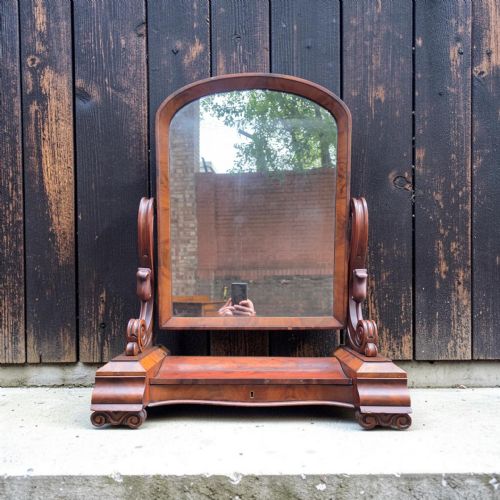
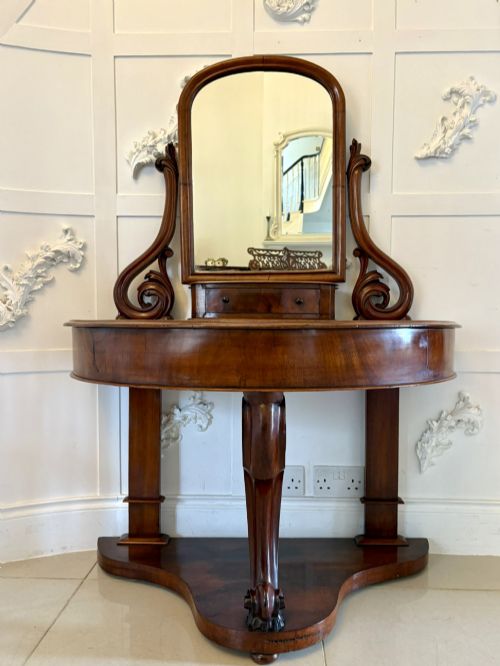


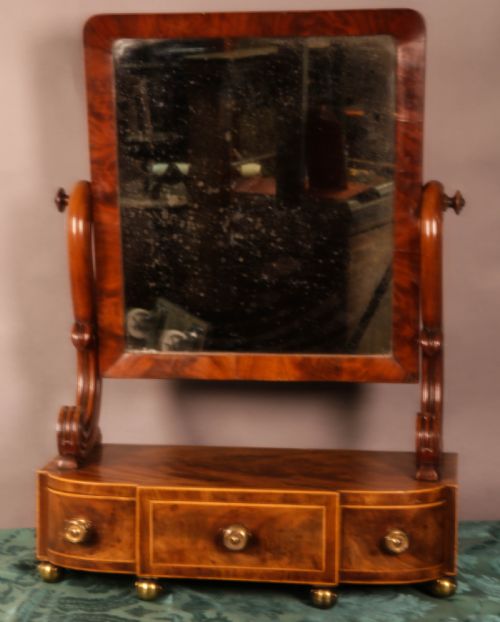

Scrolled Mirror Dressing Table
A scrolled mirror dressing table brings a sculptural Victorian presence to a room, offering the practical grace of a pivoting glass set into carved timber.
Scrolled Mirror Dressing Table
When you search for a scrolled mirror dressing table, you encounter dressing table mirrors, dressing tables, dressing mirrors, vanity mirrors, and table mirrors spanning the nineteenth century and the early twentieth century. These pieces combine a pivoting glass frame with either a compact tabletop base or a larger chest fitted with drawers.
The Victorian period dominates the selection, appearing alongside early twentieth-century examples that continue the nineteenth-century taste for revival forms. Mahogany forms the primary timber across the current items, supplemented by oak, glass, mirror glass, brass, and gilded metal.
You are most likely to meet Victorian pieces featuring carved mahogany frames and swing mechanisms, often dated across the middle and later decades of the nineteenth century. French Rococo revival styles and early Victorian designs also appear among the forms available.
How they were made
Cabinet makers constructed these pieces using mahogany and oak, often shaping the timber into carved forms associated with the Victorian era and the Rococo Revival style. Frames frequently incorporate swing mechanisms in brass or metal to allow the glass to tilt.
Mirror glass provides the reflective surface, mounted within timber or gilded metal surrounds that rest upon shaped supports or drawer bases.
Scrolled Mirror Dressing Table Retail Price Guide 2026
Typical asking prices for scrolled mirror dressing table among the pieces listed under this phrase on Sellingantiques today, from the lower quarter to the upper quarter. They describe what is for sale here now, not the wider market.
Every swing mirror relies on a pair of small side screws that occasionally need a gentle tighten after a century of daily nodding.
What varies in quality
The refinement of the carving on the mahogany or oak frame distinguishes finer examples from simpler production, particularly where scrollwork and moulded details show deeper execution. Cabinet construction on the base tables, including drawer dovetailing and timber selection, separates substantial pieces from lighter items.
The integration of the mirror mechanism and the quality of the glass plate influence the overall integrity of the piece, with heavier brass fittings and well-balanced swing arms indicating careful manufacture.
The Scrolled Mirror Dressing Table Glossary
- Swing mirror
- A mirror plate suspended on pivot screws within a frame, allowing the glass to tilt forward or backward. This mechanism sits either on upright supports or directly above a small drawer base.
- Rococo Revival
- A nineteenth-century design movement drawing on eighteenth-century French motifs, characterised by C-scrolls, asymmetrical curves, and naturalistic carved ornamentation. It appears frequently in Victorian furniture.
- Toilet mirror
- A smaller tabletop mirror designed for dressing and grooming, often placed on top of a chest of drawers or a dedicated dressing table.
- Victorian
- Pertaining to the reign of Queen Victoria, covering the nineteenth century. Furniture from this period spans several stylistic revivals including Gothic, Renaissance, and Rococo.
Scrolled Mirror Dressing Table: Frequently Asked Questions
What is a scrolled mirror dressing table?
A scrolled mirror dressing table is a Victorian or early twentieth-century furnishing that combines a tilting mirror with a dressing table or tabletop stand, featuring decorative scrollwork.
These pieces range from large mahogany dressing tables with integrated mirrors to smaller swing mirrors designed for placement on existing furniture.
How do I date a dressing mirror?
Dating relies on timber choices, construction methods, and stylistic markers such as Rococo revival carving or Victorian proportions.
Nineteenth-century examples frequently utilise solid mahogany or oak, while brass fittings and hand-cut joinery offer further clues to their period of manufacture.
Where should I place a vanity mirror?
These mirrors function effectively on dressing tables, chests of drawers, or low consoles where the swing mechanism allows light to be directed as needed.
Tabletop versions require a stable surface with sufficient depth to support the footprint of the base and the pivoting frame.
What woods were used for these mirrors?
Makers predominantly employed mahogany and oak for the frames and bases, often polished to a deep lustre.
Metal elements such as brass or gilded metal appear within the support hardware and decorative mounts.