



Satinwood Partners Desk
A satinwood partners desk is a substantial double-sided writing table offering storage and workspace on both faces for two people to work opposite one another.
Satinwood Partners Desk
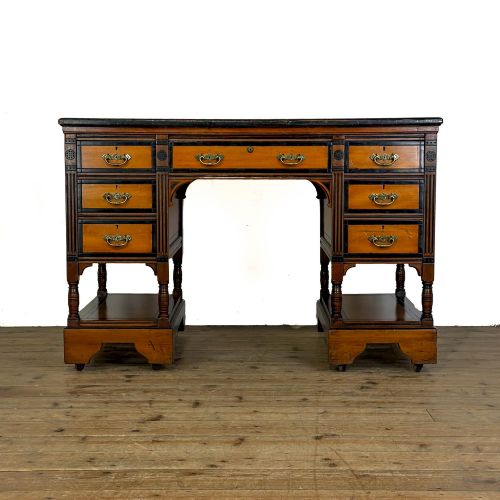
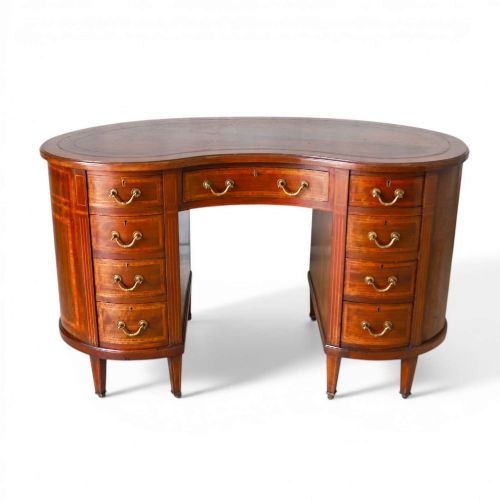
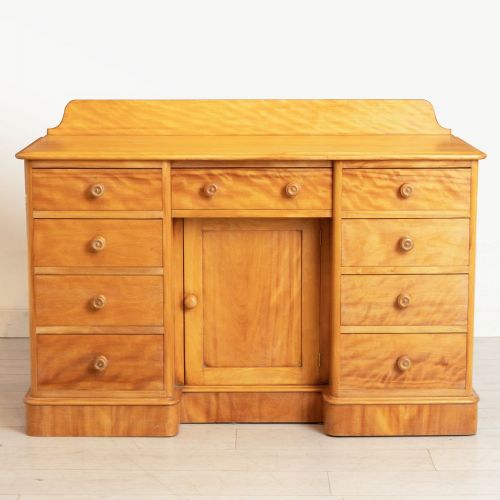
A satinwood partners desk is built to allow two users to sit opposite each other, featuring banks of drawers and cupboards arranged on both sides of a central kneehole. The pieces found here span the nineteenth century, including Victorian and Edwardian examples alongside Sheraton Revival interpretations.
Most examples you encounter combine satinwood with secondary timbers such as mahogany or satin birch, often finished with leather writing surfaces. Forms range from pedestal desks and kneehole desks to kidney shapes and executive writing tables.
Makers utilised various decorative approaches including satinwood inlay, ebonised wood details, and hand-decoration. Pieces originate from the Victorian and Edwardian eras, reflecting styles from the Aesthetic Movement to Japonisme.
Materials and construction methods
Carpenters constructed these desks using solid timbers and veneers, pairing satinwood with mahogany, walnut, satin birch, and pine carcasses. Brass fittings such as handles and drawer pulls completed the structural framework.
Writing surfaces were traditionally inset with leather, providing a durable plane for daily correspondence. Inlay work and ebonised wood accents were applied to surfaces to create decorative contrast in the wood grain.
Cabinetmakers organised these large pieces into twin pedestals supporting a wide top, housing multiple drawers accessible from both working sides in true partners configurations.
Satinwood Partners Desk Retail Price Guide 2026
Typical asking prices for satinwood partners desk among the pieces listed under this phrase on Sellingantiques today, from the lower quarter to the upper quarter. They describe what is for sale here now, not the wider market.
The listings on this site feature nineteenth-century and Edwardian pieces constructed from satinwood, mahogany, and satin birch.
Distinguishing quality in construction
Quality separates desks through the selection of timber veneers and the precision of the inlay work across both sides of the piece. Superior examples display careful matching of the satinwood grain and robust structural joinery in the drawer carcases.
The integration of original leather writing surfaces and intact brass hardware contributes to the integrity of an example. Finer pieces demonstrate careful hand-decoration and balanced proportions between the twin pedestals and the central writing top.
The Satinwood Partners Desk Glossary
- Partners desk
- A large double-sided desk designed for two people to work face-to-face, featuring drawers and cupboards on both opposing sides.
- Satinwood
- A lustrous, hard timber native to Ceylon and India with a natural golden sheen, frequently used for high-status nineteenth-century cabinetmaking.
- Pedestal desk
- A heavy freestanding desk supported by two vertical columns of drawers flanking a central kneehole opening.
- Aesthetic Movement
- A late nineteenth-century design style emphasising visual beauty and artistic reform over heavy historicism.
- Sheraton Revival
- A late nineteenth-century revival style drawing upon the lighter neoclassical furniture designs of George Sheraton.
Satinwood Partners Desk: Frequently Asked Questions
What is a partners desk?
A partners desk is a large, double-sided writing table designed with drawer units on both faces so that two people can sit opposite each other.
These desks were traditionally used in offices and libraries where two colleagues or professionals needed shared workspace and independent storage access.
How do I date a satinwood desk?
Dating relies on examining the secondary timbers, construction methods, and stylistic cues present in the woodwork and hardware.
Pieces on this page span the Victorian and Edwardian periods, with nineteenth-century examples showing specific stylistic traits like Aesthetic Movement details or Sheraton Revival motifs.
Are these desks finished on both sides?
True partners desks feature drawers, cupboards, or kneeholes finished on both opposing faces so the piece can stand in the middle of a room.
This free-standing layout allows the desk to be viewed from any angle without exposing unfinished structural backs.
What wood is used besides satinwood?
Cabinetmakers frequently paired satinwood with mahogany, satin birch, walnut, and pine for internal carcases and secondary framing.
Contrasting woods like ebonised timber and specialised inlay materials were also used to accentuate drawer borders and structural edges.