

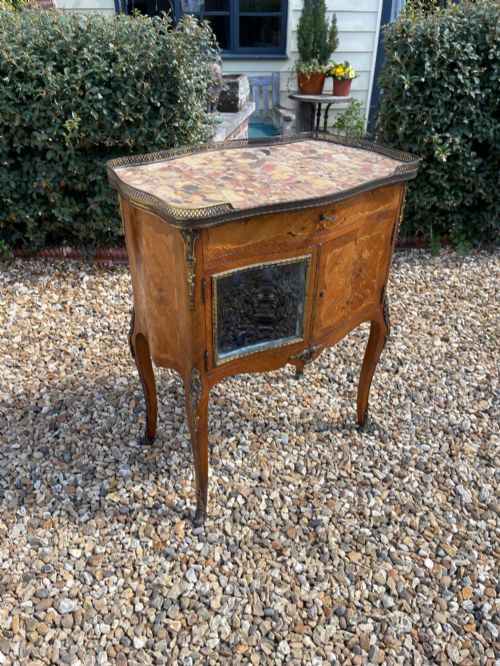

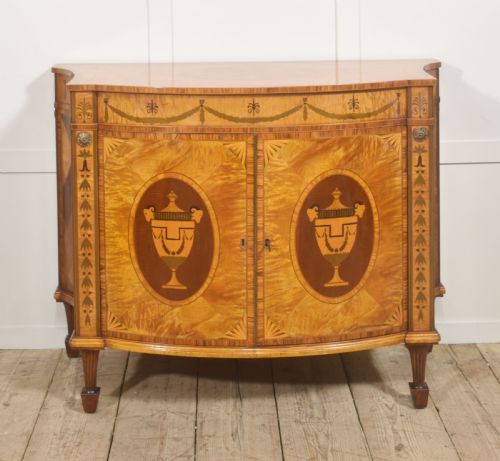


Satinwood Marquetry Commode
These satinwood marquetry commode examples combine shimmering timber with meticulous floral and classical inlay, offering a refined focal point for any sophisticated interior.
Satinwood Marquetry Commode
A satinwood marquetry commode represents the pinnacle of cabinet-making skill, combining pale, light-reflecting timbers with intricate contrasting veneers. When searching this phrase, collectors encounter serpentine chests, demi-lune side cabinets, and French-inspired transitional designs from the eighteenth, nineteenth, and early twentieth centuries.
The majority of pieces seen on this page span the Sheraton Revival and George III periods, alongside nineteenth-century French interpretations. These storage cabinets range from half-round side pieces to breakfront chests featuring elaborate floral or classical motif inlays.
Makers utilised timber grain direction to create three-dimensional pictorial effects within the marquetry panels. Such decorative storage furniture served to display wealth and refined taste in formal drawing rooms and reception spaces.
Materials and Construction Techniques
Craftsmen built these pieces using a carcase of mahogany, walnut, or pine, subsequently veneered in figured satinwood. Artisans then applied delicate marquetry using contrasting woods such as boxwood, rosewood, tulipwood, and kingwood to render urns, ribbons, and floral swarms.
Metal mounts in cast and gilt ormolu frequently accent the corners, drawer edges, and apron feet of nineteenth-century French designs. Hand-cut dovetails unite the drawer construction, while matching brass hardware secures the doors and drawers.
Listings feature satinwood marquetry commodes spanning the eighteenth century through the Edwardian era, incorporating mahogany, marble, and ormolu.
Judging Quality and Execution
The distinction between standard execution and superior artistry lies in the density and precision of the marquetry cutting. Master workshops achieved hair-thin joints between contrasting veneer pieces, whereas lesser examples rely on heavy surface engraving to hide loose fits.
Timber selection dictates overall visual impact, with top-tier specimens exhibiting tightly figured satinwood paired with rich, well-contrasted exotic woods. The crispness of ormolu chasing and the integrity of the underlying carcase construction further separate workshop tiers.
James Hicks·Edwards and Roberts
The Satinwood Marquetry Commode Glossary
- Satinwood
- A pale, hard timber native to Ceylon and the West Indies that possesses a natural golden sheen. Cabinet-makers prized this wood for its reflective surface when polished.
- Marquetry
- The art of forming decorative patterns using fitted pieces of coloured veneers applied to a wooden carcase. This technique differs from inlay by assembling the entire design before fixing it to the surface.
- Demi-Lune
- A half-moon shape characteristic of eighteenth-century and Sheraton Revival side commodes. Such curved profiles required exceptional skill in veneer bending.
- Ormolu
- Gilded bronze mounts applied to furniture edges, handles, and feet for ornamental contrast. French transitional and revival pieces frequently employ this decorative hardware.
- Serpentine
- A curved furniture front featuring a convex centre flanked by concave ends. This undulating shape demands precise hand-shaping of the solid timber carcase.
Satinwood Marquetry Commode: Frequently Asked Questions
Where should I place a commode?
These decorative cabinets suit reception rooms, grand hallways, or living spaces where their figured veneers can catch natural light. They provide functional surface space alongside enclosed storage for smaller items.
Pavilion placement away from direct sunlight protects delicate satinwood surfaces and prevents veneer lifting over extended periods.
How do I identify Sheraton Revival pieces?
Sheraton Revival furniture dates primarily from the late nineteenth and early twentieth centuries, drawing inspiration from late eighteenth-century neoclassical designs. Look for symmetrical floral marquetry, satinwood grounds, and tapered legs.
Construction clues such as machine-sawn timber elements or nineteenth-century secondary woods usually distinguish these revival items from authentic Georgian originals.
What is the difference between marquetry and inlay?
Marquetry involves assembling a complete picture or pattern from various veneer sheets before gluing the entire assembly onto the furniture carcase. Inlay requires carving a recess directly into solid wood to insert individual pieces.
Satinwood commodes rely almost exclusively on complex marquetry pictures to decorate their curved drawer fronts and top panels.
How do I care for satinwood surfaces?
Maintain satinwood using gentle dusting with a soft, dry cloth and avoid synthetic polishes containing silicone. Waxing once or twice a year preserves the natural lustre of the timber.
Keep pieces away from radiators and rapid temperature fluctuations to ensure the old veneers and boxwood stringing remain stable.