

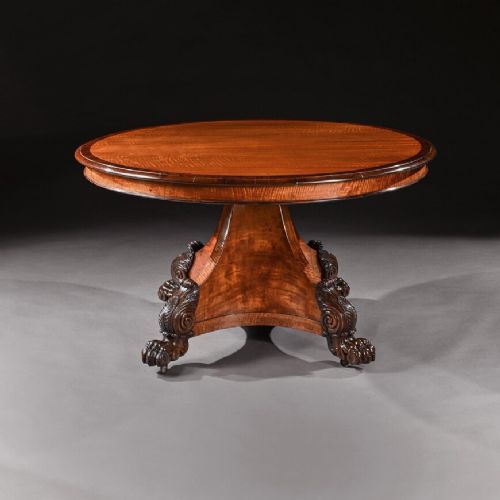


Satinwood Band Tables
Satinwood band tables combine rich timbers and pale contrasting borders to bring lightness into a room.
Satinwood Band Tables
Satinwood band tables encompass various forms including sofa tables, card tables, Pembroke tables, and centre tables that feature decorative borders of satinwood. These pieces appear across Georgian, Regency, and Edwardian periods, utilising timbers such as mahogany, rosewood, and kingwood as primary woods. A buyer on this page is most likely to meet sofa tables and dining tables displaying distinct satinwood banding.
The selection ranges from George III fold-over card tables and serving tables to Edwardian Sutherland tables and occasional writing desks. Many examples incorporate cross-banding and Sheraton revival design elements, reflecting the enduring popularity of lighter geometric borders on darker mahogany grounds. Each piece demonstrates how cabinetmakers used contrasting veneers to define the edges and surfaces of domestic furniture.
How they were made
Cabinetmakers constructed these tables using a primary carcass of mahogany, rosewood, or kingwood, complemented by contrasting veneers of satinwood, tulipwood, and boxwood. Strips of satinwood were precisely cut and laid around the perimeter of table tops, creating crisp linear borders that framed the grain of the central panels. Boxwood and dark stringing lines frequently accompanied the satinwood bands to accentuate the geometric precision of the inlay.
Makers utilised tilt mechanisms, drop leaves, and folding tops to create functional furniture for dining, card playing, and writing. Construction techniques from the Georgian and Regency periods involved solid timber framing overlaid with figured veneers, secured with traditional animal glues and finished with hand-rubbed polishes that enhanced the natural lustre of the satinwood.
Satinwood Band Tables Retail Price Guide 2026
Typical asking prices for satinwood band tables among the pieces listed under this phrase on Sellingantiques today, from the lower quarter to the upper quarter. They describe what is for sale here now, not the wider market.
What varies in quality
Quality in these tables rests upon the selection and matching of the timbers, particularly the vibrancy and figure of the satinwood banding. Finer examples display tight, even grain in the satinwood and meticulous mitring at the corners where the banded strips meet. The choice of primary timber, such as richly figured mahogany or dense kingwood, also distinguishes standard production from more ambitious cabinet work.
The sophistication of the secondary veneers and stringing, including tulipwood and boxwood accents, determines the visual depth of the piece. Proportions, the originality of the brass fittings, and the structural integrity of folding or tilting mechanisms further separate exceptional pieces from simpler utilitarian tables.
Peters of Genoa
The Satinwood Band Tables Glossary
- Banding
- A narrow strip of veneer inlaid around the border of a table top to create a contrasting frame. This technique highlights the geometric form of the piece.
- Cross-banding
- Veneer laid with its grain running perpendicular to the edge of the board it decorates. It creates a subtle border effect often seen in Georgian and Regency furniture.
- Pembroke table
- A small rectangular table with hinged drop leaves on either side and a drawer beneath the top. These versatile pieces date widely from the eighteenth and nineteenth centuries.
- Sofa table
- A long, narrow table designed to stand in front of a sofa, typically featuring drop leaves and two small drawers. Regency examples often incorporate lyre-shaped supports or pillar bases.
- Sutherland table
- A narrow drop-leaf table where both leaves can fold almost vertically down. Edwardian and late nineteenth-century versions frequently employ satinwood banding.
Satinwood Band Tables: Frequently Asked Questions
What is a satinwood band table?
A satinwood band table is a piece of antique furniture, such as a sofa table, card table, or Pembroke table, featuring decorative borders made from pale satinwood veneer. These tables utilise dark primary woods like mahogany or rosewood to create a distinct contrast with the inlay.
Craftsmen produced these pieces across the Georgian, Regency, and Edwardian periods, applying the banding to define the edges of tops and drawers.
How do I identify a Regency period table?
Regency tables typically display classical proportions, robust timber selection, and restrained decorative inlays such as satinwood banding. They often feature specific forms like pedestal bases, sabre legs, or brass paw feet.
Examining the construction methods and the integration of the veneers helps distinguish authentic Regency pieces from later nineteenth-century revivals.
How were drop leaves supported?
Drop leaves on Pembroke and Sutherland tables are supported by hinged wooden brackets or pivoting gatelegs that swing out from beneath the frame. These mechanisms allow the leaves to drop down when space is required or lock firmly into place for use.
Quality tables feature smoothly operating hinges and sturdy pivoting supports that maintain the stability of the extended surface.
Where should I place a sofa table?
Sofa tables work well positioned behind a sofa, against a hallway wall, or used as a compact writing desk in a sitting room. Their narrow profile and drop leaves make them adaptable for smaller spaces where flexibility is needed.
Keeping them away from direct heat sources and strong sunlight preserves the delicate satinwood veneer and the polished surface of the primary timber.