
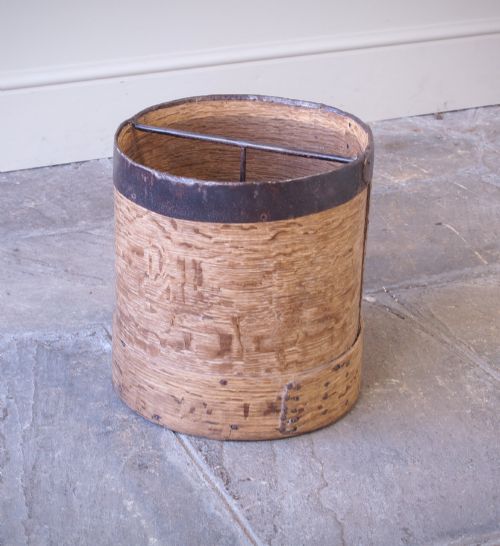
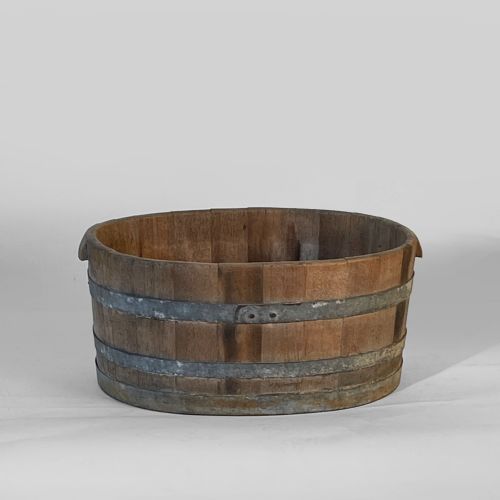


Rustic Timber Bucket
A rustic timber bucket brings grounded texture to a room, offering honest utility shaped by hard work over generations.
Rustic Timber Bucket
A rustic timber bucket encompasses utilitarian wooden vessels designed for domestic, agricultural and maritime tasks, ranging from grain measures to washing tubs. Buyers searching for a rustic timber bucket encounter coopered containers, carved mortars and well buckets intended for heavy daily use.
The selections span the nineteenth century and the Georgian era, representing English, French, Scandinavian and Chinese country workshops. Common forms include storage barrels, oyster buckets and garden planters used previously for fuel storage or fireside supplies.
Most examples rely on sturdy stave construction bound by metal bands, though solid carved elm mortars also appear. Their surfaces show the weathered grain and patination earned through decades of practical service.
How they were made
Coopers shaped curved wooden staves from regional timbers such as oak, pine, elm and general hardwoods, fitting them tightly together to hold dry goods or liquids. These staves were then secured with iron or wrought iron bands, hammered tightly around the body to maintain structural tension.
Some vessels, such as Chinese mortars, started as single blocks of timber hand-carved into deep cylindrical forms. Makers finished the wood with paint or left the raw grain exposed to weather naturally through use.
Materials recorded across these listings include oak, pine, elm, wrought iron and painted finishes.
What varies in quality
Quality rests in the integrity of the original construction and the honesty of the surface patination. Vessels that retain their original iron bands and untouched wooden surfaces carry greater character than those subjected to excessive modern restoration.
Proportion and scale also dictate desirability, particularly when larger storage barrels or well buckets exhibit balanced cooperage. The harmony between the timber staves and the metal fastenings reveals the skill of the original maker.
The Rustic Timber Bucket Glossary
- Coopered
- Constructed from curved wooden staves bound together with metal or wooden hoops. This traditional technique allowed vessels to hold contents securely without leaking.
- Mortar
- A heavy bowl-shaped vessel carved from a solid block of timber, used with a pestle for crushing grain or provisions. These show dense grain patterns from dense hardwoods like elm.
- Stave
- A narrow strip of wood with bevelled edges that forms the sides of a barrel, tub or bucket. Accurate tapering ensures a watertight or tightly sealed cylinder.
- Patina
- The surface sheen and colour developed by wood and metal over long periods of handling and exposure. This gradual change separates genuine age from modern finishing.
Rustic Timber Bucket: Frequently Asked Questions
What were rustic timber buckets used for originally?
These vessels served demanding practical roles in homes, farms and gardens. They carried water from wells, stored grain, held oysters or served as washing tubs.
Over time, many transitioned into domestic storage for fuel or logs by the hearth.
How do I care for antique wood and iron?
Keep timber away from direct heat sources and sudden temperature shifts to prevent the wood from splitting or shrinking. Occasional light waxing helps nourish dry antique surfaces.
Inspect iron bands periodically and keep them dry to prevent active corrosion.
Can I use these buckets outdoors?
Many examples function well as garden planters or patio storage containers. However, prolonged exposure to damp earth and rain will accelerate weathering on older timber.
Protecting them from standing water helps preserve the original staves and metal hoops.
How can I tell the period of a wooden bucket?
Dating relies on observing construction marks, tool traces, the type of iron used for the bands and the depth of the surface patina. Hand-forged wrought iron and adze marks often point towards earlier Georgian or nineteenth-century origins.
Comparing the timber species with known regional country traditions also aids identification.