


Rural Harvest Scene Art
Rural harvest scene art captures fields, hay carts and farmworkers through traditional British painting from the nineteenth and twentieth centuries.
Rural Harvest Scene Art
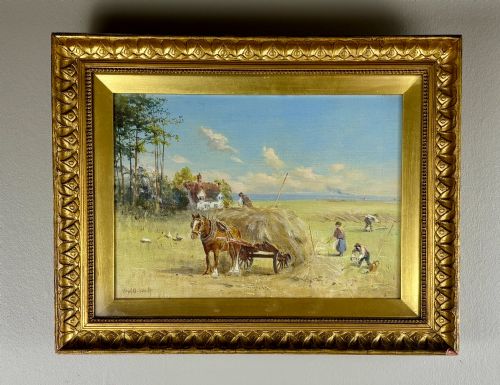
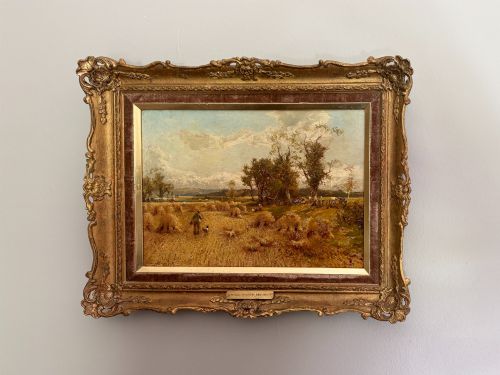
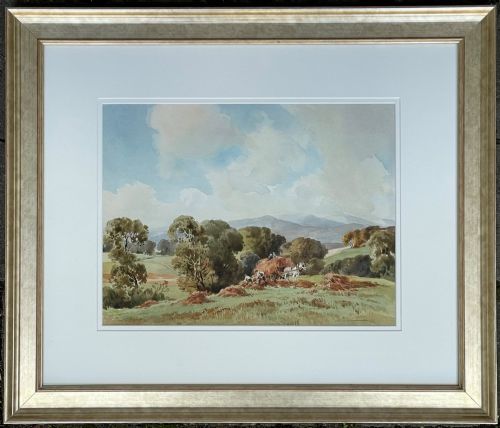
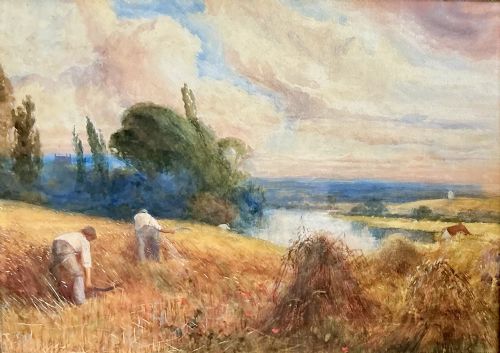
Rural harvest scene art comprises original paintings and watercolours depicting agricultural labour, cornfields and haymaking across the British countryside. When you examine these works, you see figures with horses and carts, riverbanks and valleys rendered in styles ranging from Victorian academic realism to British impressionism. The pieces span from the late nineteenth century into the mid-twentieth century, capturing traditional farming methods before mechanisation transformed the landscape.
The versions you meet most frequently on this page are framed oil paintings and watercolours on paper or canvas. Painters recorded rural views across various counties, including Yorkshire, Hampshire and Nottinghamshire, often highlighting sunset light or dusk over the fields. These works serve as a visual record of historical agricultural communities and seasonal labour.
How they were made
Artists painted these scenes using oil paint on stretched canvas or applied watercolour pigments onto paper, often mounting the finished works behind glass within traditional wooden frames. Oil painters built up rich textures using brushwork to depict the weight of hayricks and the sheen on working horses, while watercolourists employed washes of transparent colour to capture the lighter atmosphere of open skies.
The materials reflect the standard fine art practices of the Victorian and Edwardian periods. Canvases are secured to wooden stretchers, and watercolours utilise paper supports that require protective glazing to prevent environmental damage over time.
Listings feature works executed in oil on canvas and watercolour on paper, originating from the nineteenth and twentieth centuries.
What varies in quality
Quality in these rural scenes rests upon the artist's command of light, atmosphere and anatomical proportion in both human figures and working animals. Stronger works demonstrate a secure grasp of perspective within wide landscapes, whereas simpler naive or provincial examples prioritize direct storytelling over sophisticated tonal graduation.
The handling of pigment also distinguishes the range. Masterful brushwork gives texture and depth to fields of wheat and river reflections, while weaker examples rely on formulaic application and flat colour.
Percy Lancaster·Frederick Hines·James William Booth·Henry John Boddington·John Atkinson·William Grant Murray·Walter Heath Williams·Herbert Royle·Arthur Walker Redgate·Rowland Henry Hill·Frederick J. Knowles·Joseph Paulman·Henry John Kinnaird·Frederick William Jackson·Walter Duncan·George Hamilton Constantine·George Cole·William Greaves·Henry H. Parker·Joseph Thors·Alfred Augustus Glendening Snr·David Heward·William Kay Blacklock·Wilmot Pilsbury·John Clayton Adams
The Rural Harvest Scene Art Glossary
- Watercolour
- A painting method where fine pigment is suspended in a water-soluble binder and applied to paper. It creates luminous, transparent washes.
- Oil on canvas
- Pigment mixed with drying oils applied to a woven fabric stretched across a wooden frame. This medium allows for deep layering and rich texture.
- Victorian style
- Aesthetic characteristics associated with the reign of Queen Victoria, favouring detailed realism and narrative depth in landscape painting.
- British Impressionism
- A painting approach emerging in the late nineteenth century that focused on loose brushwork and the transient effects of natural light.
- Hayrick
- A large stack of hay piled in the open air to dry and protect it from weather until needed. Painters frequently used this form as a sculptural focal point in fields.
Rural Harvest Scene Art: Frequently Asked Questions
What periods do these paintings come from?
The works originate from the nineteenth and twentieth centuries, spanning the Victorian and Edwardian eras up to the nineteen-fifties.
Most pieces date between eighteen-eighty and nineteen-twenty, reflecting a peak period for British landscape and rural genre painting.
How should I care for a watercolour?
Watercolours require protection from direct sunlight to prevent the pigments and paper from fading over time.
Keep them behind glass in a stable environment away from high humidity to safeguard the paper support.
What subjects appear in rural harvest art?
Common subjects include farmworkers loading carts, horses in cornfields, haymaking by rivers, and panoramic views of valleys.
Artists frequently set these scenes at sunset or dusk to emphasise the end of the working day.
Are these paintings original works?
The selection consists of original paintings and watercolours created by individual artists rather than modern reproductions.
Many bear the original signature of the painter or retain period framing from the era of creation.