



Rural Harvest Painting
These rural harvest painting works capture agricultural scenes on canvas and paper, offering a traditional glimpse into past farming life.
Rural Harvest Painting
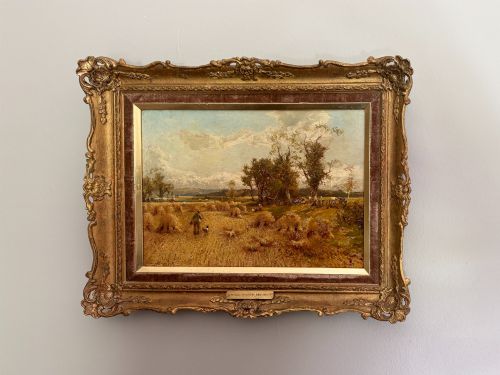
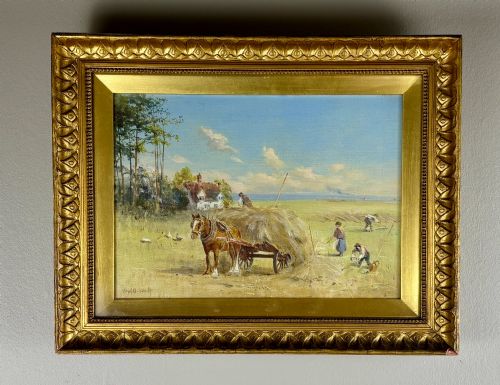
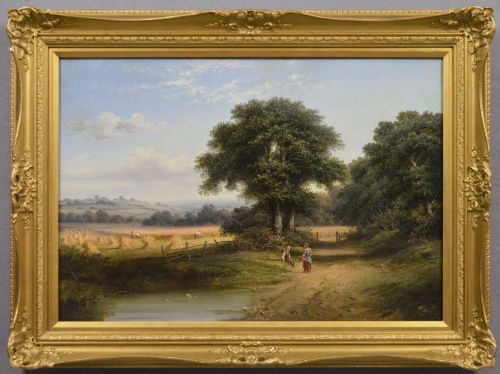
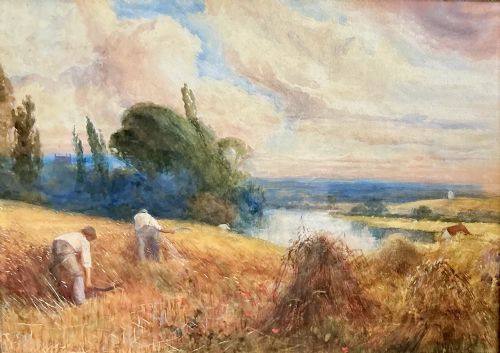
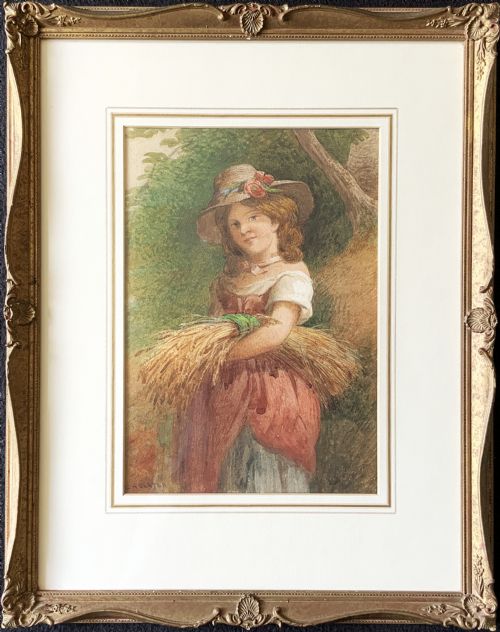
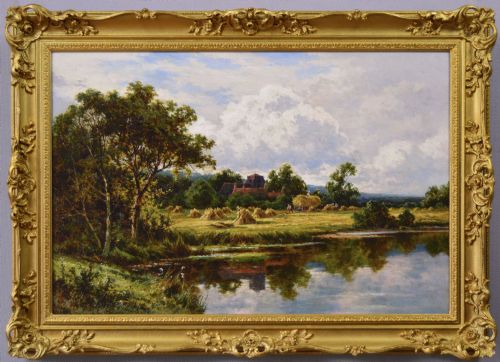
A rural harvest painting typically portrays figures in fields, hay carts, and agricultural landscapes during the seasonal gathering of crops. These works emerge primarily from the nineteenth century through the mid twentieth century, encompassing British Impressionism, Victorian realism, and Edwardian styles. Buyers most frequently encounter oil paintings on canvas and watercolours on paper depicting scenes of haymaking and cornfields.
The subjects range from detailed Victorian depictions of farmworkers with horses to looser impressionistic views of British valleys and rivers. Artists document specific regional locations, such as the Vale of Evesham, Nottinghamshire cornfields, and the river Kennet, providing topographical interest alongside the agricultural theme. These pieces function as historical records of rural labour as well as decorative landscape art.
How They Were Made
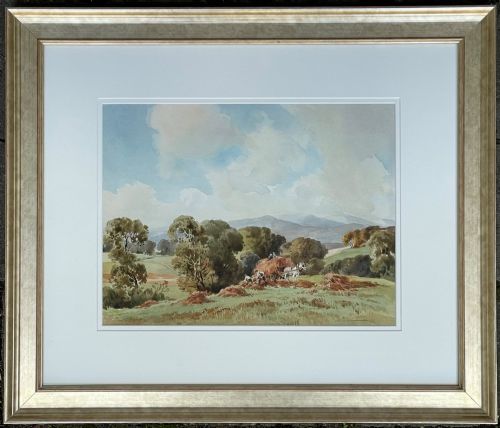
Artists created these works utilising oil paint on stretched canvas and watercolour pigments on paper, sometimes incorporating gold leaf accents within framing elements. Canvas supports allowed for heavily brushed oil layers and textured impasto, particularly in impressionistic interpretations of light over harvest fields. Watercolours on paper relied on translucent washes to capture the softer atmosphere of dusk and riverbank scenes.
Framing and mounting varied by period, utilising traditional wood frames that often complemented the palette of the nineteenth and early twentieth century works. Pigment application ranged from the tight academic realism of the Victorian era to the broader brushstrokes characteristic of British and Scottish impressionists.
Rural Harvest Painting Retail Price Guide 2026
Typical asking prices for rural harvest painting among the pieces listed under this phrase on Sellingantiques today, from the lower quarter to the upper quarter. They describe what is for sale here now, not the wider market.
Listings feature works spanning the nineteenth century through the nineteen fifties, executed in oil paint, watercolour, and canvas.
What Varies in Quality
Quality in a rural harvest painting rests upon the artist's handling of light, atmospheric depth, and the naturalistic rendering of figures and animals. Superior examples demonstrate a confident command of colour and composition, effectively balancing the expansive sky with the detailed activity of the harvest field. Weaker works may display stiff figures, static foliage, or a formulaic approach to the landscape.
The preservation of the paint surface and paper support heavily influences desirability, with stable canvas tension and minimal retouching maintaining integrity. Works that retain their original pigment vibrancy and undisturbed framing context generally represent the stronger end of the range.
Hugh Barry Scott·William Manners·Percy Lancaster·Walter Heath Williams·Charles Henry Slater·Frederick Hines·James William Booth·Henry John Boddington·William Grant Murray·Helmut Reuter·Henry H Parker·Arthur Walker Redgate·Rowland Henry Hill·Herbert Royle·Frederick J Knowles·Joseph Paulman·Henry John Kinnaird·Frederick William Jackson·Walter Duncan·George Hamilton Constantine·George Cole·William Greaves·Joseph Thors·Alfred Augustus Glendening Snr·David Heward
The Rural Harvest Painting Glossary
- Oil on Canvas
- A painting medium where pigments bound in drying oil are applied to a woven fabric stretched across a wooden frame. This combination allows for rich colour saturation and textured brushwork.
- Watercolour
- A painting method in which the paints are made of pigments suspended in a water-soluble vehicle. It is typically executed on paper to produce translucent, luminous effects.
- Impressionism
- A style of painting that focuses on capturing the visual impression of the moment, especially regarding shifting light and spontaneous brushwork. British interpretations often applied these tenets to traditional rural landscapes.
- Victorian Realism
- An artistic approach aiming to represent subject matter truthfully without artificiality, prevalent during the nineteenth century. In harvest scenes, this manifests as meticulous attention to agricultural tools and labour.
- Hayrick
- A large stack of hay piled up in the open air to dry and protect it from rain. Artists frequently used this architectural farm element as a focal point in compositional depth.
Rural Harvest Painting: Frequently Asked Questions
What periods do these paintings come from?
The works span from the nineteenth century through the mid twentieth century, covering Victorian, Edwardian, and later periods of British art.
Most examples date between eighteen sixty and nineteen fifty, aligning with the rise of realist and impressionist landscape painting in Britain.
How should I hang a rural harvest painting?
These pieces suit traditional living spaces, studies, or dining rooms where their pastoral subject matter complements wooden furniture and period interiors.
Ensure they are placed away from direct sunlight and excessive humidity to protect both the canvas and the paper supports.
What subjects typically appear in these scenes?
Common motifs include farmworkers gathering hay and wheat, horse-drawn carts, cornfields at sunset, and rivers running alongside agricultural land.
Some compositions incorporate domestic animals such as geese and working dogs to enrich the rural narrative.
How do I distinguish watercolours from oil paintings?
Oil paintings feature textured paint layers on canvas, often displaying visible brush relief and a heavier varnished finish.
Watercolours are executed on paper behind glass, showing flat washes of pigment where the texture of the paper remains apparent beneath the colour.