
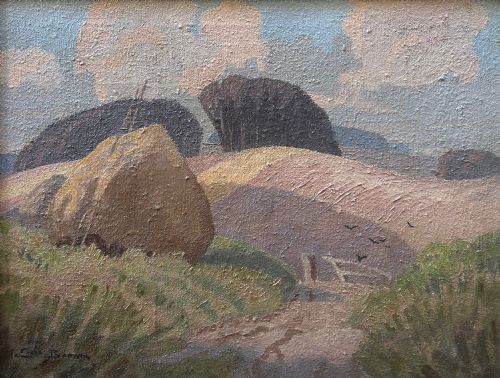


Rural Farm Landscape Painting
A rural farm landscape painting captures the agricultural heart of past centuries through working horses, harvest fields, and homesteads.
Rural Farm Landscape Painting
When searching for a rural farm landscape painting, collectors encounter works depicting traditional agricultural life, farmyards, and livestock across the nineteenth and twentieth centuries. These pieces record rural industries, showing working shires, hay carts, and laborers amidst fields and farmsteads.
The selection ranges from Victorian pastoral watercolors to mid-century British school oils on canvas and board. Works frequently capture specific northern English valleys, Welsh landscapes, and French provincial scenes.
Most examples date from the Victorian era through the Edwardian period and into the mid-twentieth century, reflecting regional artistic communities and plein air traditions.
How They Were Made
Artists utilised oil paint on stretched canvas, wooden panels, or board to build rich textures in fields, foliage, and animal coats. Others worked in watercolor on paper, applying washes to capture changing light across harvest scenes and farmyards.
Pigments were handled through varied regional styles, encompassing British Impressionism, realism, and pastoral traditions. Frames ranged from ebonised wood to provincial mouldings that complemented the domestic scale of the works.
Materials recorded include canvas, wood panel, paper, and board combined with oil or watercolour.
What Varies in Quality
The strength of a rural farm landscape painting rests upon the artist's handling of light, atmospheric depth, and the anatomy of working animals. Superior works demonstrate confident brushwork and acute observation of agricultural labour rather than static composition.
Provenance and documentation enhance a piece, particularly when studio sales, exhibition histories, or specific named farmsteads are recorded. The integration of figures and livestock into the wider topography dictates the artistic merit of the composition.
Raimond Louis Lecourt·Herbert Royle·William JB Jenkins·James William Booth·Ernest Pile Bucknall·Samuel Joseph Clark·John Atkinson·Charles Vickers·Frederick W. Jackson·John Linnell·J.C. Grey·George Soper·Florence Hess·Arthur Winter Shaw·Owen Bowen·John Frederic Greenwood·Robert Russell MacNee·B. Kaufmann·Rowland Henry Hill·Frederick J. Knowles·John Frederick Herring Jnr·John R. K. Duff·John Percy Cooke·Ernest Higgins Rigg·Samuel Towers
The Rural Farm Landscape Painting Glossary
- Pastoral
- Relating to the countryside and rural life, often romanticising agricultural scenes and farm laborers. This style dominated nineteenth-century depictions of farming.
- Plein air
- Painting outdoors to capture natural light and direct observations of the landscape. Artists utilised this method to render changing weather over fields and farmsteads.
- Provenance
- The documented history of ownership of an artwork, tracing it from the artist's studio to the present market. Studio sales often provide this foundational record.
- Board
- A rigid flat substrate, such as wood or millboard, used as a support for oil paintings instead of woven canvas. It offers a stable surface for smaller plein air works.
Rural Farm Landscape Painting: Frequently Asked Questions
What subjects appear in these paintings?
These artworks primarily depict agricultural scenes, including haymaking, shire horses at work, cattle by streams, and farmyard buildings. Artists focused on the daily labour of rural communities.
Subjects extend from Yorkshire dales and Welsh mountains to French provincial landscapes, documenting traditional farming methods before mechanisation.
How do I date a farm painting?
Dating relies on stylistic clues, clothing of the figures, framing materials, and recorded exhibition dates for specific artists. Victorian works often feature detailed realism, while later pieces adopt impressionistic brushwork.
Signatures, exhibition labels on the reverse, and written provenance on stretchers or boards offer precise chronological markers.
Where were these artists working?
Painters worked across regional British art colonies, particularly in Yorkshire, the North East, and Wales, as well as continental locations like Normandy. Many captured local farms near their residences.
Their output reflects a broader movement of artists leaving urban centres to record rural industries and pastoral scenery firsthand.
How should I frame and display them?
Displaying these works involves placing them away from direct sunlight to protect pigments, particularly watercolors on paper. Period frames, such as ebonised wood or gilt moulding, often complement their historic character.
Stable indoor humidity preserves both canvas and wood panel supports against warping or paint cracking over time.