



Ruby Diamond Trilogy Ring
A ruby diamond trilogy ring brings together three stones of past, present, and future in a lasting testament to sentiment.
Ruby Diamond Trilogy Ring
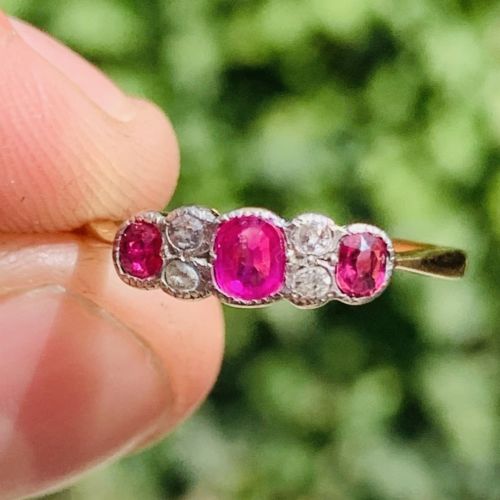
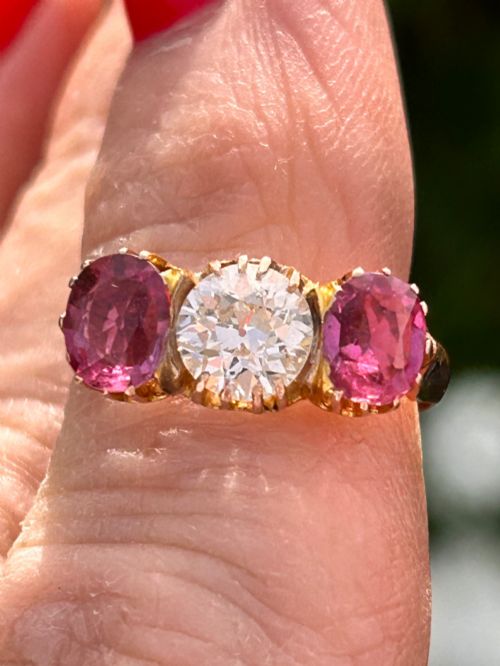
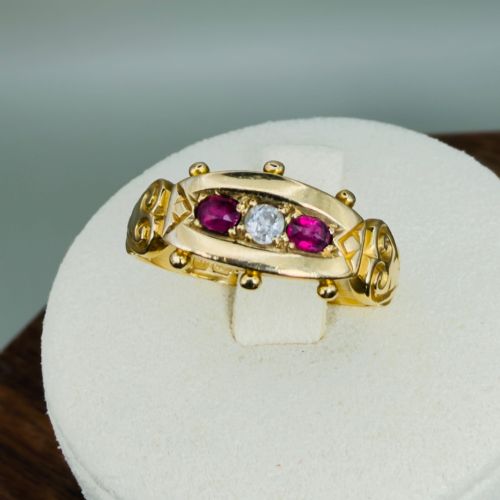
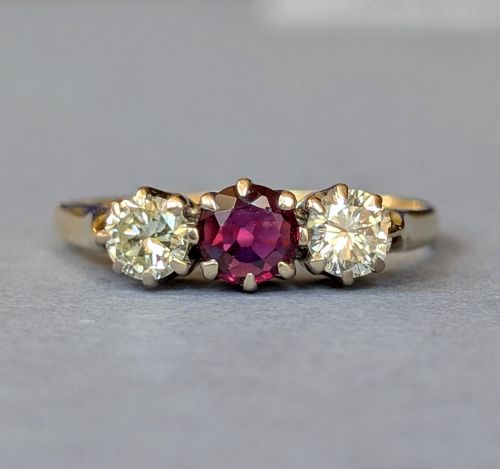
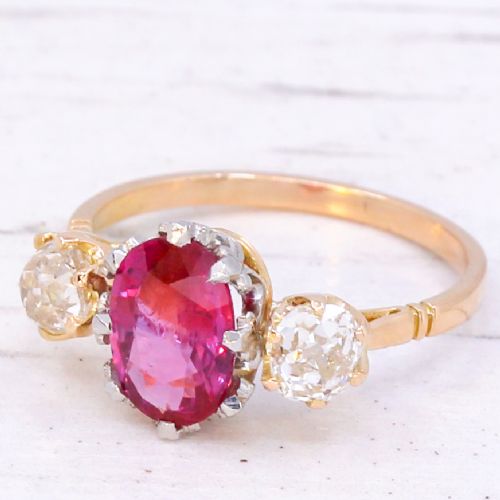
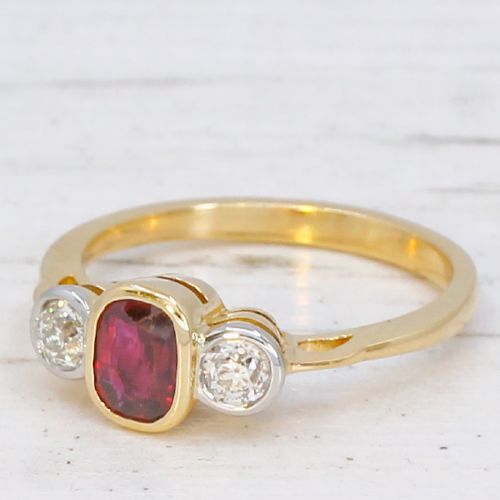
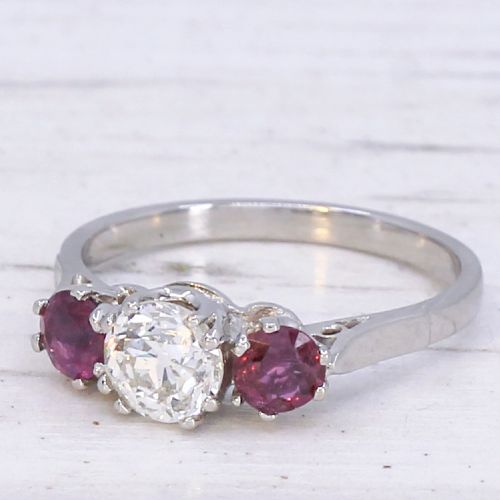
When you search for a ruby diamond trilogy ring, you examine a lineage of three-stone settings spanning the Victorian, Edwardian, and Art Deco periods, alongside later mid-century examples. These pieces typically present a central ruby flanked by diamonds, or a central diamond flanked by rubies, mounted upon precious bands.
The most common formats on this page pair old cut diamonds with natural rubies in traditional claw or gypsy mountings. You encounter examples dated from the late nineteenth century through to the mid-twentieth century, showing how jewellers adapted the three-stone concept across changing aesthetic eras.
How they were made
The materials recorded in these listings centre on 18ct yellow gold, rose gold, and platinum, which provide the structural foundation for the gemstones. Jewellers secured the stones using claw settings, starburst engravings, or flush gypsy mountings embedded directly into the solid metal band.
Gemstone preparation relies heavily on old cut diamonds, displaying characteristic open culets and hand-faceted symmetry, paired with rubies shaped as faceted rounds or smooth cabochons. These components were worked by hand in British assay offices, as evidenced by period hallmarking from cities such as Birmingham and Chester.
Ruby Diamond Trilogy Ring Retail Price Guide 2026
Typical asking prices for ruby diamond trilogy ring among the pieces listed under this phrase on Sellingantiques today, from the lower quarter to the upper quarter. They describe what is for sale here now, not the wider market.
Several pieces incorporate star rubies that catch the light with a wandering six-rayed star.
What varies in quality
Quality across these three-stone rings depends upon the optical harmony and proportion between the ruby and the diamond components. The finest pieces unite stones of balanced scale and saturated colour, where neither gem visually overpowers its neighbours.
The execution of the metalwork further distinguishes the work, from the crispness of hand-cut starburst motifs to the integrity of the claw settings. Superior examples maintain structural weight in the shank while preserving delicate proportions around the stone shoulders.
The Ruby Diamond Trilogy Ring Glossary
- Trilogy ring
- A ring set with three stones, traditionally symbolising the past, present, and future. This layout remains a staple of antique and vintage jewellery design.
- Old cut diamond
- A hand-faceted diamond cut before the standardisation of modern brilliant geometry, typically featuring a smaller table and a prominent open culet. These stones capture candlelight with a distinctive soft warmth.
- Gypsy setting
- A mounting style where the gemstone is flush-set directly into a thick, tapered metal band. The surrounding gold is pushed up around the girdle to secure the stone.
- Cabochon
- A gemstone polished to a smooth, rounded convex surface rather than faceted. This style is frequently utilised for star rubies to display their optical phenomenon.
- Carved half hoop
- A ring band decorated with carved or chased sculptural details along the upper half. This technique often frames the gemstone clusters in Victorian designs.
Ruby Diamond Trilogy Ring: Frequently Asked Questions
How do I care for a ruby ring?
Rubies rank high on the hardness scale, making them durable for regular wear. Gentle cleaning with warm soapy water and a soft brush maintains their clarity.
Avoid harsh chemical dips or ultrasonic cleaners, particularly for antique settings where older mounting techniques secure the stones.
What is an old cut diamond?
An old cut diamond is a gemstone shaped by hand before modern cutting machinery existed. These stones exhibit smaller tables, higher crowns, and larger facets that produce a characteristic blocky sparkle.
They are commonly found in Victorian and Edwardian rings listed on this page.
How can I tell a Victorian ring from an Art Deco one?
Victorian pieces often utilise yellow or rose gold with ornate carved shoulders, gypsy settings, and organic motifs. Art Deco designs favour platinum settings, geometric layouts, and clean lines.
Assay office hallmarks and style shifts help distinguish the manufacturing decades.