



Round Writing Desk
A round writing desk is a rotating circular table designed for correspondence, and these pieces combine practical writing surfaces with concealed storage.
Round Writing Desk
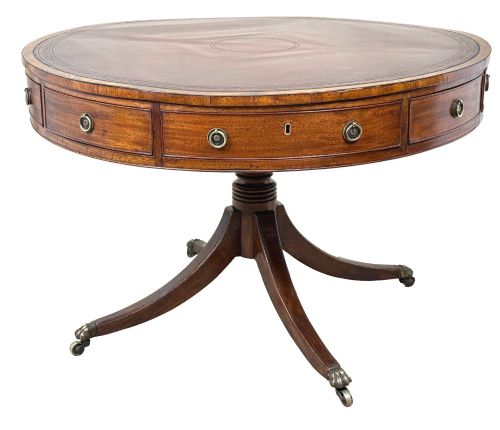
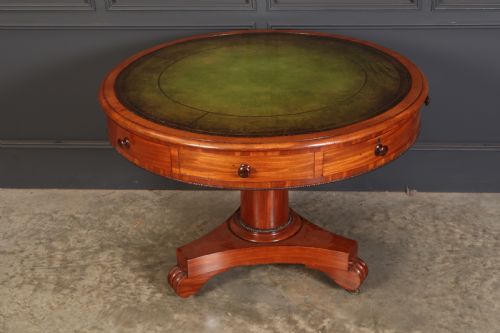
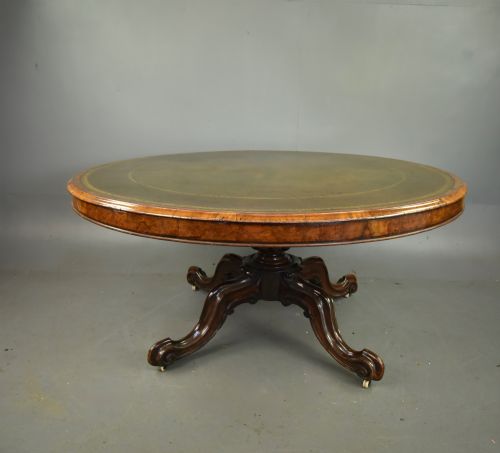
A round writing desk takes the form of a circular table, frequently designated as a drum table or library table in period records. These pieces emerge across the Georgian, Regency, and Victorian eras, carrying circular tops inset with leather writing surfaces.
The layout generally includes a rotating top or a fixed circular surface surrounded by radial frieze drawers. Within this category, buyers frequently encounter mahogany and rosewood examples dating from the nineteenth century.
Makers designed these items to stand in the centre of a room rather than against a wall, allowing access from all sides. The configuration provides compartments for writing materials while maintaining a balanced circular silhouette.
How they were made
Cabinet makers utilised solid timbers and veneers of mahogany, rosewood, flame mahogany, and walnut over a sturdy carcase. These woods were turned, carved, and polished to highlight the natural grain.
Green or coloured leather inserts were tooled with gold leaf borders to form the writing surface on the top. Brass fittings, including locks, handles, and casters, completed the construction of the drawers and pedestals.
Round Writing Desk Retail Price Guide 2026
Typical asking prices for round writing desk among the pieces listed under this phrase on Sellingantiques today, from the lower quarter to the upper quarter. They describe what is for sale here now, not the wider market.
Some nineteenth-century writers relied on a portable silver capstan inkwell to match their revolving desk.
What varies in quality
The selection of timber grain separates standard pieces from finer examples, particularly where figured flame mahogany or choice rosewood veneers are matched across the circular top. Finer execution shows in the precision of the drawer dovetails and the smooth action of the rotating mechanism.
Original hardware, such as brass drawer pulls and fitted locks, elevates the integrity of an antique piece. The quality of the blind-tooled leather insert and the crispness of any carved wooden details dictate the standing of the work.
The Round Writing Desk Glossary
- Drum table
- A circular library table with a deep frieze resembling a drum, housing multiple drawers around the circumference.
- Frieze
- The horizontal band situated directly beneath the top edge of a table, often containing drawers in these circular formats.
- Flame mahogany
- A distinct timber veneer exhibiting a flamed or feather-like grain pattern created by cutting across the branch junction.
- Blind tooling
- An impression pressed into leather without the addition of gold leaf, creating a subtle decorative border.
- Capstan inkwell
- A small ink receptacle shaped like a nautical capstan, commonly fashioned from silver or glass.
Round Writing Desk: Frequently Asked Questions
What is a round writing desk?
A round writing desk is a circular table featuring a leather-lined top and multiple frieze drawers arranged around the circumference. These pieces were built to stand in the centre of a room.
Cabinet makers produced them primarily during the Georgian, Regency, and Victorian periods using timbers such as mahogany and rosewood.
How were these tables used?
Owners utilised them as functional writing surfaces and for storing correspondence in the radial drawers.
Because the circular top often rotated, a writer could access different compartments or reference books without leaving the seat.
Where should a round writing desk be placed?
These pieces function best when positioned in the centre of a study or library rather than pushed against a wall. Their finished appearance on all sides allows unobstructed access to the drawers.
Sufficient floor space around the circumference is necessary to permit movement and the pulling out of chairs.
How do I identify a Regency period piece?
Regency round writing desks typically display specific architectural motifs, classical proportions, and dark timbers like rosewood or mahogany. Brass inlay and sabots on the feet frequently appear on pieces from this era.
The construction methods and joinery visible inside the drawers also assist in confirming the nineteenth-century date.