

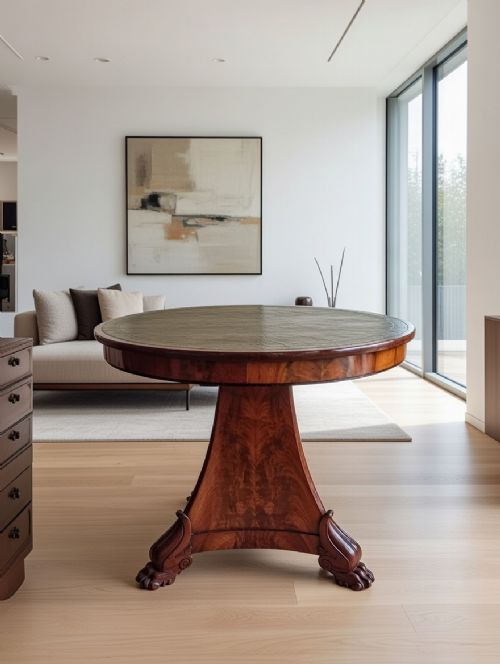
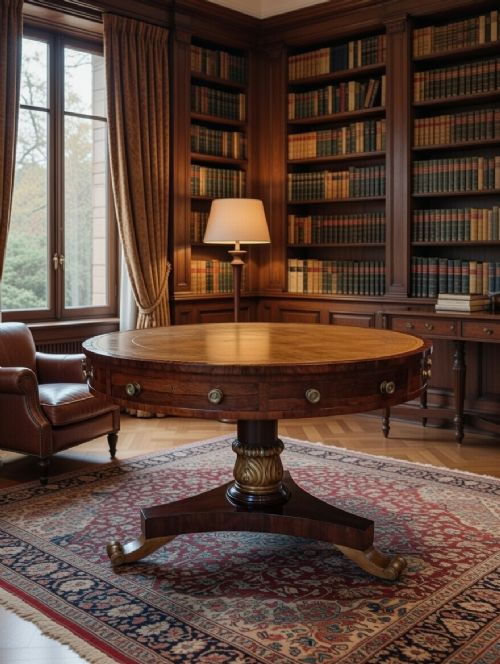
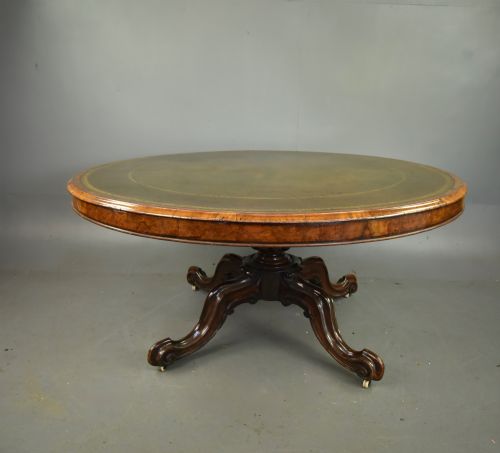
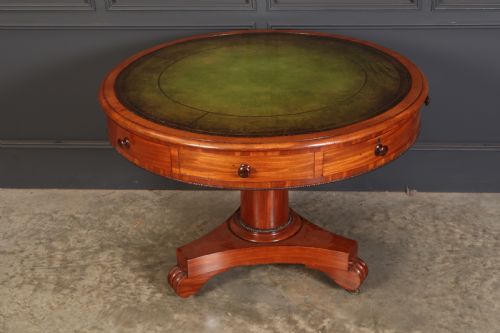


Round Leather Table
A round leather table brings steady utility and understated elegance to a room, offering a circular surface inset with hide for writing or display.
Round Leather Table
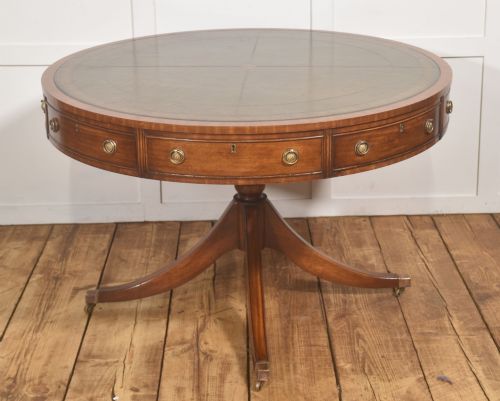
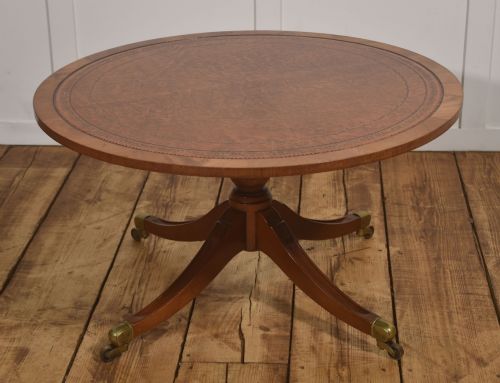
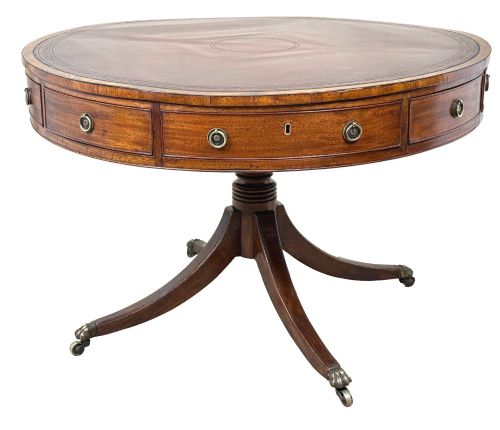
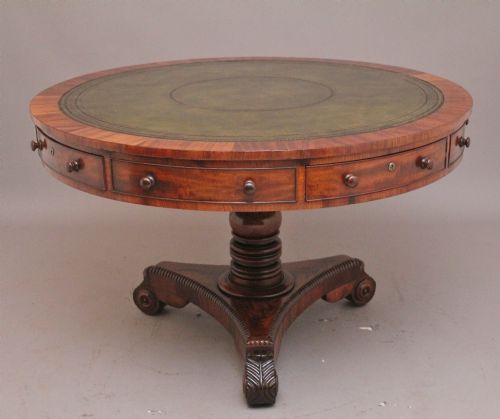
A round leather table is typically encountered as a drum table, library table, or centre table originating from the Georgian, Victorian, or Edwardian eras. These pieces combine a circular wooden top with a supple leather writing surface, often featuring multiple drawers around the circumference.
The form is frequently seen in mahogany, flame mahogany, or rosewood, spanning periods from 1800 through to early twentieth-century revivals. Buyers commonly meet drum tables and circular centre tables that reflect Regency and Victorian stylistic influences.
Proportions vary from small occasional pieces to large library tables measuring over sixty inches across. Each iteration maintains a circular footprint designed to sit comfortably in the middle of a room or beside seating.
Materials and construction
Construction relies heavily on dense timbers such as mahogany, rosewood, and walnut, frequently paired with turned pedestals or tripod bases. Cabinetmakers selected these hardwoods to support the heavy circular tops and housing for peripheral drawers.
The inset leather surfaces were typically tooled with gold leaf and blind stamping before being secured into the wooden top. Brass fittings, including castors and drawer pulls, complete the fabrication of these circular tables.
Round Leather Table Retail Price Guide 2026
Typical asking prices for round leather table among the pieces listed under this phrase on Sellingantiques today, from the lower quarter to the upper quarter. They describe what is for sale here now, not the wider market.
Drum tables got their name because their deep circular tops resemble musical drums, though they thankfully produce no noise when dropped.
Assessing quality and craftsmanship
Quality reveals itself in the choice of timber figure, such as flame mahogany or well-matched rosewood veneers, and the crispness of the turned woodwork. Superior examples exhibit seamless integration between the leather insert and the timber surround.
The sophistication of the internal drawer construction and the presence of original brass hardware elevate certain pieces above standard utility furniture. Proportion and balance in the pedestal base further separate finer workshops from ordinary production.
The Round Leather Table Glossary
- Drum table
- A circular library table with a deep top resembling the shape of a drum, usually fitted with alternating real and dummy drawers around the frieze.
- Gueridon
- A small circular table on a central pillar, originating in seventeenth-century France and adopted into later British classical revival styles.
- Flame mahogany
- A veneer cut from the fork of the mahogany tree, prized for its distinctive flickering flame-like pattern.
- Blind stamping
- A method of impressing a decorative pattern into leather using heated metal tools without applying gold leaf.
- Tripod table
- A small freestanding table supported by a central pillar resting on three spreading feet.
Round Leather Table: Frequently Asked Questions
What is a drum table used for?
A drum table served traditionally as a library or writing table where books and papers could be kept close at hand in the drawers. The circular top allowed easy access to materials while sitting or standing in the centre of a room.
Today, these tables function effectively as central display pieces in a hallway or as large coffee tables in a living space. Their enclosed storage remains practical for stowing away household items.
How do I care for the leather top?
The leather inset requires gentle cleaning using a slightly damp cloth followed by a neutral leather cream to keep the hide supple. Avoid harsh chemical cleaners and excessive moisture that might damage the surface.
Direct sunlight can fade the dyed leather and dry out the gold tooling over time. Positioning the table away from direct heat sources helps preserve both the hide and the underlying timber.
How can I tell a Georgian table from a Victorian one?
Georgian tables, particularly from the George III period, typically display restrained classical proportions, finer timber veneers, and subtle brass work. The construction techniques focus on lightness and structural elegance.
Victorian pieces often exhibit heavier proportions, darker walnut or mahogany timbers, and more robust pedestal bases. Revival pieces from later periods frequently emulate these earlier styles with varying degrees of ornamentation.
Can I use a centre table as a desk?
Many circular centre tables and drum tables were originally intended for writing and correspondence, equipped with fitted drawers for stationery. The leather top provides a smooth, resilient surface suitable for daily writing tasks.
When using one as a desk, check the height of the frieze and drawers to ensure adequate leg clearance. Most tables offer sufficient space for a chair to tuck underneath comfortably.